
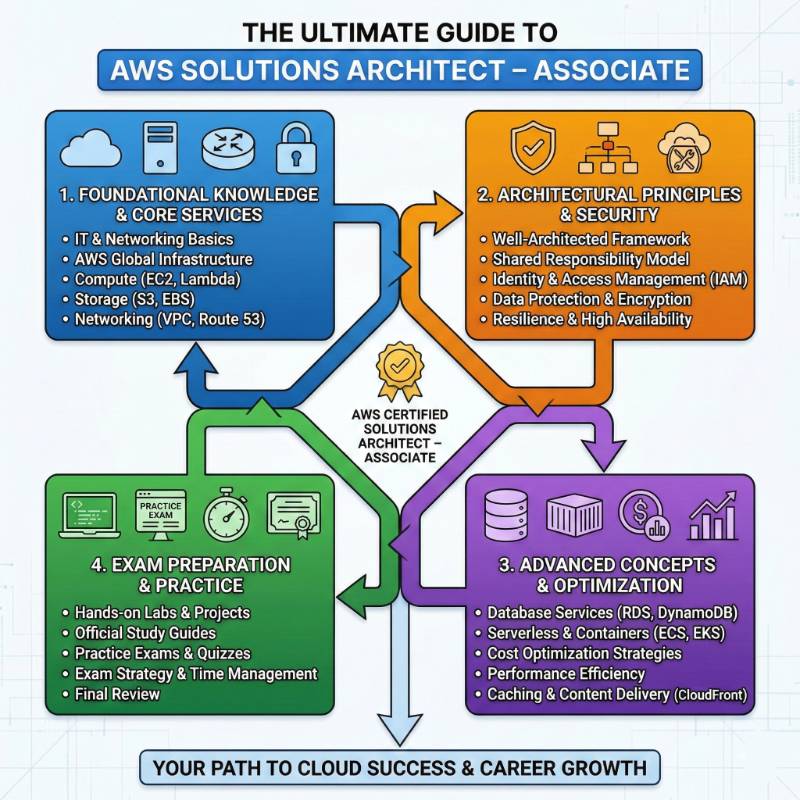
The cloud is no longer a luxury; it is the engine that drives modern business. In my time watching the industry move from physical servers to virtual clouds, one thing has remained constant: the need for solid architecture. Whether you are an engineer in Bangalore or a manager in New York, understanding how to design systems on AWS is a superpower.
The AWS Certified Solutions Architect – Associate (SAA-C03) is widely considered the most valuable certification for anyone serious about a career in the cloud. It doesn’t just show you know how to use tools; it proves you know how to solve problems. This guide is built to help you understand what this certification is, why it matters, and how to pass it without getting lost in the noise.
Understanding the AWS Certification Landscape
Before you jump in, it is helpful to see where you stand. AWS offers different tracks depending on your career goals. Choosing the right one ensures you don’t waste time on skills you won’t use.
Table: AWS Certification Roadmap for Professionals
| Track | Level | Who it’s for | Prerequisites | Skills Covered | Recommended Order |
| Cloud Core | Foundational | Beginners/Managers | None | Cloud Basics, Costs | 1st |
| Architect | Associate | Engs & Architects | None | VPC, EC2, S3, RDS | 2nd |
| Operations | Associate | SysAdmins/Ops | Cloud Basics | Deployment, Patching | 3rd (Optional) |
| Developer | Associate | Software Engineers | Basic Coding | APIs, CI/CD, Serverless | 3rd (Optional) |
| Architect | Professional | Sr. Architects | Associate Cert | Enterprise Design | 4th |
| DevOps | Professional | DevOps/SREs | Associate Cert | Automation, Security | 4th |
| Security | Specialty | Security Experts | Associate Cert | IAM, Encryption | 5th |
Deep Dive: AWS Certified Solutions Architect – Associate
What it is
This certification validates your ability to design and deploy functional applications on AWS. It focuses on the “Well-Architected Framework,” which teaches you how to make systems secure, high-performing, resilient, and efficient. It is the middle ground between basic cloud knowledge and high-level enterprise design.
Who should take it
- Software Engineers who want to manage their own infrastructure.
- Systems Administrators looking to transition into cloud roles.
- Engineering Managers who need to make technical decisions about cloud budgets and vendors.
- DevOps Aspirants who need a strong foundation in AWS services before learning automation.
Skills you’ll gain
- Virtual Private Cloud (VPC): How to build a secure network in the cloud.
- Global Infrastructure: Understanding Regions and Availability Zones.
- Storage Solutions: Knowing when to use S3, EBS, or EFS based on cost and speed.
- Compute Power: Managing EC2 instances, Lambda functions, and Auto-scaling.
- Identity and Access Management (IAM): How to lock down your system so only the right people have access.
- Database Management: Setting up SQL (RDS) and NoSQL (DynamoDB) databases.
Real-world projects you should be able to do after it
- Scalable Web Hosting: Build a website that automatically grows to handle millions of users and shrinks to save money.
- Disaster Recovery: Set up a system that stays online even if a whole data center fails.
- Media Processing: Create a pipeline that automatically resizes images or videos when they are uploaded.
- Private Networks: Build a secure, isolated network for a bank or a government project.
Preparation Plan
Preparing for this certification is not a race; it is a strategic build. You cannot just read about the cloud; you have to build in it. Below are three timelines designed to help you move from basic understanding to architectural mastery.
- 7–14 Days (The Fast Track): This is for people who use AWS every day at work. Focus on taking 3-5 full-length mock exams to find your weak spots. Spend your time reading the FAQs for core services like VPC and S3.
- 30 Days (The Standard Path): Spend 2 hours a day. Spend the first two weeks on videos and reading. Spend the next two weeks on hands-on labs. Build every architecture you study.
- 60 Days (The Foundation Path): If you are new to the cloud, take it slow. Spend the first month understanding basic IT concepts (IP addresses, databases, servers). Spend the second month focusing specifically on AWS patterns.
Common Mistakes
- Ignoring the “Cost” Factor: Many people pick the most powerful service but forget that the exam often asks for the “most cost-effective” solution.
- Thinking it’s Only Theory: AWS questions are scenarios. They ask, “What would you do if…?” If you haven’t done the labs, you won’t know the answer.
- Skipping the Networking: Networking is the hardest part for most. Don’t skip VPC study; it is a huge part of the exam.
Best next certification after this
If you want to stay in architecture, move to the AWS Certified Solutions Architect – Professional. If you want to focus on automation, go for the AWS Certified DevOps Engineer – Professional.
Choose Your Path: 6 Specialized Career Tracks
Once you have your Associate certification, you should align your future learning with a specific job role.
1. DevOps Path
This is for those who love automation. You will learn to use tools like Terraform and AWS CodePipeline to make sure software is delivered quickly and without errors. It is about bridging the gap between developers and operations.
2. DevSecOps Path
This is a security-first approach. You learn how to automate security checks so that code is safe before it even reaches the cloud. It is a high-demand role for companies that handle sensitive data.
3. SRE (Site Reliability Engineering) Path
SREs focus on making sure systems are always “up.” You will learn deep monitoring with CloudWatch and how to build systems that fix themselves when they break.
4. AIOps / MLOps Path
This track combines artificial intelligence with operations. You will learn how to use AWS SageMaker to build and manage machine learning models that can handle massive amounts of data.
5. DataOps Path
For the data enthusiasts. This path focuses on building “data lakes” and pipelines using AWS Glue and Redshift. You make sure data flows smoothly from one place to another for analysis.
6. FinOps Path
This is where technology meets finance. You learn how to manage the cloud bill. You help companies save thousands of dollars by choosing the right AWS pricing models and stopping wasteful spending.
Role → Recommended Certifications Mapping
| Role | Recommended Certifications |
| DevOps Engineer | SAA-Associate, SysOps Associate, AWS DevOps Professional |
| SRE | SAA-Associate, CKA (Kubernetes), AWS Security Specialty |
| Platform Engineer | SAA-Associate, Terraform Associate, AWS DevOps Professional |
| Cloud Engineer | SAA-Associate, SysOps Associate, Terraform Associate |
| Security Engineer | SAA-Associate, AWS Security Specialty, CISSP |
| Data Engineer | SAA-Associate, AWS Data Engineer Associate |
| FinOps Practitioner | SAA-Associate, FinOps Certified Practitioner |
| Engineering Manager | Cloud Practitioner, SAA-Associate |
Next Certifications to Take
After you pass the Solutions Architect Associate, you have three main ways to grow your career:
- Same Track (Expertise): AWS Certified Solutions Architect – Professional. This is the highest level for architects and proves you can handle complex, multi-account systems.
- Cross-Track (Broadening): Certified Kubernetes Administrator (CKA). Most cloud apps run on Kubernetes. Pairing AWS knowledge with K8s makes you a top-tier candidate.
- Leadership (Management): Certified Information Systems Security Professional (CISSP). This is great if you want to move into a Director or CISO role where strategy and risk are the main focus.
Top Institutions for AWS Training and Certification
Choosing the right training can save you months of frustration. Here are the top institutions that provide help with the AWS Solutions Architect journey:
- DevOpsSchool:
A leader in practical IT training. They offer deep-dive courses that combine AWS theory with 50+ DevOps tools, ensuring you are ready for a real job, not just an exam. Their mentors provide real-world insights that you won’t find in textbooks. - Cotocus:
This institution is known for its high-quality bootcamps designed for working professionals. They focus on senior-level training and provide a very structured environment for engineers looking to level up quickly. - Scmgalaxy:
A massive community-driven platform that offers a wealth of technical content and specialized training in configuration management and cloud architecture. It is a great place for those who want to learn through continuous technical engagement. - BestDevOps:
They specialize in making complex topics simple. Their training is perfect for engineers who are short on time and need a streamlined, project-oriented way to learn AWS and DevOps practices. - devsecopsschool.com:
As the name suggests, this is the best place to learn the security side of the cloud. They teach you how to protect your AWS infrastructure and build secure pipelines from day one. - sreschool.com:
If you want to focus on reliability and uptime, this is your home. They specialize in teaching Site Reliability Engineering principles specifically for cloud environments. - aiopsschool.com:
This school is at the forefront of the AI revolution. They teach you how to use artificial intelligence to manage cloud operations, a skill that is becoming essential for modern IT teams. - dataopsschool.com:
This institution focuses on the lifecycle of data. They provide excellent training for anyone looking to become a Data Engineer or manage large-scale data systems on AWS. - finopsschool.com:
They focus on the financial health of the cloud. Their courses teach you how to bridge the gap between engineering and finance to ensure cloud costs stay under control.
FAQs: General Career & Outcomes
1. How difficult is the SAA-C03 exam?
It is a medium-difficulty exam. It requires a solid understanding of how different AWS services work together. It is not just about definitions; it is about architecture.
2. How much time do I need to study?
If you have a full-time job, expect to spend about 4 to 6 weeks studying for 1-2 hours a day.
3. Do I need to know how to code?
You don’t need to be a software developer, but you should be comfortable with basic scripting and understanding how web applications work.
4. Should I take the Cloud Practitioner exam first?
If you are completely new to IT, yes. If you already work as an engineer or manager, you can go straight to the Solutions Architect Associate.
5. Is the certification recognized in India?
Yes, it is one of the most requested certifications by top IT companies and startups in India.
6. Will this certification help me get a remote job?
Absolutely. Many global companies look for AWS-certified professionals to manage their cloud infrastructure remotely.
7. Does the exam have a lot of math?
No. You only need to do very simple math, like adding up storage costs or figuring out how many IP addresses are in a network.
8. Can I take the exam in my local language?
The exam is available in several languages, including English and Japanese. Most professionals in India take it in English.
9. What is the value of this certification for a manager?
It helps you understand what your team is talking about. You will be able to spot technical risks and estimate project costs much better.
10. How long is the certificate valid?
It is valid for 3 years. You can renew it by taking the exam again or passing the Professional version.
11. Are there any labs in the actual exam?
Currently, the SAA-C03 exam is mostly multiple-choice and multiple-response questions, but the questions are based on real-world lab scenarios.
12. Can I get a job just with this certification?
A certification helps you get the interview, but your hands-on skills get you the job. That is why doing labs and projects is so important.
FAQs: AWS Solutions Architect – Associate Specifics
1. What is the passing score?
You need a 720 out of 1000 to pass.
2. Which service is the most important for the exam?
Networking (VPC) and Storage (S3) are usually the two biggest sections of the exam.
3. Can I take the exam from home?
Yes, you can take it online with a proctor, or you can go to a testing center.
4. How many questions are on the exam?
There are usually 65 questions, and you have 130 minutes to complete them.
5. What is the “Well-Architected Framework”?
It is a set of five (now six) pillars: Security, Reliability, Performance Efficiency, Cost Optimization, Operational Excellence, and Sustainability.
6. Does the exam cover the latest AWS services?
Yes, AWS updates the exam to include newer services like Lambda, Aurora, and updated security tools.
7. Are there “trick” questions?
AWS doesn’t try to trick you, but they do give you multiple “correct” answers. Your job is to pick the one that fits the specific requirement (like “cheapest” or “fastest”).
8. Is there a discount for retaking the exam?
Usually, if you fail, you have to pay the full price again. However, if you pass, AWS often gives you a 50% discount voucher for your next exam.
Conclusion
Earning your AWS Certified Solutions Architect – Associate is one of the best investments you can make in your career. It moves you from a “worker” to a “thinker.” You stop just following instructions and start designing the systems that keep businesses running.
The path to success is simple: study the theory, do the labs, and practice the exams. Whether you want to lead a DevOps team, manage a data project, or just understand the cloud better, this is where you start.

Really enjoyed this guide — the way you break down AWS core services and real architectural patterns makes the journey much clearer than most articles. I’ve designed AWS solutions in real projects, and these practical tips truly reflect what’s needed on the job. Thanks for the actionable insights!