
Introduction
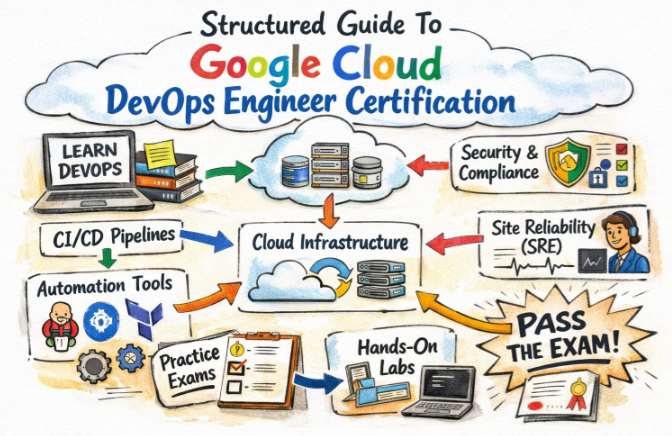
Google Cloud has moved from “nice to know” to a serious platform for production workloads, data platforms, and AI in companies of all sizes. Teams now need people who can not only build on Google Cloud but also ship changes safely, keep services stable, and control cost. The Google Cloud Professional Cloud DevOps Engineer certification is designed exactly for this type of modern engineer.
In this guide, we will treat it as the centre of the broader Google Cloud Professional Engineer family. You will see what this certification covers, who it is meant for, which skills it builds, how to prepare in realistic time frames, and how it fits into DevOps, DevSecOps, SRE, AIOps/MLOps, DataOps, and FinOps career paths. The goal is to give working engineers and managers in India and globally a clear, simple map they can actually follow.
What Is “Google Cloud Professional Engineer”?
When people say Google Cloud Professional Engineer, they usually mean the family of Professional‑level role-based certifications on Google Cloud. These certifications validate deeper skills for specific roles such as:
- Professional Cloud DevOps Engineer
- Professional Cloud Architect
- Professional Cloud Developer
- Professional Data Engineer
- Professional Cloud Security Engineer
- Professional Cloud Network Engineer
- Professional Machine Learning Engineer
These are not beginner certifications. They expect that you already understand basic cloud concepts and have at least some hands‑on experience with Google Cloud. The Professional level focuses on how you design, implement, and operate real systems, not just how well you remember theory.
In the rest of this guide, we keep Professional Cloud Engineer as the main reference point, and place the other Professional certifications around it.
Key Google Cloud Professional Certifications
Overview Table
| Track | Level | Who it’s for | Prerequisites (recommended) | Skills covered (summary) | Recommended order |
|---|---|---|---|---|---|
| Google Cloud Professional Cloud DevOps Engineer | Professional | DevOps, SRE, platform, production engineers | 1+ years on GCP, CI/CD basics, ops/monitoring experience | SRE principles, CI/CD pipelines, observability, incident response, performance and cost optimisation on GCP | After GCP fundamentals or Associate-level skills |
| Google Cloud Professional Cloud Architect | Professional | Architects, senior engineers, tech leads | Strong GCP basics, architecture and design thinking | Design secure, scalable, cost-aware GCP architectures; risk, security, and reliability trade-offs | After Cloud Engineer or similar hands-on background |
| Google Cloud Professional Cloud Developer | Professional | Backend/app developers building on GCP | Good coding skills, experience with GCP app services | Design, build, test, and deploy cloud-native apps; integrate GCP services and CI/CD | After solid dev background plus some GCP projects |
| Google Cloud Professional Data Engineer | Professional | Data and analytics engineers | SQL, data modeling, and GCP data tools exposure | Design data systems, pipelines, analytics, and basic ML workloads on GCP | After GCP fundamentals and data engineering basics |
| Google Cloud Professional Cloud Security Engineer | Professional | Security engineers and cloud security specialists | GCP fundamentals, security principles and controls | Design and implement IAM, network and data security, monitoring and compliance on GCP | After Cloud Engineer/Architect-level skills |
| Google Cloud Professional Cloud Network Engineer | Professional | Network and platform engineers | Networking fundamentals, GCP networking experience | Design and operate VPCs, hybrid connectivity, load balancing, and network security on GCP | After core GCP + networking expertise |
| Google Cloud Professional Machine Learning Engineer | Professional | ML engineers, data scientists, MLOps professionals | Strong ML basics and GCP ML services experience | Design, build, deploy, and run ML solutions and pipelines on GCP | After data/ML work plus GCP ML tooling |
Google Cloud Professional Engineer
What it is
The Google Cloud Professional Engineer certification proves that you can use DevOps and SRE practices to build and run services on Google Cloud. It checks whether you can create pipelines, monitor systems, respond to incidents, and balance speed with reliability in a structured way.
Who should take it
This certification is a strong fit if you:
- Work as a DevOps Engineer, SRE, Platform Engineer, or Cloud Engineer on GCP.
- Are a software engineer who looks after deployments, on‑call, and production health.
- Lead or manage teams that build and operate services on Google Cloud.
A good starting point is:
- Comfort with Linux, scripting, and at least one programming language.
- Basic understanding of CI/CD tools and concepts.
- Hands‑on knowledge of core GCP services like Compute Engine, GKE, Cloud Run, Cloud Storage, VPC networking, and IAM.
Skills you’ll gain
- Apply SRE concepts such as SLIs, SLOs, and error budgets.
- Design and implement CI/CD pipelines for apps and infrastructure on GCP.
- Build observability with metrics, logs, traces, dashboards, and alerting.
- Plan and run incident response and post‑incident reviews.
- Improve performance and cost efficiency using autoscaling and right‑sizing.
Real-world projects you should handle after it
After finishing this certification, you should be able to:
- Build a full pipeline that builds, tests, and deploys a containerised service to GKE or Cloud Run with safe rollbacks.
- Set up SLOs for a critical API, connect them to dashboards, and alert when error budgets are at risk.
- Transform a manual deployment process on GCP into an automated, observable pipeline with clear stages.
- Design an incident lifecycle for your team: detection, triage, mitigation, communication, and post‑mortem.
Preparation Plan
7–14 day plan (fast track)
Use this if you already work with GCP and DevOps/SRE every day:
- List all exam topics and mark them as strong, medium, or weak.
- Focus labs on weak topics only: CI/CD flows you do less often, or GCP services you rarely touch.
- Take at least two full practice exams; for each incorrect answer, go back to the docs and test the concept in a small lab.
30 day plan (balanced)
Suitable for most working professionals:
- Week 1: Learn or revise SRE basics (SLIs, SLOs, error budgets), reliability thinking, and basic incident patterns.
- Week 2: Build one or two CI/CD pipelines on GCP for sample applications using containers.
- Week 3: Set up monitoring, logging, tracing, and dashboards for those apps; practise debugging common issues.
- Week 4: Combine everything into a mini “production” project and take multiple timed mock exams with focused review.
60 day plan (deep-dive)
Use this if you are new to GCP or to DevOps:
- Weeks 1–2: Learn GCP fundamentals: compute, storage, networking, IAM, and simple deployments.
- Weeks 3–4: Introduce DevOps and SRE ideas, and build your first basic pipeline and monitoring setup.
- Weeks 5–6: Build an integrated project, simulate incidents, practise post‑mortems, and take practice exams spread across the weeks.
Common Mistakes Candidates Make
- Treating the exam as only about tools and commands instead of systems, trade‑offs, and SRE principles.
- Skipping real labs and relying only on notes or videos.
- Ignoring observability and incident response topics until the last week.
- Not practising performance and cost scenarios, for example autoscaling, resource limits, and right‑sizing.
Best Next Certification After DevOps Engineer
Based on common software engineer certification paths, three good directions are:
- Same track (deeper design): move to Google Cloud Professional Architect to own end‑to‑end system design.
- Cross‑track (adjacent skills): add Professional Data Engineer or Professional Cloud Security Engineer if you work closely with data or security teams.
- Leadership path: combine your DevOps certification with architecture or management‑oriented programs that focus on strategy, stakeholder communication, and team leadership.
Choose Your Path: 6 Learning Paths
DevOps path
Here, Professional Cloud Engineer is your main badge. You combine it with Cloud Developer or Architect‑level knowledge so that you can own both the code and the production environment. You become the person who can take features from idea to stable, running service.
DevSecOps path
In this path, you pair DevOps Engineer with security skills or a security certification. The focus is on building pipelines where every change is checked for security issues, policies, and compliance, without slowing delivery more than necessary. This suits people who sit between development and security teams.
SRE path
If you enjoy reliability, on‑call, and systems thinking, you make DevOps Engineer your base and then go deep on SRE practices. You focus on SLOs and error budgets, incident handling, capacity planning, and automation, often acting as a bridge between developers and operations.
AIOps/MLOps path
Here, you mix DevOps Engineer with data and ML skills. You work on automating data and model pipelines, managing model releases, and using rich telemetry to make operations smarter. You are part DevOps, part data platform/MLOps engineer.
DataOps path
In the DataOps path, you combine DevOps Engineer with Data Engineer skills. Your work centres on building reliable, monitored data pipelines, and treating data flows with the same discipline as application deployments, including versioning, tests, and SLOs.
FinOps path
For FinOps, you take DevOps Engineer and add cloud cost and governance knowledge. You use metrics and automation to help teams balance reliability and features with cloud spend, making cost a visible, shared signal instead of an afterthought.
Role → Recommended Certifications
| Role | Recommended certification flow (including DevOps Engineer) |
|---|---|
| DevOps Engineer | GCP fundamentals → Professional Cloud DevOps Engineer → Professional Cloud Architect |
| SRE | GCP fundamentals → Professional Cloud DevOps Engineer, plus dedicated SRE training and practice |
| Platform Engineer | GCP fundamentals → Professional Cloud Architect → DevOps or Network Engineer |
| Cloud Engineer | Fundamentals/Associate skills → DevOps Engineer or Architect depending on main responsibilities |
| Security Engineer | Fundamentals → Cloud Security Engineer → DevOps Engineer for secure delivery and operations |
| Data Engineer | Fundamentals → Data Engineer → DevOps Engineer or ML Engineer for production pipelines |
| FinOps Practitioner | Fundamentals → Architect or DevOps → FinOps/cost management specialisation |
| Engineering Manager | Fundamentals → Cloud Architect → DevOps Engineer or Data/Security tracks for team alignment |
Training Institutions for Google Cloud Professional Engineer
- DevOpsSchool:
Offers structured training specifically mapped to the Professional Cloud DevOps Engineer exam, with full labs, scenario‑based exercises, and support for busy working professionals. - Cotocus:
Provides blended cloud and DevOps programs where Google Cloud skills sit alongside SRE, automation, and architecture learning paths. - Scmgalaxy:
Focuses on real‑world DevOps, CI/CD, and containerisation, helping learners apply Google Cloud DevOps concepts directly to pipelines and operations. - BestDevOps:
Curates a range of DevOps and cloud‑oriented courses, including tracks that align with Google Cloud Professional certifications. - devsecopsschool.com:
Specialises in DevSecOps, teaching how to insert security checks and policy controls into cloud pipelines, including Google Cloud environments. - sreschool.com:
Targets SRE skills such as SLO design, incident management, and observability and connects them to practical cloud work. - aiopsschool.com:
Focuses on data‑driven operations and automation (AIOps), where strong telemetry and DevOps discipline are essential. - dataopsschool.com:
Works on DataOps practice, joining data tooling and DevOps methods to keep analytics platforms reliable. - finopsschool.com:
Concentrates on cloud cost and governance; DevOps and architecture skills from GCP provide the technical base for these financial decisions.
FAQs – Google Cloud Professional Cloud DevOps Engineer
- Is the Professional Cloud DevOps Engineer exam very hard?
It is demanding, especially if you are new to GCP or SRE, but with hands‑on practice and a structured plan, most working engineers can pass. - How much time do I need to prepare?
Many candidates need between one and three months, depending on existing GCP and DevOps experience and available study time. - Do I need an Associate Cloud Engineer certification first?
It is not mandatory, but Associate‑level skills or equivalent hands‑on experience make the Professional exam much more comfortable. - Can beginners attempt this certification directly?
A beginner can attempt it, but it is usually better to first build GCP fundamentals and do at least one real project before trying. - What is the main career benefit of this certification?
It clearly shows that you can handle both fast delivery and stable operations on Google Cloud, which is exactly what many DevOps, SRE, and platform roles require. - Is it more suited to DevOps or SRE roles?
It suits both. The content is based on SRE ideas, but focuses on how you deliver and operate services, so it aligns well with either job title. - How is it different from architecture‑focused certifications?
Architecture certifications emphasise system design and service selection. This one focuses on delivery, observability, reliability, and continuous improvement of running systems. - Will this certification guarantee a job or promotion?
No certification can guarantee that, but this credential is a strong support when combined with good project work and clear impact stories. - What common mistakes do candidates make while preparing?
Ignoring SLOs and error budgets, skipping hands‑on work, underestimating observability and incidents, and focusing only on memorising service names. - What is a good order to take Google Cloud certifications?
A simple sequence is: GCP fundamentals → Associate‑level skills → Professional Cloud DevOps Engineer → another Professional like Architect, Data, or Security Engineer. - Are the skills from this certification useful outside GCP?
Yes. DevOps, SRE, observability, and incident management concepts are portable; only the specific cloud tools change. - Is this certification worth it for engineering managers?
It helps managers understand what “good” looks like for pipelines, SLOs, and incident processes, and makes technical decisions and reviews more grounded.
Conclusion
The Google Cloud Professional Cloud DevOps Engineer certification is one of the most practical credentials in the Google Cloud Professional family. It combines DevOps automation, SRE discipline, observability, and cost awareness into a single, clear standard for how modern services should run on GCP. When you place it inside a longer path—DevOps, DevSecOps, SRE, AIOps/MLOps, DataOps, or FinOps—you build a profile that is technically strong, business‑aware, and relevant in India and worldwide.

Really helpful breakdown of the Google Cloud DevOps Engineer certification — it clearly links real DevOps practices with the skills needed for modern cloud roles. Having applied similar CI/CD and observability work myself, I can say this guide hits the practical points that matter in real projects. Thanks for the clarity and structure!