
Introduction
Aviation is one of the most dynamic and rapidly growing industries in the world today. With increasing global connectivity, rising air travel demand, and continuous expansion of airlines and cargo networks, the need for skilled pilots has never been higher.
For aviation students, becoming a pilot is not just one career path—it opens the door to multiple exciting opportunities across commercial airlines, defense services, private aviation, and modern drone operations. However, many students are often confused about which pilot career suits them best after completing their training.
Choosing the right aviation career path depends on interests, training goals, financial investment, and long-term growth expectations. In this guide, we will explore the best pilot career options for aviation students, along with required skills, training pathways, and future scope.
Overview of Pilot Career Opportunities
After completing aviation studies such as CPL (Commercial Pilot License) or related training programs, students can explore several career directions. Each career path offers unique responsibilities, salary structures, and growth opportunities.
Some pilots prefer the structured lifestyle of commercial airlines, while others enjoy adventure-based roles like helicopter flying or military aviation. With technological advancements, even drone piloting has emerged as a modern and in-demand career.
Let’s explore all major pilot career options in detail.
Best Pilot Career Options for Aviation Students
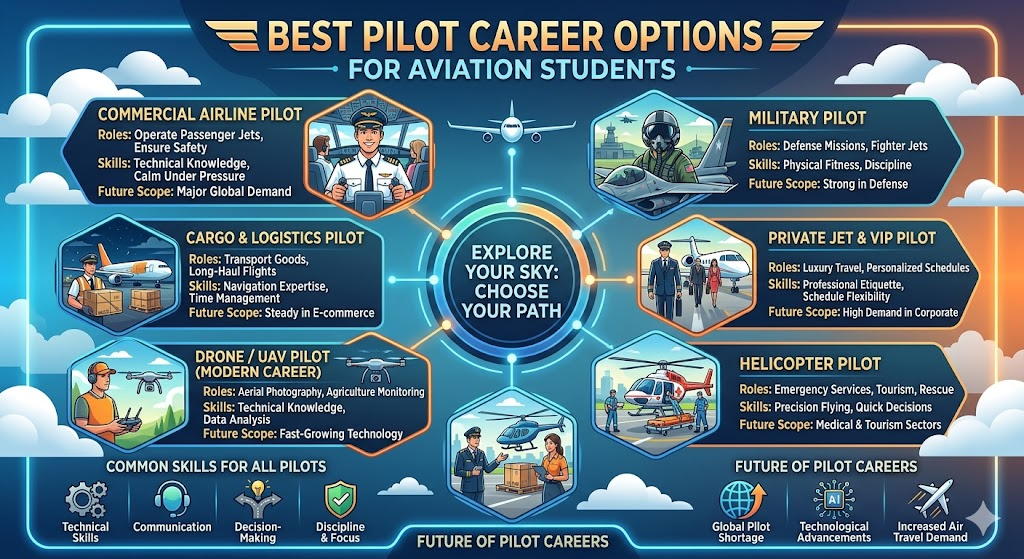
1. Commercial Airline Pilot
A commercial airline pilot operates passenger aircraft for domestic and international airlines. This is one of the most prestigious and in-demand careers in aviation.
Role Description
- Operate large passenger aircraft
- Ensure flight safety and navigation
- Coordinate with co-pilot and air traffic control
- Manage emergency situations
Skills Required
- Strong technical knowledge of aircraft systems
- Excellent communication skills
- Situational awareness and decision-making
- Calm behavior under pressure
Career Scope
Commercial pilots can progress from First Officer to Captain and even training or management roles within airlines.
Salary Expectations
Generally high and increases significantly with experience and aircraft type.
2. Cargo Pilot
Cargo pilots are responsible for transporting goods, packages, and logistics shipments across different regions and countries.
Role Description
- Fly cargo aircraft for logistics companies
- Ensure timely delivery of goods
- Handle night and long-haul flights
Skills Required
- Navigation expertise
- Time management skills
- Ability to handle long-duration flights
Career Scope
With the growth of e-commerce and global trade, cargo pilot demand is steadily increasing.
Salary Expectations
Competitive and often includes additional allowances for long flights.
3. Private Jet Pilot
Private jet pilots fly aircraft for VIPs, business executives, and high-net-worth individuals.
Role Description
- Operate luxury private jets
- Handle personalized flight schedules
- Ensure privacy and comfort of passengers
Skills Required
- Professional etiquette
- High-level communication skills
- Flexibility in schedules
Career Scope
High demand in corporate aviation and luxury travel sectors.
Salary Expectations
Generally higher than standard airline pilots due to exclusivity.
4. Flight Instructor
Flight instructors train new aviation students and help them earn their pilot licenses.
Role Description
- Teach flying techniques and theory
- Conduct simulator and practical training
- Evaluate student performance
Skills Required
- Strong knowledge of aviation fundamentals
- Teaching and mentoring ability
- Patience and clarity in communication
Career Scope
Excellent stepping stone for gaining flight hours and advancing to airlines.
Salary Expectations
Moderate initially but increases with experience and certifications.
5. Military Pilot
Military pilots serve in defense forces and operate fighter jets, transport aircraft, or reconnaissance planes.
Role Description
- Conduct defense missions
- Operate high-speed fighter jets
- Participate in national security operations
Skills Required
- Physical and mental fitness
- Advanced flying skills
- Discipline and leadership qualities
Career Scope
Highly respected career with strong growth in defense services.
Salary Expectations
Stable government pay with additional benefits and allowances.
6. Helicopter Pilot
Helicopter pilots operate rotary-wing aircraft for emergency services, tourism, and industrial operations.
Role Description
- Air ambulance services
- Rescue missions
- Offshore transport and tourism flights
Skills Required
- Precision flying skills
- Quick decision-making ability
- Strong coordination
Career Scope
Growing demand in medical emergency and tourism sectors.
Salary Expectations
Varies based on industry and mission type.
7. Charter Pilot
Charter pilots operate non-scheduled flights for individuals or organizations.
Role Description
- Fly private chartered flights
- Manage flexible schedules
- Provide customized travel services
Skills Required
- Customer service skills
- Flexible working mindset
- Strong navigation abilities
Career Scope
Expanding with the rise of luxury travel and business aviation.
Salary Expectations
Good earning potential depending on client base.
8. Drone / UAV Pilot (Modern Aviation Career)
Drone pilots operate unmanned aerial vehicles for commercial and industrial use.
Role Description
- Aerial photography and mapping
- Agriculture monitoring
- Surveillance and inspection tasks
Skills Required
- Technical knowledge of UAV systems
- Remote operation skills
- Data analysis basics
Career Scope
One of the fastest-growing aviation careers in modern technology sectors.
Salary Expectations
Increasing demand across industries like media, defense, and agriculture.
Skills Required to Become a Successful Pilot
To succeed in any aviation career, students must develop a strong skill set:
Technical Skills
Understanding aircraft systems, navigation tools, and aviation regulations.
Communication Skills
Clear communication with air traffic control and crew members.
Decision-Making Ability
Quick thinking during emergencies or unexpected weather conditions.
Discipline and Focus
Strict adherence to safety protocols and operational guidelines.
Education & Training Path
Becoming a pilot requires structured training and certification.
Step 1: Ground Training
- Aviation theory
- Meteorology
- Air navigation
- Aircraft systems
Step 2: CPL (Commercial Pilot License)
- Mandatory license for professional pilots
- Requires flight hours and exams
Step 3: Flight Training
- Simulator training
- Real aircraft flying experience
- Instructor-led sessions
Step 4: Medical Fitness
- Class 1 medical examination
- Ensures physical and mental fitness for flying
Challenges in Aviation Careers
While aviation is rewarding, it also comes with challenges:
- High cost of pilot training
- Strict selection and licensing requirements
- Competitive job market
- Irregular schedules and long working hours
- Continuous skill upgrading required
Future of Pilot Careers
The aviation industry is evolving rapidly. Some key future trends include:
Increased Air Travel Demand
Global passenger traffic continues to grow every year.
Technological Advancements
Automation and AI are improving flight systems but still require skilled pilots.
Drone and UAV Expansion
New job roles are emerging in unmanned aviation systems.
Global Pilot Shortage
Many regions are facing a shortage of trained pilots, creating strong job opportunities.
FAQs
1. Which pilot career is best for aviation students?
Commercial airline pilot is the most popular choice, but drone and cargo pilots are also rapidly growing fields.
2. How long does it take to become a pilot?
It usually takes 2 to 4 years depending on training, flight hours, and licensing requirements.
3. Is becoming a pilot expensive?
Yes, pilot training requires significant investment, especially for CPL programs and flight hours.
4. Can aviation students choose multiple pilot careers?
Yes, many pilots start in one field and later transition to airlines or private aviation roles.
5. Is drone piloting a good career option?
Yes, drone piloting is a modern and fast-growing career in multiple industries like media, agriculture, and defense.
6. What is the minimum qualification to become a pilot?
Generally, students must complete 10+2 with physics and mathematics to pursue pilot training.
7. Do pilots have good career growth?
Yes, pilots have strong global demand, career stability, and high earning potential with experience.
Conclusion
Pilot careers offer some of the most exciting and respected opportunities in the aviation industry. From commercial airlines to military aviation and modern drone operations, aviation students have multiple paths to choose from based on their interests and skills.
However, success in this field requires dedication, proper training, discipline, and continuous learning. Choosing the right pilot career early can shape a strong and rewarding professional journey.
