
Introduction
Pilot training can feel confusing for beginners because aviation has different types of licenses, each with a different purpose. Many students hear terms like SPL, PPL, and CPL but do not clearly understand which license comes first, which one allows private flying, and which one is required for a professional pilot career. Understanding these licenses is very important before joining a flying school because each stage has different eligibility rules, medical needs, training requirements, costs, and career value. This guide explains the difference between CPL, PPL, and SPL in simple language so aviation aspirants can choose the right path with confidence.
Understanding the Pilot Training Journey
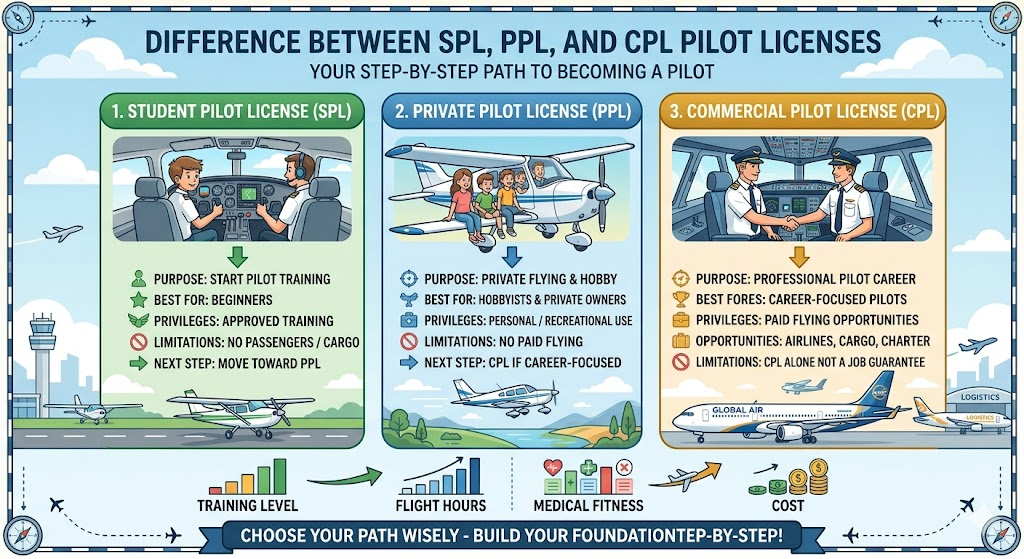
The pilot training journey usually follows a step-by-step path. Each license builds a stronger foundation for the next stage.
Student Pilot License → Private Pilot License → Commercial Pilot License → Airline Career
An SPL helps beginners start formal flight training. A PPL allows pilots to fly for private or personal purposes. A CPL allows pilots to fly professionally and apply for paid flying opportunities. Students who want to become airline pilots usually work toward a CPL and later complete additional training, experience building, and airline selection requirements.
What Is SPL?
SPL stands for Student Pilot License. It is the starting license for aviation students who want to begin flight training.
The main purpose of SPL is to allow a beginner to enter structured pilot training under approved supervision. It helps students learn aviation basics, aircraft handling, safety rules, communication, and discipline before progressing further.
Key Points About SPL
- It is the first step in pilot training
- It is meant for beginners
- It allows training under approved conditions
- It does not make someone a professional pilot
- It helps students start practical flying lessons
- It requires basic eligibility and medical fitness
- It prepares students for higher licenses
SPL Privileges
With an SPL, students can begin flight training under the rules of the flying school and aviation authority. They may be allowed to fly under instructor supervision and later perform approved training exercises based on progress and safety readiness.
SPL Limitations
An SPL does not allow commercial flying. It also does not allow a student to carry passengers for private or paid purposes. It is mainly a training license.
What Is PPL?
PPL stands for Private Pilot License. It is a license for individuals who want to fly aircraft for personal or recreational purposes.
A PPL is suitable for aviation enthusiasts, private aircraft owners, hobby flyers, and people who want to fly without making aviation their full-time profession. It gives more privileges than SPL but does not generally allow paid commercial flying.
Key Points About PPL
- It is used for private flying
- It is suitable for aviation hobbyists
- It allows personal or recreational flying
- It requires more training than SPL
- It does not usually allow pilots to earn money from flying
- It builds strong flying confidence and aircraft handling skills
PPL Privileges
A PPL holder can fly aircraft for personal use, subject to aviation rules and license conditions. It is useful for people who want to enjoy flying privately or build experience before moving toward professional training.
PPL Limitations
A PPL is not a commercial license. A pilot cannot generally use a PPL to fly passengers or cargo for payment. Students who want airline or professional flying careers must progress toward CPL.
What Is CPL?
CPL stands for Commercial Pilot License. It is the license required for pilots who want to fly professionally and earn money through flying.
A CPL is an important step for students who want to become airline pilots, cargo pilots, charter pilots, corporate pilots, or flight instructors. It requires advanced training, stronger technical knowledge, medical fitness, and practical flying experience.
Key Points About CPL
- It is a professional pilot license
- It allows paid flying opportunities
- It is required for many commercial aviation jobs
- It needs advanced flight training
- It requires strong discipline and exam preparation
- It is an important step toward airline careers
- It has higher cost and training commitment than SPL and PPL
CPL Privileges
A CPL allows pilots to work in commercial aviation roles based on license privileges, aircraft ratings, experience, and regulatory requirements. It can lead to opportunities in airlines, charter aviation, cargo operations, corporate aviation, and training organizations.
CPL Limitations
A CPL alone does not automatically guarantee an airline job. Pilots may need additional requirements such as type rating, airline selection, medical fitness, simulator checks, interviews, and experience building.
Detailed Comparison Between CPL, PPL, and SPL
Purpose
SPL is for starting flight training. PPL is for private flying. CPL is for professional flying.
Training Level
SPL is the beginner level. PPL is an intermediate private flying level. CPL is a professional training level.
Eligibility
Eligibility depends on aviation authority rules, age, education, medical fitness, and license type. CPL generally requires stronger academic and training preparation than SPL and PPL.
Medical Requirements
Medical fitness is important for all pilot licenses. CPL usually has stricter medical standards because it is connected with professional flying responsibilities.
Flight Hours
SPL involves early training. PPL requires more flying hours than SPL. CPL requires advanced training and higher flight hour completion.
Privileges
SPL allows training. PPL allows private flying. CPL allows professional flying opportunities.
Career Opportunities
SPL is only a starting point. PPL is mainly for personal flying. CPL opens the path toward paid aviation careers.
Cost Involvement
SPL usually has lower cost involvement. PPL costs more because it requires more training. CPL is usually the most expensive because it includes advanced training, exams, flight hours, and professional preparation.
Training Duration
Training duration depends on school quality, aircraft availability, weather, student performance, exams, and licensing process. CPL generally takes longer than SPL and PPL.
Complexity Level
SPL is basic, PPL is moderate, and CPL is advanced. CPL requires more serious preparation because it is linked to professional aviation responsibilities.
CPL vs PPL vs SPL Comparison Table
| Factor | SPL | PPL | CPL |
|---|---|---|---|
| Full Form | Student Pilot License | Private Pilot License | Commercial Pilot License |
| Main Purpose | Start pilot training | Fly privately | Fly professionally |
| Best For | Beginners | Hobby flyers and private pilots | Career-focused pilots |
| Commercial Flying Allowed | No | No | Yes, based on rules and ratings |
| Training Level | Basic | Intermediate | Advanced |
| Career Scope | Training stage only | Limited career use | Airline, cargo, charter, corporate aviation |
| Cost Level | Lower | Medium | Higher |
| Medical Requirement | Required | Required | Stricter professional medical fitness |
| Flying Privilege | Training under approved conditions | Private flying | Paid flying opportunities |
| Next Step | PPL or further training | CPL if career-focused | Type rating and job applications |
Which License Comes First?
For most beginners, the training path starts with SPL. This license allows the student to begin aviation training. After gaining basic experience, students may move toward PPL if they want private flying privileges. Students who want professional pilot careers continue toward CPL.
Typical progression:
SPL → PPL → CPL → Type Rating → Airline or Professional Flying Career
Some training paths may vary depending on country, aviation rules, and flying school structure, but SPL is usually considered the starting stage for beginners.
Who Should Choose SPL?
SPL is suitable for:
- Complete aviation beginners
- Students starting flight training
- Future pilot candidates
- Learners exploring aviation careers
- Students planning to move toward higher pilot licenses
SPL is best for those who are just beginning their flying journey.
Who Should Choose PPL?
PPL is suitable for:
- Aviation hobbyists
- Recreational flyers
- Private aircraft owners
- People who want to fly for personal use
- Students who want more flying experience before professional training
PPL is best for people who love flying but do not necessarily want to work as professional pilots.
Who Should Choose CPL?
CPL is suitable for:
- Students who want to become professional pilots
- Airline pilot aspirants
- Cargo pilot candidates
- Charter aviation career seekers
- Corporate aviation aspirants
- Flight instructor career candidates
CPL is the right choice for students who want flying to become their profession.
Costs Associated With Each License
Pilot training costs vary depending on the flying school, country, aircraft type, fuel cost, instructor charges, exam fees, and living expenses.
SPL Costs
SPL costs usually include basic application charges, medical examination, ground training, documentation, and initial training support.
PPL Costs
PPL costs are higher than SPL because students need more flight hours, instructor training, ground school, exams, and aircraft usage.
CPL Costs
CPL costs are usually the highest because this license requires advanced training, more flight hours, professional exams, medical checks, and additional preparation.
Students should always ask flying schools for a full fee breakdown before joining.
Career Opportunities After CPL
A CPL can open doors to different aviation careers. However, actual job opportunities depend on experience, ratings, hiring conditions, medical fitness, and airline requirements.
Career options after CPL include:
- Airline pilot
- Cargo pilot
- Charter pilot
- Corporate pilot
- Flight instructor
- Aerial survey pilot
- Medical evacuation pilot
- Aviation operations role
For airline careers, pilots may also need type rating, simulator checks, interviews, and airline-specific training.
Common Misconceptions About Pilot Licenses
Many beginners misunderstand pilot licenses. Here are some common myths:
- SPL does not make you a professional pilot
- PPL is not usually for paid flying
- CPL is generally required for commercial flying jobs
- A license alone does not guarantee employment
- More flight hours help, but skill and discipline matter too
- Choosing a flying school only by cost can be risky
- Medical fitness is important at every stage
Understanding these points helps students avoid wrong decisions.
How to Choose the Right Pilot License
Students should choose a license based on their aviation goal.
Choose SPL if you are beginning flight training.
Choose PPL if you want to fly privately or as a hobby.
Choose CPL if you want to become a professional pilot.
Before deciding, consider:
- Career goal
- Budget
- Medical fitness
- Time commitment
- Training location
- Flying school quality
- Long-term aviation plans
How BestPilotsSchool.com Helps Aviation Aspirants
BestPilotsSchool.com can help students and parents understand pilot licenses, training stages, flying school selection, aviation career planning, and licensing requirements. Beginners often need simple and reliable guidance before investing in pilot training.
BestPilotsSchool.com can support aviation aspirants with:
- Pilot license information
- Flying school guidance
- Aviation career roadmap
- Beginner-friendly training resources
- Cost planning awareness
- Pilot career education
Common Mistakes Students Make
Students should avoid these common mistakes:
- Confusing PPL with CPL
- Thinking SPL allows professional flying
- Ignoring medical requirements
- Choosing a flying school without research
- Not planning training costs properly
- Not understanding license limitations
- Ignoring ground school preparation
- Assuming CPL automatically guarantees an airline job
- Not checking aircraft availability
- Depending only on advertisements
Proper research helps students make better aviation career decisions.
Frequently Asked Questions
1- What is the difference between CPL, PPL, and SPL?
SPL is for starting pilot training, PPL is for private flying, and CPL is for professional flying. Each license has different privileges, training requirements, costs, and career value.
2- Which pilot license comes first?
The Student Pilot License usually comes first. It allows beginners to start formal flight training before progressing toward PPL or CPL depending on career goals.
3- Can I earn money with a PPL?
A PPL is generally meant for private or personal flying and does not usually allow paid commercial flying. Students who want to earn money as pilots should work toward CPL.
4- Is CPL required for airline jobs?
Yes, a Commercial Pilot License is generally required for professional airline pilot careers. Additional requirements such as type rating, experience, interviews, and airline training may also apply.
5- What is the purpose of SPL?
The purpose of SPL is to allow aviation students to begin flight training under approved supervision. It helps beginners enter the structured pilot training system.
6- How long does pilot training take?
Pilot training duration depends on the license type, flying school, weather, aircraft availability, exam progress, and student performance. CPL usually takes longer than SPL and PPL.
7- What medical requirements apply?
Medical fitness is required for pilot training. The exact medical standard depends on the license type and aviation authority rules. CPL usually requires stricter medical fitness because it is linked to professional flying.
8- Which license is best for beginners?
SPL is usually best for beginners because it is the starting point of pilot training. After SPL, students can decide whether to move toward PPL or CPL.
9- How much training is involved?
Training depends on the license type. SPL involves basic training, PPL includes more private flying preparation, and CPL includes advanced professional training with more flight hours and exams.
10- Which license should I choose for a pilot career?
Students who want a professional pilot career should aim for CPL after completing the required training stages. PPL is better for private flying, while SPL is the starting point.
Conclusion
SPL, PPL, and CPL are different stages of the pilot training journey. SPL helps beginners start flight training, PPL allows private flying, and CPL opens the path toward professional flying careers. Students should not choose a license randomly. The right choice depends on career goal, budget, medical fitness, training commitment, and long-term aviation plans. If your dream is to become an airline or commercial pilot, CPL is the key professional license, but SPL and PPL help build the foundation. BestPilotsSchool.com can guide aviation aspirants with simple, practical, and beginner-friendly information to make better pilot training decisions.
