
Introduction
Modern IT environments have become increasingly complex. Organizations now operate across cloud platforms, microservices architectures, containers, hybrid infrastructure, and distributed applications. Traditional monitoring approaches often struggle to keep pace with the volume of data and alerts generated by these systems.
This is where AIOps enters the picture.
AIOps, or Artificial Intelligence for IT Operations, combines machine learning, analytics, automation, and big data technologies to improve operational efficiency, reduce downtime, and accelerate incident resolution. As enterprises continue their digital transformation journeys, demand for professionals with AIOps skills is growing rapidly.
Whether you are a DevOps Engineer, Site Reliability Engineer, Cloud Engineer, IT Operations Professional, or complete beginner, understanding AIOps can significantly improve your career opportunities and technical expertise.
In this comprehensive guide, you’ll learn what AIOps is, why organizations need it, how AIOps tools work, certification options, career opportunities, and how to start your AIOps learning journey.
What is AIOps?
AIOps stands for Artificial Intelligence for IT Operations. It is the application of artificial intelligence, machine learning, analytics, and automation technologies to enhance and automate IT operations processes.
The term was introduced to describe systems that can automatically analyze large volumes of operational data, identify patterns, detect anomalies, correlate events, determine root causes, and recommend or execute corrective actions.
Evolution of AIOps
Traditional IT operations relied heavily on manual monitoring and troubleshooting. As infrastructures became more complex, organizations adopted monitoring tools and dashboards.
However, modern environments generate millions of events, logs, traces, and metrics every day. Human teams cannot efficiently process this volume of information. AIOps emerged to bridge this gap by using machine learning algorithms to automate analysis and decision-making.
Core Principles of AIOps
- Data-driven decision making
- Event correlation
- Anomaly detection
- Root cause analysis
- Predictive analytics
- Intelligent automation
- Continuous learning
- Observability enhancement
Why Organizations Need AIOps
Organizations face several challenges that make AIOps increasingly important.
Monitoring Complexity
Modern enterprises operate thousands of servers, applications, APIs, databases, and cloud resources. Monitoring these components manually is nearly impossible.
Cloud-Native Infrastructure
Cloud environments are dynamic and continuously changing. AIOps helps organizations gain visibility into cloud operations and maintain performance.
Microservices and Containers
Applications built using Kubernetes and container technologies create additional operational complexity. AIOps helps correlate events across distributed systems.
Alert Fatigue
Operations teams often receive thousands of alerts daily. AIOps reduces noise by grouping related alerts and highlighting critical incidents.
Faster Incident Resolution
Machine learning algorithms identify patterns and probable causes faster than manual investigation, reducing downtime significantly.
Key Components of AIOps
Data Collection
AIOps platforms gather data from:
- Metrics
- Logs
- Events
- Traces
- Network devices
- Cloud platforms
- Monitoring systems
Event Correlation
Event correlation connects related alerts and incidents into meaningful groups, reducing alert overload.
Anomaly Detection
Machine learning models identify unusual behavior that deviates from normal operational patterns.
Root Cause Analysis
AIOps tools analyze dependencies and relationships between systems to identify the actual source of incidents.
Predictive Analytics
Historical trends are used to forecast future failures and capacity requirements.
Automation and Remediation
Routine operational tasks can be automated to improve efficiency and consistency.
Observability
AIOps enhances observability by providing visibility across infrastructure, applications, networks, and cloud services.
AIOps Use Cases
Infrastructure Monitoring
Monitor servers, virtual machines, cloud resources, storage systems, and networks.
Application Performance Monitoring
Track application performance and user experience in real time.
Incident Management
Automatically identify, prioritize, and resolve incidents.
Capacity Planning
Predict resource utilization and optimize infrastructure investments.
Security Operations
Detect suspicious activities and unusual patterns across systems.
Network Operations
Improve network performance monitoring and troubleshooting.
Cloud Operations
Manage hybrid and multi-cloud environments effectively.
AIOps for SRE Operations
Support Site Reliability Engineering teams with intelligent automation and operational insights.
AIOps for SRE Teams
Site Reliability Engineering focuses on reliability, scalability, and automation. AIOps aligns naturally with these objectives.
Reducing Mean Time to Detect
AIOps platforms continuously analyze operational data to identify issues before users are impacted.
Reducing Mean Time to Resolve
Root cause analysis and automated remediation reduce incident resolution times.
Intelligent Alerting
Only relevant alerts are surfaced to engineers, reducing distractions.
Reliability Engineering
AIOps helps improve system availability and service reliability.
Proactive Operations
Potential failures can be identified and addressed before they become outages.
Popular AIOps Tools List
Dynatrace
Offers AI-powered observability, root cause analysis, and automated monitoring.
Datadog
Provides cloud monitoring, log analytics, and AI-assisted troubleshooting.
Splunk ITSI
Uses machine learning for event correlation and operational intelligence.
New Relic
Combines observability, performance monitoring, and AI-powered insights.
Moogsoft
Specializes in event correlation and noise reduction.
BigPanda
Offers intelligent incident management and alert aggregation.
PagerDuty
Provides incident response automation and operational workflows.
LogicMonitor
Delivers infrastructure monitoring and predictive analytics.
AppDynamics
Focuses on application performance monitoring and business observability.
Elastic Observability
Provides unified observability across logs, metrics, traces, and security data.
AIOps vs DevOps
| Area | AIOps | DevOps |
|---|---|---|
| Goal | Intelligent Operations | Faster Software Delivery |
| Focus | Operations Optimization | Development and Operations Collaboration |
| Automation | AI-driven | Pipeline-driven |
| Monitoring | Advanced Analytics | Traditional Monitoring |
| Incident Response | Predictive and Automated | Manual and Automated |
| Users | Operations Teams | DevOps Teams |
AIOps vs MLOps
| Area | AIOps | MLOps |
|---|---|---|
| Purpose | IT Operations Optimization | Machine Learning Lifecycle Management |
| Users | Operations Teams | Data Science Teams |
| Focus | Incident Management | Model Management |
| Data Sources | Operational Data | Training Data |
| Outcomes | Reliability and Automation | Model Deployment |
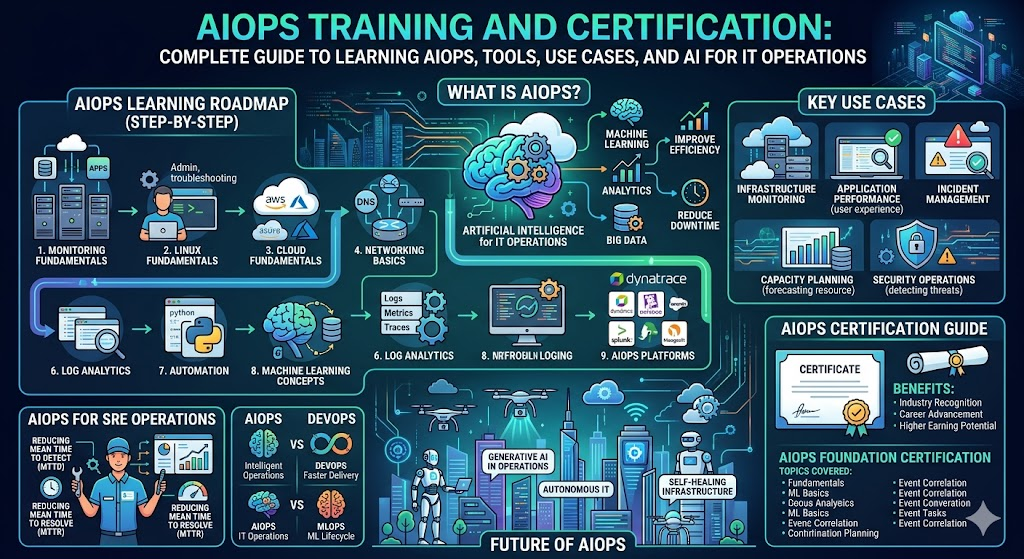
AIOps Training Roadmap
Step 1: Monitoring Fundamentals
Learn infrastructure and application monitoring basics.
Step 2: Linux Fundamentals
Understand operating system administration and troubleshooting.
Step 3: Cloud Fundamentals
Gain knowledge of AWS, Azure, or Google Cloud.
Step 4: Networking Basics
Learn protocols, DNS, routing, and network troubleshooting.
Step 5: Observability
Understand logs, metrics, traces, and distributed monitoring.
Step 6: Log Analytics
Work with centralized logging platforms.
Step 7: Automation
Learn scripting using Python and automation frameworks.
Step 8: Machine Learning Concepts
Understand basic machine learning algorithms and data analysis.
Step 9: AIOps Platforms
Gain hands-on experience with leading AIOps tools.
AIOps Course Curriculum
A comprehensive AIOps course should include:
Foundations of AIOps
Introduction to AI-driven operations.
Event Correlation
Techniques for grouping and prioritizing alerts.
Root Cause Analysis
Methods for identifying underlying issues.
Observability
Comprehensive monitoring and visibility practices.
Automation
Operational workflow automation.
Incident Response
Modern incident management strategies.
Predictive Analytics
Forecasting operational issues.
Hands-On Labs
Real-world practical exercises.
Enterprise Use Cases
Industry-specific implementation scenarios.
AIOps Certification Guide
Certification validates your expertise and demonstrates your commitment to professional development.
Benefits of Certification
- Industry recognition
- Career advancement
- Increased earning potential
- Skills validation
- Greater employer confidence
Career Opportunities
Certified professionals are often considered for leadership and specialist roles.
AIOps Foundation Certification
An AIOps Foundation Certification introduces learners to fundamental concepts and industry best practices.
Topics Covered
- AIOps fundamentals
- Machine learning basics
- Event correlation
- Automation
- Monitoring
- Observability
Exam Preparation
- Study official materials
- Practice hands-on labs
- Review case studies
- Take mock exams
Career Value
Foundation certification establishes credibility and opens opportunities in operations and cloud engineering.
Career Opportunities in AIOps
AIOps Engineer
Designs and manages AI-powered operational systems.
Site Reliability Engineer
Improves reliability using automation and observability.
DevOps Engineer
Integrates AIOps capabilities into operational workflows.
Platform Engineer
Builds scalable and resilient infrastructure platforms.
Cloud Operations Engineer
Manages cloud environments using intelligent operations.
Monitoring Specialist
Focuses on observability and performance optimization.
IT Operations Manager
Leads operational excellence initiatives.
Skills Required to Become an AIOps Engineer
Technical Skills
- Linux
- Cloud Platforms
- Networking
- Python
- Automation
- Monitoring Tools
- Observability Platforms
Analytical Skills
- Problem Solving
- Data Analysis
- Incident Investigation
- Performance Optimization
Business Skills
- Communication
- Collaboration
- Process Improvement
Future of AIOps
The future of AIOps is closely tied to advances in artificial intelligence and automation.
Generative AI in Operations
AI assistants will help engineers troubleshoot systems faster.
Autonomous IT Operations
Systems will increasingly manage themselves with minimal human intervention.
Self-Healing Infrastructure
Automated remediation will reduce operational workloads.
Intelligent Automation
More processes will become fully automated.
Predictive Operations
Organizations will shift from reactive to proactive operations models.
Why Learn AIOps from AIOpsSchool
AIOpsSchool provides a structured learning path designed specifically for modern IT professionals.
Structured Learning Path
Step-by-step progression from fundamentals to advanced concepts.
Practical Training
Hands-on exercises and real-world scenarios.
Real-World Projects
Enterprise-focused implementation examples.
Industry-Focused Curriculum
Aligned with current industry requirements.
Certification Preparation
Guidance for AIOps Foundation Certification and related programs.
Expert Instructors
Learn from professionals with practical operational experience.
Frequently Asked Questions
1. What is AIOps?
AIOps uses artificial intelligence and machine learning to automate and improve IT operations processes.
2. Is AIOps a good career?
Yes. Demand for AI-driven operations skills continues to grow across industries.
3. How long does it take to learn AIOps?
Most professionals can build foundational knowledge within a few months of focused study.
4. Which certification is best for beginners?
AIOps Foundation Certification is often the best starting point.
5. What skills are required for AIOps?
Linux, cloud, monitoring, automation, networking, and basic machine learning concepts.
6. Is coding required for AIOps?
Basic scripting knowledge, especially Python, is highly beneficial.
7. What are the best AIOps tools?
Popular options include Dynatrace, Datadog, Splunk ITSI, New Relic, and Moogsoft.
8. How does AIOps help SRE teams?
It reduces alert fatigue and improves incident resolution.
9. Can beginners learn AIOps?
Yes. Many training programs are designed specifically for beginners.
10. What is event correlation?
The process of grouping related alerts into meaningful incidents.
11. What is anomaly detection?
Identifying unusual patterns that may indicate problems.
12. How is AIOps different from DevOps?
DevOps focuses on software delivery, while AIOps focuses on intelligent operations.
13. How is AIOps different from MLOps?
MLOps manages machine learning models, while AIOps improves IT operations.
14. What industries use AIOps?
Banking, healthcare, retail, telecommunications, cloud services, and technology companies.
15. Does AIOps require machine learning expertise?
Not necessarily. Basic understanding is usually sufficient for most operational roles.
Conclusion
AIOps is transforming the way organizations manage modern IT operations. As infrastructure becomes increasingly complex, traditional monitoring and operational approaches are no longer enough. AIOps combines artificial intelligence, machine learning, observability, event correlation, anomaly detection, root cause analysis, and automation to help organizations achieve faster incident resolution, greater reliability, and improved operational efficiency.
For professionals, investing in AIOps Training and pursuing an AIOps Certification can open doors to high-demand roles in DevOps, SRE, cloud operations, platform engineering, and IT operations management. By following a structured learning roadmap, gaining hands-on experience with leading AIOps tools, and building practical operational knowledge, learners can position themselves for success in the rapidly evolving world of AI for IT Operations. The best time to start your AIOps journey is now.
