
Introduction
Modern IT operations are no longer simple. Today, businesses run applications across cloud platforms, containers, microservices, hybrid infrastructure, databases, APIs, security tools, and monitoring systems. Every system produces logs, metrics, traces, alerts, events, and performance data every second.
For IT teams, this creates a major challenge. They must manage large systems, reduce downtime, respond to alerts, find root causes, and keep services reliable. Traditional monitoring alone is not enough because the volume of data is too high and incidents move too fast.
This is where AIOps becomes important.
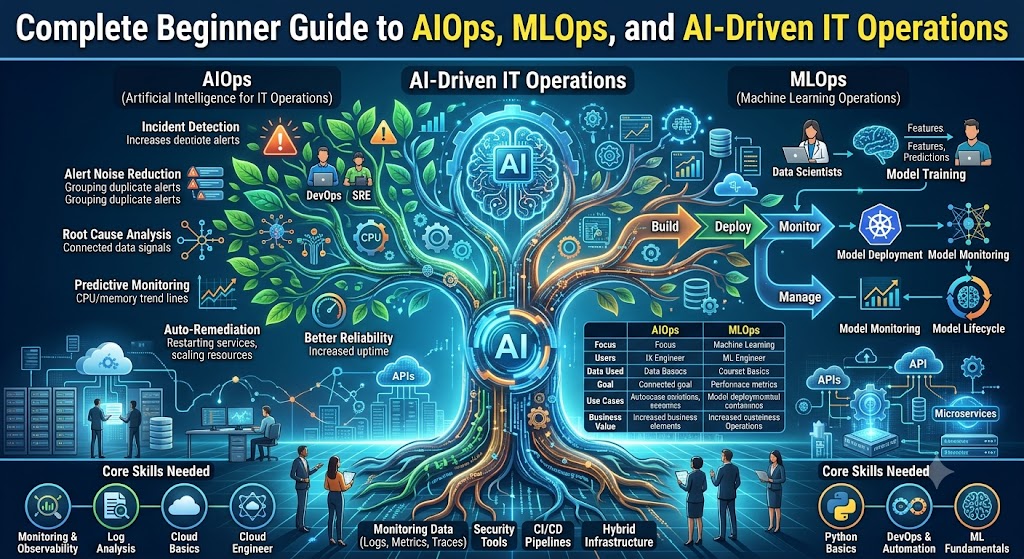
AIOps helps IT teams use artificial intelligence, machine learning, observability, automation, and analytics to improve IT operations. It supports faster incident detection, better alert management, root cause analysis, predictive monitoring, and auto-remediation.
For DevOps engineers, SREs, cloud engineers, monitoring teams, platform engineers, automation engineers, freshers, and managers, learning AIOps is becoming a future-ready skill. It helps professionals understand how modern IT operations are moving from manual response to intelligent automation.
What is AIOps?
AIOps stands for Artificial Intelligence for IT Operations.
In simple English, AIOps means using AI and machine learning to improve how IT systems are monitored, managed, and automated. It helps teams understand large amounts of operational data and take faster action during incidents.
AIOps combines:
- Monitoring data
- Logs
- Metrics
- Traces
- Alerts
- Events
- Machine learning
- Automation workflows
- Incident management
- Root cause analysis
For example, a traditional monitoring tool may show 500 alerts during a service outage. An AIOps system can analyze those alerts, group related events, identify the most likely root cause, and even trigger an auto-remediation workflow.
This makes IT operations faster, smarter, and more reliable.
Why AIOps Matters for Modern IT Teams
Modern IT teams deal with complex systems. A single application may depend on cloud servers, Kubernetes clusters, databases, APIs, third-party services, CI/CD pipelines, and security tools. When something fails, it is not always easy to find the real reason.
AIOps helps solve this problem by making operations more intelligent.
Alert Noise Reduction
Too many alerts create confusion. Engineers may receive hundreds or thousands of alerts, but many of them are duplicate, low-priority, or related to the same issue.
AIOps helps reduce alert noise by grouping similar alerts and identifying which ones need immediate attention.
Faster Incident Detection
Traditional monitoring often reacts after a problem becomes visible. AIOps can detect unusual behavior early by analyzing patterns in logs, metrics, and traces.
This helps teams find incidents before they become major outages.
Root Cause Analysis
Finding the root cause is one of the hardest parts of incident management. AIOps can connect different signals and show relationships between systems.
For example, it may show that a database slowdown caused API errors, which then caused user-facing application failures.
Predictive Monitoring
AIOps can study historical trends and predict future problems. It may identify that CPU usage, memory usage, disk space, or request latency is moving toward a risky level.
This gives teams time to act before failure happens.
Auto-Remediation
Auto-remediation means automatically fixing known problems through predefined workflows.
For example:
- Restarting a failed service
- Scaling cloud resources
- Clearing temporary files
- Rolling back a failed deployment
- Opening an incident ticket
- Notifying the right team
AIOps makes this process smarter by deciding when automation should be triggered.
Better Reliability
Reliability is a major goal for IT teams. AIOps supports service reliability by improving detection, response, prevention, and learning from incidents.
For SREs and DevOps teams, this helps improve uptime and user experience.
AIOps vs MLOps
AIOps and MLOps are connected, but they are not the same.
AIOps focuses on improving IT operations using AI and automation. MLOps focuses on building, deploying, monitoring, and managing machine learning models.
Both are important in modern technology environments.
| Area | AIOps | MLOps |
|---|---|---|
| Main Focus | IT operations and incident management | Machine learning model lifecycle |
| Main Users | DevOps, SRE, IT operations, cloud teams | Data scientists, ML engineers, platform teams |
| Data Used | Logs, metrics, traces, alerts, events | Training data, models, features, predictions |
| Goal | Improve reliability, automation, and response | Build, deploy, and manage ML models |
| Common Use Cases | Alert correlation, anomaly detection, auto-remediation | Model training, model deployment, model monitoring |
| Business Value | Faster operations and reduced downtime | Reliable ML delivery and better AI products |
In simple terms, AIOps improves IT operations, while MLOps improves machine learning operations.
However, they often work together. A company using ML models in production may need MLOps to manage the models and AIOps to monitor the infrastructure, alerts, and incidents around those systems.
Core Skills Needed to Learn AIOps
AIOps is not only about tools. Beginners should first understand the basic concepts behind IT operations, monitoring, automation, and machine learning.
Monitoring and Observability
Monitoring tells you whether a system is working. Observability helps you understand why something is happening.
AIOps depends heavily on observability because AI needs quality data to analyze system behavior.
Important observability areas include:
- Logs
- Metrics
- Traces
- Dashboards
- Alerts
- Service health
- User experience monitoring
Log Analysis
Logs contain details about what happened inside applications, servers, containers, databases, and network systems.
AIOps uses log analysis to detect errors, unusual behavior, repeated failures, and incident patterns.
Metrics and Traces
Metrics show numbers such as CPU usage, memory usage, request count, error rate, and response time.
Traces show how a request moves through different services.
Together, metrics and traces help AIOps tools understand system performance.
Incident Management
AIOps supports incident detection and response, so beginners should understand:
- What an incident is
- How tickets are created
- How teams respond
- How escalation works
- How post-incident reviews are done
Cloud Basics
Most modern systems run on cloud platforms. AIOps learners should understand basic cloud concepts like:
- Compute
- Storage
- Networking
- Scaling
- Load balancing
- Cloud monitoring
- Cloud cost visibility
Python Basics
Python is useful for automation, data analysis, scripting, and machine learning experiments.
You do not need to become an advanced programmer at the beginning, but basic Python knowledge is helpful for AIOps training and real projects.
Machine Learning Fundamentals
AIOps uses machine learning for anomaly detection, prediction, classification, clustering, and pattern recognition.
Beginners should understand simple ML concepts such as:
- Training data
- Models
- Patterns
- Anomalies
- Predictions
- Accuracy
- False positives
DevOps and Automation
AIOps works closely with DevOps automation. Knowledge of CI/CD, infrastructure automation, configuration management, and scripting helps you design better AIOps workflows.
Popular AIOps Use Cases
AIOps can be used in many areas of IT operations. Here are some common and practical use cases.
Anomaly Detection
Anomaly detection means finding unusual behavior in systems.
For example, if an application normally has 2% error rate but suddenly reaches 15%, AIOps can detect this change and raise an alert.
Event Correlation
Event correlation connects related alerts and events.
Instead of showing many separate alerts, AIOps can group them into one incident. This helps engineers focus on the real issue.
Intelligent Alerting
Traditional alerts are often rule-based. Intelligent alerting uses patterns, context, severity, and historical data to decide which alerts matter.
This improves response quality and reduces alert fatigue.
Capacity Prediction
AIOps can help predict future resource needs.
For example, it can detect that a server may run out of disk space in a few days or that traffic may increase during a business event.
Self-Healing Infrastructure
Self-healing infrastructure means systems can fix common problems automatically.
For example, if a container fails, automation can restart it. If traffic increases, infrastructure can scale automatically.
Incident Automation
AIOps can automate incident workflows such as ticket creation, notification, escalation, and remediation.
This reduces manual work and improves response time.
Cloud Cost Visibility
Cloud cost visibility is becoming important for IT teams. AIOps can help identify unusual usage patterns, unused resources, or sudden cost increases.
Service Reliability Improvement
AIOps helps teams improve reliability by learning from incidents, identifying weak points, and supporting proactive action.
AIOps Learning Roadmap for Beginners
Learning AIOps becomes easier when you follow a clear path. Beginners should not jump directly into advanced AIOps tools without understanding the basics.
| Step | What to Learn | Why It Matters |
|---|---|---|
| Step 1 | IT operations basics | Builds a foundation for understanding incidents and systems |
| Step 2 | Monitoring and observability | Helps you understand logs, metrics, traces, and alerts |
| Step 3 | DevOps and cloud fundamentals | Connects AIOps with modern infrastructure and automation |
| Step 4 | AI and ML basics | Helps you understand anomaly detection and prediction |
| Step 5 | AIOps tools and workflows | Shows how real platforms analyze and automate operations |
| Step 6 | Real projects | Builds practical confidence and portfolio value |
| Step 7 | AIOps certification preparation | Validates your learning and improves career readiness |
Step 1: Learn IT Operations Basics
Start with the basics of servers, applications, networks, databases, and incidents. Understand how IT teams keep systems running.
Step 2: Understand Monitoring and Observability
Learn how monitoring tools collect logs, metrics, and traces. Understand dashboards, alerts, service health, and performance indicators.
Step 3: Learn DevOps and Cloud Fundamentals
AIOps is closely connected with DevOps automation and cloud infrastructure. Learn CI/CD, containers, Kubernetes basics, cloud services, and infrastructure automation.
Step 4: Learn AI/ML Basics
You do not need to become a data scientist, but you should understand basic machine learning concepts. Focus on anomaly detection, classification, prediction, and pattern recognition.
Step 5: Practice AIOps Tools and Workflows
Explore AIOps tools and understand how they support alert correlation, intelligent alerting, root cause analysis, and auto-remediation.
Step 6: Work on Real Projects
Practice with real or sample datasets. Build small projects using logs, alerts, dashboards, and automation scripts.
Step 7: Prepare for AIOps Certification
An AIOps certification can help learners structure their knowledge. It can be useful for professionals who want to show practical understanding of AI-driven IT operations.
Real-World AIOps Project Ideas
Practical projects are the best way to learn AIOps. Here are some beginner-friendly project ideas:
Alert Classification System
Build a system that classifies alerts into categories such as critical, warning, informational, duplicate, or false positive.
This helps reduce alert noise.
Log Anomaly Detector
Create a simple log analysis project that identifies unusual error patterns in application logs.
This project teaches log parsing, anomaly detection, and incident signals.
Incident Prediction Dashboard
Build a dashboard that uses historical metrics to show possible future incidents.
For example, it may show rising memory usage, increasing error rate, or slow response time.
Auto-Remediation Workflow
Create an automation workflow that restarts a failed service or sends a notification when a known issue occurs.
This teaches how AIOps connects with IT automation.
Cloud Monitoring Pipeline
Build a small cloud monitoring pipeline that collects metrics, creates alerts, and displays system health.
This helps you understand observability and cloud operations.
Who Should Learn AIOps?
AIOps is useful for many roles in IT and software operations.
DevOps Engineers
DevOps engineers can use AIOps to improve CI/CD visibility, deployment monitoring, incident response, and automation.
SREs
Site Reliability Engineers can use AIOps for reliability improvement, error budget tracking, alert reduction, and faster root cause analysis.
Cloud Engineers
Cloud engineers can use AIOps for cloud monitoring, cost visibility, scaling decisions, and infrastructure automation.
IT Operations Teams
IT operations teams can use AIOps to manage alerts, incidents, service health, and system performance.
Monitoring Engineers
Monitoring engineers can improve dashboards, alert rules, event correlation, and observability pipelines using AIOps practices.
Managers
Managers can learn AIOps to understand how intelligent automation improves reliability, reduces downtime, and supports business continuity.
Freshers
Freshers who want a modern IT career can learn AIOps because it connects DevOps, cloud, automation, monitoring, and AI.
Common Mistakes Beginners Make
AIOps is powerful, but beginners often make mistakes while learning it.
Learning Tools Without Concepts
Many learners start with AIOps tools but do not understand monitoring, observability, incidents, or automation basics.
Tools are useful, but concepts are more important.
Ignoring Observability Basics
AIOps depends on quality data. If logs, metrics, and traces are poor, AI results may also be poor.
Good observability is the foundation of good AIOps.
Depending Only on AI Without Human Review
AIOps should support humans, not replace human judgment completely. Engineers should review recommendations, especially during critical incidents.
Not Practicing Real Incidents
Reading about AIOps is not enough. Learners should practice with real incident examples, logs, alerts, and dashboards.
Skipping Automation Fundamentals
Auto-remediation requires automation knowledge. Without scripting, workflows, and DevOps basics, it becomes difficult to apply AIOps practically.
AIOps Career Opportunities
AIOps is creating new career opportunities because organizations want smarter and faster IT operations.
AIOps Engineer
An AIOps Engineer works on intelligent monitoring, alert correlation, anomaly detection, incident automation, and operational analytics.
MLOps Engineer
An MLOps Engineer focuses on machine learning pipelines, model deployment, model monitoring, and ML automation.
Site Reliability Engineer
SREs use AIOps to improve service reliability, reduce incidents, manage alerts, and automate operational tasks.
Platform Engineer
Platform Engineers can use AIOps to build internal platforms with better observability, automation, and reliability features.
Cloud Automation Engineer
Cloud Automation Engineers can use AIOps for cloud monitoring, scaling, cost visibility, and infrastructure automation.
Observability Engineer
Observability Engineers can use AIOps to improve data collection, dashboards, traces, alerting, and system health analysis.
AIOps career growth depends on practical skills. Professionals who understand monitoring, cloud, DevOps automation, and AI-driven IT operations can build strong career opportunities.
Role of AIOps Training and Certification
Structured AIOps training helps beginners learn concepts in the right order. It can reduce confusion and provide a clear path from basics to real projects.
AIOps certification can also help professionals validate their knowledge. It may be useful for DevOps engineers, SREs, cloud engineers, freshers, and managers who want to show that they understand modern IT operations.
However, certification alone is not enough. Learners should also work on practical projects, understand real incidents, and practice automation workflows.
A good learning approach should include:
- Concepts
- Hands-on practice
- Use cases
- Real-world projects
- Tool understanding
- Incident examples
- Automation workflows
This balanced approach helps learners move from theory to practical AIOps implementation.
AIOps Consulting and Business Value
Many organizations need AIOps consulting when they want to improve IT operations but are unsure where to start.
AIOps consulting may help businesses with:
- Observability strategy
- Monitoring tool assessment
- Alert noise reduction
- Incident workflow improvement
- Automation planning
- Root cause analysis process
- AIOps tool selection
- Cloud monitoring improvement
- Reliability engineering practices
For businesses, the goal is not just to use AI. The real goal is to reduce downtime, improve team productivity, detect problems faster, and create more reliable digital services.
FAQs
1. What is AIOps in simple words?
AIOps means using artificial intelligence and machine learning to improve IT operations. It helps teams analyze logs, metrics, alerts, and events so they can detect problems faster and automate responses.
2. Is AIOps only for large companies?
No. AIOps is useful for any organization that manages complex IT systems, cloud platforms, applications, alerts, and monitoring tools. Small teams can also use AIOps practices to reduce manual work.
3. What is the difference between AIOps and DevOps?
DevOps focuses on software delivery, automation, collaboration, and CI/CD. AIOps focuses on using AI and machine learning to improve monitoring, incidents, alerting, and IT operations.
4. What is the difference between AIOps and MLOps?
AIOps improves IT operations using AI. MLOps manages the machine learning lifecycle, including model training, deployment, and monitoring.
5. Do I need coding knowledge to learn AIOps?
Basic coding knowledge is helpful, especially Python. You do not need advanced programming at the beginning, but scripting and automation skills are useful.
6. Which skills are important for AIOps?
Important skills include monitoring, observability, logs, metrics, traces, incident management, cloud basics, DevOps automation, Python basics, and machine learning fundamentals.
7. What are common AIOps use cases?
Common use cases include anomaly detection, event correlation, intelligent alerting, capacity prediction, root cause analysis, auto-remediation, and incident automation.
8. Can freshers learn AIOps?
Yes. Freshers can learn AIOps by starting with IT operations, monitoring, cloud basics, DevOps fundamentals, and simple AI/ML concepts.
9. Is AIOps certification useful?
AIOps certification can be useful for structured learning and career validation. However, practical projects and hands-on experience are also important.
10. Is AIOps a good career skill?
Yes. AIOps is a strong career skill because modern IT teams need intelligent monitoring, automation, faster incident response, and reliable digital operations.
Conclusion
AIOps is becoming an important part of modern IT operations. As systems become larger and more complex, teams need smarter ways to manage alerts, incidents, logs, metrics, traces, cloud platforms, and automation workflows.
For beginners, AIOps may look advanced at first. But the learning path becomes simple when you start with IT operations, monitoring, observability, DevOps, cloud basics, automation, and machine learning fundamentals.
AIOps is not about replacing engineers. It is about helping engineers work faster, reduce noise, find root causes, predict problems, and improve reliability.
For DevOps engineers, SREs, cloud engineers, automation engineers, monitoring teams, platform engineers, freshers, and managers, AIOps is a future-ready skill. It connects AI, automation, observability, and IT operations into one practical discipline.
