
Introduction
Choosing a career at a young age can feel confusing, especially when the dream is as exciting and challenging as becoming a pilot. For many school students, aviation begins as a fascination with airplanes, airports, uniforms, travel, and the idea of flying above the clouds. But becoming a pilot is not only about passion. It also requires education, discipline, medical fitness, training, financial planning, and a clear understanding of the aviation career path.
This pilot career guide for school students is designed to help young learners understand what it takes to become a pilot, what subjects to focus on, what skills to develop, and how to start preparing early. Whether you dream of flying passenger aircraft, cargo planes, helicopters, private jets, or serving in military aviation, the right planning during school years can give you a strong foundation for the future.
Why Choose a Pilot Career?
A pilot career is one of the most respected and exciting professions in the world. It combines technology, travel, responsibility, discipline, and decision-making. Pilots do much more than fly aircraft. They ensure safety, manage flight systems, communicate with air traffic control, handle weather challenges, and work as part of a professional aviation team.
Some major reasons students choose a pilot career include:
- Opportunity to travel to different cities and countries
- Professionally respected career path
- Exciting and dynamic work environment
- Strong focus on technology and skill development
- Career growth from junior pilot to captain
- Chance to work in airlines, cargo, charter, corporate, or defense aviation
- Personal satisfaction of achieving a challenging dream
A pilot career is ideal for students who are disciplined, responsible, focused, calm under pressure, and willing to keep learning throughout life.
What Does a Pilot Do?
A pilot is responsible for safely operating an aircraft from one place to another. While passengers may only see takeoff and landing, pilots perform many important tasks before, during, and after each flight.
A pilot’s responsibilities include:
- Checking aircraft condition before flight
- Studying weather conditions
- Planning the route
- Calculating fuel requirements
- Communicating with air traffic control
- Operating aircraft systems
- Monitoring instruments during flight
- Coordinating with co-pilots and cabin crew
- Making safety decisions
- Handling emergencies calmly
- Completing post-flight reports
A good pilot must be alert, responsible, technically strong, and able to make quick decisions when needed.
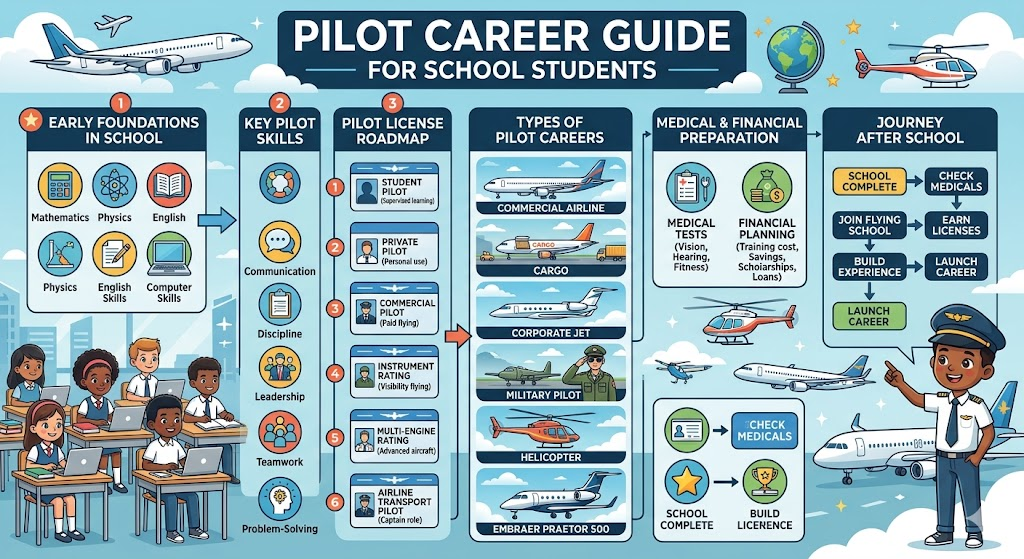
Types of Pilot Careers
There are many different pilot career options. School students should understand these options early so they can choose the right path later.
Commercial Airline Pilot
Commercial airline pilots fly passenger aircraft for airlines. This is one of the most popular career goals for aspiring pilots. Airline pilots usually start as first officers and later grow into captain roles after gaining experience.
Cargo Pilot
Cargo pilots fly aircraft that transport goods, packages, and supplies. This career is important for global trade, logistics, and emergency supply movement.
Corporate Jet Pilot
Corporate pilots fly private jets for companies, executives, business owners, and private clients. This role requires professionalism, flexibility, and excellent communication skills.
Charter Pilot
Charter pilots fly private or rented aircraft for individuals, businesses, tourists, or special travel needs. Charter flying can offer varied routes and aircraft experience.
Flight Instructor
Flight instructors teach student pilots how to fly. Many pilots begin their professional career as instructors to build flying hours and strengthen their aviation knowledge.
Military Pilot
Military pilots fly aircraft for defense forces. This path requires strict selection, strong physical fitness, discipline, and dedication to national service.
Helicopter Pilot
Helicopter pilots work in tourism, rescue services, medical transport, offshore operations, defense, and private aviation.
Rescue and Emergency Service Pilot
These pilots support emergency medical services, disaster response, rescue missions, and special operations. This career requires strong flying skills and calm decision-making.
Educational Requirements for Future Pilots
School students who want to become pilots should build a strong academic foundation. While exact requirements may vary by country and aviation authority, some subjects are especially useful for aviation careers.
Mathematics
Mathematics helps pilots understand speed, distance, fuel calculations, navigation, altitude, weight, balance, and flight planning. Students should focus on building strong basic math skills.
Physics
Physics helps students understand how aircraft fly. Concepts like force, pressure, motion, lift, drag, thrust, and gravity are closely connected to aviation.
English
English is very important in aviation because pilots communicate with air traffic control, crew members, and aviation authorities using clear language. Good English improves safety and confidence.
Computer Knowledge
Modern aircraft use advanced digital systems. Basic computer literacy helps students understand aviation technology, flight planning tools, simulators, and navigation systems.
General Science
Science develops logical thinking and helps students understand weather, aircraft systems, and aviation safety basics.
Is a College Degree Required?
A college degree may not always be mandatory for every pilot career, but it can be useful. Some airlines prefer candidates with higher education. A degree in aviation, science, engineering, or management can provide extra career flexibility.
Skills Every Student Pilot Should Develop
A successful pilot needs both technical and personal skills. School students can start developing these skills early.
Communication Skills
Pilots must speak clearly and listen carefully. Miscommunication in aviation can create safety risks, so strong communication is essential.
Discipline
Aviation is built on rules, procedures, timing, and responsibility. Students who develop discipline early will find pilot training easier.
Leadership
Pilots must take responsibility and guide teams during normal and challenging situations. Leadership skills are important even for junior pilots.
Teamwork
Pilots work with co-pilots, cabin crew, engineers, ground staff, and air traffic controllers. Teamwork keeps flights safe and smooth.
Problem-Solving
Weather changes, technical issues, route changes, and operational challenges require quick and logical problem-solving.
Situational Awareness
Pilots must always know what is happening around them, including aircraft position, weather, instruments, traffic, and instructions.
Time Management
Pilot training includes classes, flying practice, exams, and self-study. Good time management helps students progress faster.
Confidence and Calmness
Pilots must stay calm under pressure. Confidence grows through preparation, practice, and knowledge.
Pilot License Roadmap
Pilot training is completed step by step. Each license or rating gives a pilot more knowledge and flying privileges.
Student Pilot License
This is often the first stage of pilot training. It allows beginners to start learning how to fly under supervision.
Private Pilot License
A Private Pilot License allows a person to fly an aircraft for personal use. It is not meant for paid commercial flying, but it builds strong basic flying skills.
Commercial Pilot License
A Commercial Pilot License allows a pilot to fly professionally and earn money as a pilot. This is a major milestone for students who want aviation as a career.
Instrument Rating
Instrument Rating trains pilots to fly using cockpit instruments, especially in low visibility or difficult weather conditions.
Multi-Engine Rating
This rating allows pilots to fly aircraft with more than one engine. It is important for airline, cargo, charter, and corporate aviation.
Airline Transport Pilot License
This is one of the highest levels of pilot certification. It is usually required for senior airline roles such as captain.
Medical Requirements for Pilots
Medical fitness is very important in aviation. Students should learn about medical requirements early because pilots must meet strict health standards.
Common medical checks may include:
- Vision test
- Hearing test
- General physical fitness
- Heart health
- Mental fitness
- Medical history review
- Neurological health check
Students should not ignore medical eligibility. It is better to complete an aviation medical check early before spending a large amount of money on training.
Pilot Training Journey After School
Here is a simple roadmap for school students who want to become pilots:
1- Complete school education with focus on mathematics, physics, English, and science.
2- Research pilot career paths and understand different aviation roles.
3- Check aviation medical eligibility through an approved medical examiner.
4- Compare flying schools and understand training costs.
5- Join a recognized flying school or aviation training program.
6- Complete ground school and flight training.
7- Earn required licenses and ratings.
8- Build flying hours through approved flying opportunities.
9- Apply for entry-level pilot jobs, instructor roles, charter jobs, or airline cadet programs.
10- Continue gaining experience and progress toward airline or advanced pilot roles.
Financial Planning for Pilot Training
Pilot training can be expensive, so students and parents should start financial planning early. Costs may include flying school fees, aircraft rental, simulator sessions, exams, uniforms, books, medical tests, travel, accommodation, and license fees.
Ways to plan financially include:
- Research total training cost early
- Compare different flying schools
- Look for scholarships
- Explore education loans
- Create a savings plan
- Avoid unnecessary delays during training
- Prepare well before each flying lesson
- Understand hidden or extra costs
Good financial planning can reduce stress and help students complete training smoothly.
Activities School Students Can Start Today
School students do not need to wait until graduation to begin preparing for aviation. They can start small and build interest gradually.
Helpful activities include:
- Reading aviation books
- Watching educational aviation videos
- Using flight simulator software
- Visiting airports when possible
- Attending airshows
- Joining aviation clubs
- Learning about aircraft types
- Improving English communication
- Studying basic weather concepts
- Talking to pilots or aviation mentors
- Following aviation news
- Practicing discipline and time management
These activities help students understand aviation better and confirm whether they truly want this career.
Common Mistakes Future Pilots Should Avoid
Many students dream of becoming pilots but make mistakes due to lack of guidance.
Common mistakes include:
- Ignoring medical requirements
- Not focusing on studies
- Weak English communication
- Choosing a flying school without research
- Underestimating training costs
- Thinking passion alone is enough
- Not developing discipline
- Delaying career planning
- Not learning about different pilot careers
- Expecting instant airline jobs after training
Avoiding these mistakes can make the pilot journey smoother and more successful.
Expert Advice for School Students
If you are a school student dreaming of becoming a pilot, start with awareness and preparation. You do not need to know everything immediately, but you should begin learning step by step.
Focus on your studies, especially mathematics, physics, and English. Stay physically fit, build confidence, and develop discipline. Learn about aircraft, airports, and aviation careers. Speak with experienced pilots if possible. Most importantly, understand that becoming a pilot takes time, patience, and commitment.
Your school years are the perfect time to build the habits that future pilots need.
Frequently Asked Questions
1- Can I become a pilot directly after school?
Yes, in many cases students can begin pilot training after completing school education, depending on the country and aviation authority requirements. You may need to meet minimum age, education, and medical standards before starting formal training.
2- What subjects are important for pilots?
Mathematics, physics, English, and science are very useful for future pilots. These subjects help with navigation, flight planning, aircraft performance, communication, and understanding basic aviation principles.
3- What age can I start pilot training?
The starting age depends on local aviation rules and the type of license. However, students can begin preparing much earlier by studying aviation basics, improving English, using simulators, and learning about pilot career paths.
4- Is mathematics compulsory for pilots?
Mathematics is highly important for pilots because flying involves calculations related to speed, distance, fuel, altitude, time, and navigation. Even where rules vary, strong math skills are always useful in aviation.
5- How long does pilot training take?
The duration depends on the training program, weather, flying school availability, exam progress, and student performance. Some students complete training faster, while others may take longer due to financial, academic, or scheduling reasons.
6- How expensive is pilot training?
Pilot training cost varies based on country, flying school, aircraft type, number of flying hours, license requirements, and additional ratings. Students should always request a full cost breakdown before selecting a training program.
7- Can girls become commercial pilots?
Yes, girls can absolutely become commercial pilots. Aviation careers are open to capable and qualified candidates regardless of gender. Many women successfully work as airline pilots, military pilots, instructors, and aviation leaders.
8- What medical tests do pilots take?
Pilot medical tests usually check vision, hearing, physical fitness, heart health, mental fitness, and general medical history. The exact process depends on aviation authority rules, so early medical assessment is recommended.
9- Is a college degree required to become a pilot?
A college degree may not be required for every pilot role, but it can be beneficial. Some airlines may prefer degree holders, and higher education can also provide backup career options in aviation or related industries.
10- What should school students do right now to prepare?
Students should focus on studies, improve English, learn aviation basics, maintain fitness, explore pilot career paths, research training options, and develop discipline. Starting early helps students make better decisions later.
Conclusion
A pilot career is exciting, respected, and full of opportunities, but it requires serious preparation. School students who start early can build the right academic foundation, understand medical and licensing requirements, develop important skills, and prepare financially for training. Becoming a pilot is not only about flying an aircraft; it is about responsibility, discipline, teamwork, and lifelong learning. If you are a student dreaming of the cockpit, begin with small steps today. Study well, stay curious, improve your communication, learn about aviation, and keep your goal clear. With the right planning and dedication, your dream of becoming a pilot can become a real and successful career.
