
Introduction
A pilot career is one of the most respected and rewarding professions in the world, combining technical expertise, responsibility, and the thrill of aviation. For college students, this career path offers a unique opportunity to start early, build strong foundations, and strategically plan a future in both national and international aviation sectors.
The aviation industry continues to grow with increasing demand for commercial travel, cargo transport, and private aviation services. This creates strong long-term opportunities for aspiring pilots who begin their preparation during college years.
Starting early gives students a clear advantage in understanding eligibility requirements, developing essential skills, and planning the financial and training roadmap required to become a licensed pilot.
Why College Students Should Consider Aviation Early
Choosing aviation during college years is not just about career interest—it is about strategic timing.
Early Planning Advantage
Students who begin exploring aviation in college can align their academic path, medical requirements, and training decisions early, avoiding delays later.
Skill Development Window
College years are ideal for developing communication, mathematics, physics understanding, and decision-making abilities required in aviation.
Cost and Time Efficiency
Early awareness helps students plan finances better and avoid unnecessary training changes or delays.
Eligibility Basics for Becoming a Pilot
Before entering pilot training, students must understand the basic eligibility requirements.
Education Requirements
- Completion of 10+2 education is typically required
- Physics and Mathematics are highly recommended subjects
- Graduation is not mandatory but beneficial for career flexibility
Age Considerations
- Students can start training as early as 17–18 years
- Commercial pilot licensing generally requires adulthood completion
Medical Fitness
Aviation requires strict medical fitness standards:
- Good vision (correctable in many cases)
- Normal hearing ability
- No major chronic illnesses affecting performance
Communication Skills
- Strong English communication is essential
- Aviation communication follows international standards
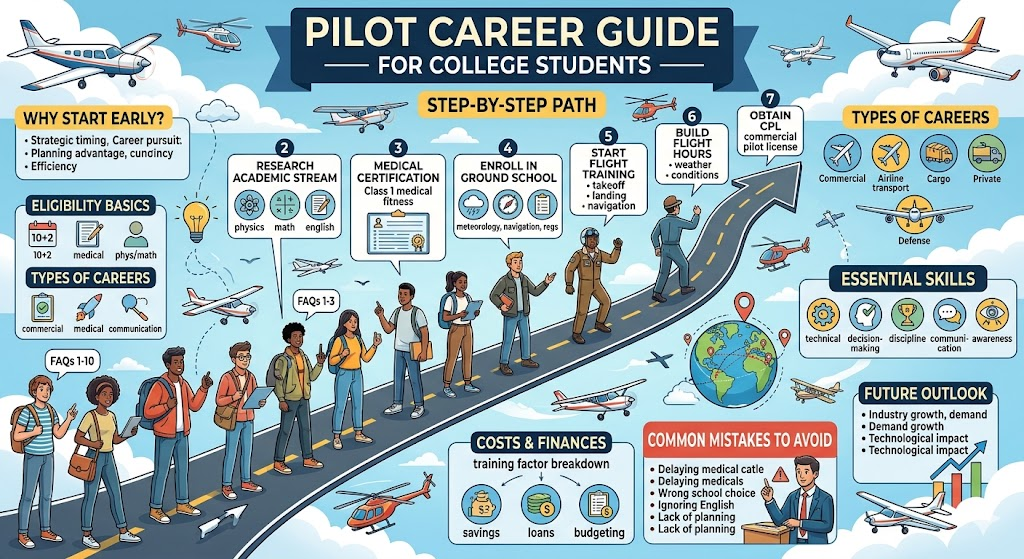
Step-by-Step Pilot Career Path for College Students
Becoming a pilot involves a structured training process. College students can follow this roadmap:
Step 1: Choose the Right Academic Stream
- Science stream with Physics and Mathematics is preferred
- Focus on logical reasoning and technical subjects
Step 2: Research Flying Schools and Training Options
- Understand different types of pilot training academies
- Compare training structure, aircraft availability, and instructor quality
Step 3: Medical Certification
- Obtain Class 1 medical fitness certification
- This ensures eligibility for commercial pilot training
Step 4: Enroll in Ground School Training
- Learn aviation theory subjects such as:
- Air navigation
- Meteorology
- Aircraft systems
- Aviation regulations
Step 5: Start Flight Training
- Begin practical flying lessons
- Learn takeoff, landing, navigation, and emergency handling
Step 6: Build Flight Hours
- Complete required flying hours for licensing
- Gain experience in different weather and flight conditions
Step 7: Obtain Commercial Pilot License (CPL)
- Final certification allowing you to work professionally as a pilot
Types of Pilot Careers
Aviation offers multiple career paths depending on interest and specialization.
Commercial Pilot
Operates passenger aircraft for airlines and charter services.
Airline Transport Pilot
Advanced level pilots responsible for operating large aircraft and long-haul flights.
Cargo Pilot
Focuses on transporting goods and logistics operations globally.
Private Pilot
Flies private aircraft for individuals or corporate use.
Defense Aviation
Military pilots serving air force or defense aviation units.
Skills Required for Future Pilots
A successful pilot must develop a combination of technical and personal skills.
Technical Knowledge
Understanding aircraft systems, navigation, and aviation rules.
Decision-Making Skills
Ability to make quick and accurate decisions under pressure.
Situational Awareness
Monitoring surroundings, weather, and flight conditions continuously.
Discipline and Responsibility
Strict adherence to procedures and safety regulations.
Communication Skills
Clear communication with air traffic control and crew members.
Costs and Financial Planning Overview
Pilot training requires significant financial planning.
Training Cost Factors
- Flight hours required
- Type of aircraft used for training
- Simulator usage
- Ground school fees
Financial Planning Tips
- Start saving early during college
- Explore educational loans
- Research scholarship opportunities in aviation institutions
Budget Mindset
Students should treat pilot training as a long-term investment in a high-value career.
Common Mistakes Students Should Avoid
Many students face delays due to avoidable mistakes:
Delaying Medical Checkups
Medical fitness should be checked early before investing in training.
Choosing Wrong Training Institutes
Lack of research may lead to poor-quality training.
Ignoring English Proficiency
Communication is critical in aviation safety.
Lack of Financial Planning
Unexpected costs can delay training completion.
Not Understanding Career Path
Students should clearly understand licensing stages before starting.
Career Opportunities After Training
Once licensed, pilots can explore multiple job opportunities.
Airlines
Commercial airlines are the most common career destination.
Charter Companies
Private jet operations offer flexible flying opportunities.
International Aviation Jobs
Experienced pilots can work globally depending on licensing.
Growth Timeline
- Entry-level copilots
- Senior first officers
- Captain roles with experience
10. Future of Aviation Industry
The aviation industry is evolving rapidly with new technologies.
Technology Impact
Advanced aircraft systems are improving safety and efficiency.
Automation in Aviation
While automation supports flying, human pilots remain essential for decision-making.
Long-Term Demand
Global air travel continues to expand, ensuring strong demand for skilled pilots.
FAQs
1. Can college students start pilot training immediately?
Yes, students can begin ground school and medical preparation during college and start flying training after meeting eligibility requirements.
2. Is science mandatory to become a pilot?
Physics and Mathematics are strongly recommended, but requirements may vary depending on training institutions.
3. How long does pilot training take?
Typically, it takes 18 months to 3 years depending on training pace and flight hours completion.
4. What is the minimum age to become a pilot?
Students can start training in late teens, but licensing requires meeting minimum age standards.
5. Is pilot training very expensive?
Yes, it requires significant investment due to flight training, simulator use, and licensing costs.
6. Can pilots work internationally?
Yes, with proper licensing conversion and experience, pilots can work in different countries.
7. Do pilots need perfect eyesight?
Perfect eyesight is not always required, but medical fitness standards must be met.
8. Is English mandatory for pilots?
Yes, English is the global aviation language for communication and safety.
9. What are the job opportunities after CPL?
Pilots can join airlines, charter companies, cargo operations, or private aviation services.
10. Is pilot a stable career option?
Yes, aviation continues to grow globally, making it a strong long-term career option.
Conclusion
A pilot career is a powerful and rewarding journey that requires early planning, dedication, and structured training. For college students, this is the ideal stage to explore aviation, build foundational skills, and prepare for professional licensing.
With the right guidance, financial planning, and commitment, students can successfully transition from classrooms to cockpits. The aviation industry offers not only global opportunities but also long-term career growth and stability.
Starting early is the key advantage—those who plan today can confidently fly into a successful aviation future tomorrow.
