
Introduction
Becoming a pilot is a structured journey that begins with understanding the flying school admission process. Many students are excited about flying careers but feel confused about eligibility, documentation, medical requirements, and selection steps. A lack of clarity often leads to delays or wrong school choices.
This guide from bestpilotsschool.com explains the complete flying school admission process in a clear, practical, and step-by-step manner so you can confidently begin your aviation journey.
Why Understanding the Admission Process Matters
The flying school admission process is more structured than typical college admissions because it involves aviation safety standards, medical fitness, and regulatory approvals.
Understanding it helps you:
- Avoid unnecessary delays in admission
- Prepare documents in advance
- Meet medical requirements early
- Choose a properly approved flying school
- Reduce financial and time-related risks
A clear process ensures a smooth and stress-free start to pilot training.
Eligibility Criteria for Flying School Admission
Before applying, you must meet basic eligibility requirements set by aviation authorities and flying schools.
1. Educational Qualification
Most flying schools require:
- Completion of 10+2 or equivalent education
- Physics and Mathematics (mandatory in many regions)
- Basic English communication skills
2. Age Requirements
- Minimum age is usually 17 to 18 years
- No strict upper age limit for training, but airline requirements may vary
3. Medical Fitness Requirements
Medical fitness is a mandatory part of admission.
You must clear:
- DGCA Class 1 medical (India) or FAA/EASA medical standards
- Vision and hearing tests
- Physical and mental fitness evaluation
Without medical clearance, admission cannot proceed.
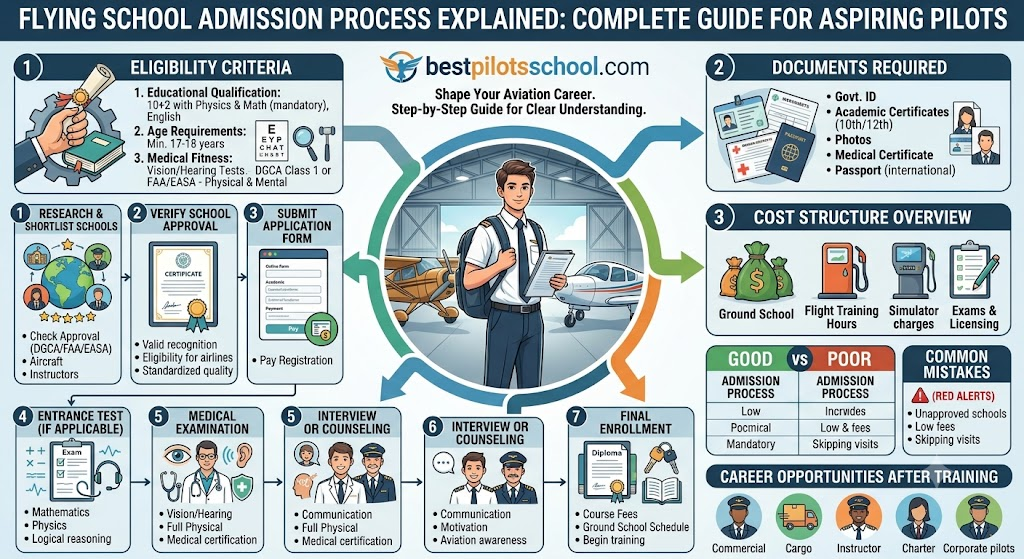
Step-by-Step Flying School Admission Process
Below is the complete pilot training admission process explained step by step.
Step 1: Research and Shortlist Flying Schools
Start by identifying multiple flying schools based on:
- Regulatory approval (DGCA/FAA/EASA)
- Safety record
- Aircraft quality
- Instructor experience
- Student feedback
Shortlisting helps you compare options effectively.
Step 2: Verify School Approval
Ensure the school is officially approved by aviation authorities.
This guarantees:
- Valid license recognition
- Standardized training quality
- Eligibility for airline careers
Step 3: Submit Application Form
After selecting a school:
- Fill the admission form
- Provide personal and academic details
- Pay registration fee if required
Step 4: Entrance Test (If Applicable)
Some flying schools conduct entrance exams covering:
- Basic mathematics
- Physics fundamentals
- English proficiency
- Logical reasoning
This ensures academic readiness for aviation training.
Step 5: Medical Examination
Medical clearance is essential before training begins.
It includes:
- Vision and color blindness tests
- Hearing tests
- Full physical examination
- Aviation medical certification approval
Step 6: Interview or Counseling
Some schools conduct interviews to evaluate:
- Communication skills
- Motivation for aviation career
- Basic aviation awareness
This helps assess student suitability.
Step 7: Final Enrollment
After completing all steps:
- Submit remaining documents
- Pay course fees
- Receive training schedule
- Begin ground school training
Documents Required for Admission
Keep the following documents ready:
- Government-issued ID proof (Aadhaar, Passport, etc.)
- Academic certificates (10th and 12th mark sheets)
- Passport-sized photographs
- Medical fitness certificate
- Passport (if required for international training)
Cost Structure Overview
Pilot training is a major investment, so understanding costs is essential.
Common cost components:
- Ground school training fees
- Flight training hours
- Simulator training charges
- Examination and licensing fees
- Fuel and operational costs
Always ask for a complete fee breakdown before admission.
Comparison: Good vs Poor Admission Process
| Factor | Good Flying School | Poor Flying School |
|---|---|---|
| Admission Steps | Clear and structured | Confusing and unclear |
| Fee Transparency | Fully disclosed | Hidden charges present |
| Medical Guidance | Proper support provided | No proper guidance |
| Documentation | Organized process | Poor communication |
| Student Support | Active assistance | Minimal support |
Common Mistakes During Admission Process
Avoid these mistakes when applying:
- Choosing a school without checking approval
- Ignoring medical requirements early
- Selecting based only on low fees
- Not preparing documents in advance
- Skipping campus visits
These errors can delay your pilot training journey.
Career Opportunities After Training
After completing training, multiple aviation career paths open up:
- Commercial Airline Pilot
- Cargo Pilot
- Flight Instructor
- Charter Pilot
- Corporate Pilot
A proper admission process leads to a strong aviation foundation.
FAQs: Flying School Admission Process Explained
1. What is the first step in the flying school admission process?
The first step is researching and shortlisting approved flying schools based on certification, safety, and training quality.
2. Is medical fitness required for admission?
Yes, medical fitness is mandatory. Without DGCA, FAA, or EASA medical clearance, you cannot proceed with training.
3. Do all flying schools conduct entrance exams?
No, not all schools conduct entrance exams. Some only require basic eligibility and medical clearance.
4. What qualification is required for admission?
Most schools require 10+2 education with Physics and Mathematics along with basic English proficiency.
5. How long does the admission process take?
It usually takes a few weeks depending on documentation, medical approval, and school procedures.
6. Can I apply without a passport?
Yes, you can apply without a passport for local training, but it is required for international licensing or training.
7. Is the admission process the same everywhere?
No, it varies depending on aviation authorities like DGCA, FAA, or EASA.
8. What happens after final admission?
You begin ground school training followed by simulator and flight training phases.
9. Can I switch flying schools after admission?
Yes, but it may involve documentation transfer and additional costs depending on regulations.
10. What is the biggest mistake during admission?
The biggest mistake is choosing a school without verifying approval, safety standards, and total training costs.
Conclusion
The flying school admission process is the foundation of your aviation career. Understanding each step helps you avoid confusion, reduce delays, and choose the right training institute with confidence. From eligibility checks and medical tests to final enrollment, every stage plays an important role in shaping your future as a pilot.
A well-planned admission decision ensures smooth training progress and better career opportunities in aviation. Take your time, research carefully, and choose a certified flying school that aligns with your long-term goals.
Your journey to the skies begins with the right admission decision, so choose wisely and move forward with confidence.
