
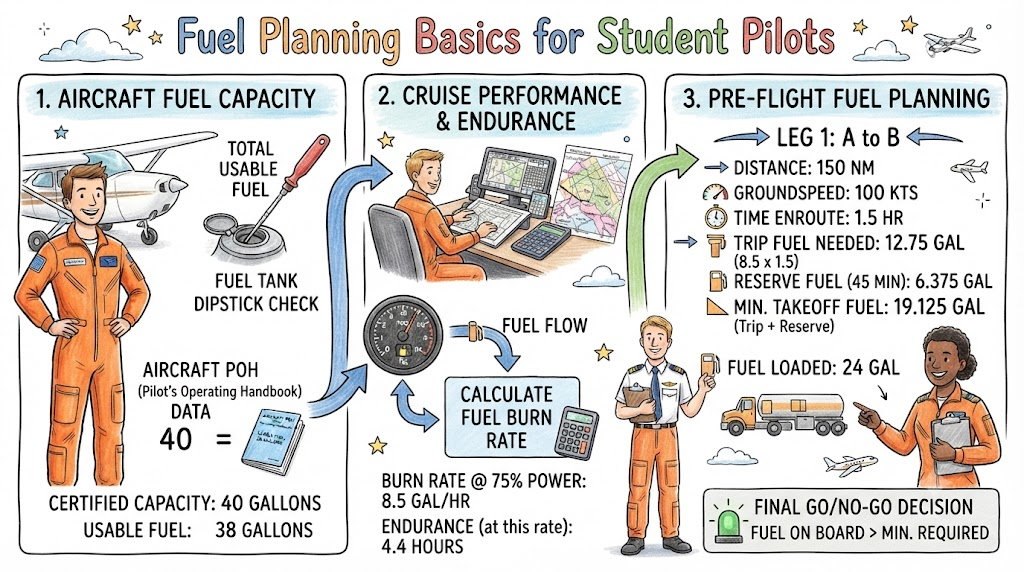
Introduction
Fuel planning is one of the most important habits every student pilot must learn early in training. A flight may look simple on paper, but fuel use can change because of wind, weather, taxi delays, route changes, holding, aircraft weight, and pilot technique.
Fuel Planning Basics for Student Pilots means understanding how much fuel is needed before flight, how much reserve should remain, and how to monitor fuel during the flight. It is not just a calculation. It is a safety decision.
A good pilot does not ask, “Do I have enough fuel to reach?” A good pilot asks, “Do I have enough fuel to reach safely, manage changes, and still land with required reserve?”
What Is Fuel Planning in Aviation?
Fuel planning is the process of estimating how much fuel an aircraft needs for a planned flight. It includes fuel for engine start, taxi, takeoff, climb, cruise, descent, approach, landing, possible diversion, and reserve.
For student pilots, fuel planning teaches three important things:
- How long the aircraft can safely fly
- How much fuel the aircraft will burn
- How much extra fuel must remain for safety
Fuel planning should always consider wind and weather. FAA fuel rules, for example, specifically include wind and forecast weather when calculating fuel requirements for VFR flight.
Why Student Pilots Must Learn Fuel Planning
Student pilots must learn fuel planning because fuel is directly connected to flight safety. Running low on fuel is not a small mistake. It can quickly become an emergency.
Fuel planning helps students understand:
- Safe pre-flight preparation
- Cross-country flight planning
- Weather and wind impact
- Aircraft performance limits
- Diversion planning
- Fuel reserve requirements
- In-flight decision-making
A student pilot who understands fuel planning becomes more disciplined, confident, and safety-minded.
Basic Fuel Terms Student Pilots Should Know
Before learning calculations, students should understand common fuel terms.
| Term | Simple Meaning |
|---|---|
| Usable Fuel | Fuel that can be safely used by the engine |
| Unusable Fuel | Fuel that remains in the tank but cannot be used safely |
| Fuel Burn | Amount of fuel used during a period of flight |
| Fuel Flow | Rate at which the engine uses fuel, often shown per hour |
| Reserve Fuel | Extra fuel required or planned for safety |
| Endurance | How long the aircraft can fly with available fuel |
| Range | How far the aircraft can fly with available fuel |
| Alternate Fuel | Fuel needed to fly to another airport if required |
| Contingency Fuel | Extra fuel for delays, weather, routing, or unexpected changes |
The aircraft Pilot’s Operating Handbook, or POH, is one of the most important sources for aircraft-specific fuel and performance information. FAA safety guidance also recommends using the POH and tracking real fuel consumption from past flights.
Main Parts of Fuel Planning
Fuel planning is easier when students divide it into parts.
Fuel for Engine Start and Taxi
Fuel is used even before takeoff. Engine start, warm-up, ground movement, and waiting at the holding point can all consume fuel.
Student pilots sometimes forget taxi fuel, especially during short training flights. This is a common beginner mistake.
Fuel for Takeoff and Climb
The engine usually uses more fuel during takeoff and climb because higher power is required. Climb fuel depends on aircraft weight, climb rate, temperature, altitude, and engine settings.
Fuel for Cruise
Cruise fuel is the fuel used during the main part of the flight. It is usually calculated using expected cruise time and fuel burn rate.
Fuel for Descent and Approach
Descent may use less fuel than climb, but it still must be included. Approach and circuit time can also increase fuel use, especially at busy airports.
Fuel for Alternate Airport
If the weather becomes unsuitable, the runway closes, or the flight cannot land at the planned airport, the pilot may need to divert. Alternate fuel gives the pilot more options.
Final Reserve Fuel
Reserve fuel is the minimum fuel that should remain for safety, based on applicable rules and operating procedures. Reserve requirements are not the same everywhere. They depend on aviation authority rules, aircraft type, flight category, and operation type.
For example, FAA VFR airplane rules include different reserve expectations for day and night conditions, while FAA IFR rules include fuel to reach the destination, then the alternate if required, plus additional reserve time.
Simple Fuel Planning Example for Beginners
Let us take a simple educational example.
A student pilot is planning a short training flight. The aircraft burns around 8 gallons per hour during cruise. The planned flight time is 1.5 hours.
Basic cruise fuel estimate:
8 gallons per hour × 1.5 hours = 12 gallons
Now the student must also think about:
- Taxi fuel
- Climb fuel
- Approach and landing fuel
- Weather changes
- Possible delay
- Required reserve fuel
- Extra safety margin
So, the pilot should not plan with only 12 gallons. The pilot must calculate total fuel based on aircraft data, instructor guidance, school procedures, and local aviation rules.
This example is only for learning. Real fuel planning must always use actual aircraft performance data.
Factors That Affect Fuel Consumption
Fuel burn is not fixed for every flight. It changes based on many conditions.
Aircraft Type
Different aircraft burn fuel at different rates. A small trainer aircraft will not use fuel like a larger twin-engine aircraft.
Engine Power Setting
Higher power settings usually increase fuel burn. Takeoff and climb often use more fuel than cruise.
Aircraft Weight
A heavier aircraft may need more power, especially during climb. More power can mean more fuel use.
Wind Direction and Speed
A headwind increases flight time and fuel use. A tailwind may reduce flight time and fuel use.
This is why pilots must study weather carefully before flight.
Flight Altitude
Fuel burn and aircraft performance can change with altitude. Student pilots should use the POH performance charts and instructor guidance.
Weather Conditions
Turbulence, storms, high temperature, and poor visibility can affect route planning and fuel decisions.
Route Distance
Longer routes need more fuel. But students should also consider indirect routing, airspace restrictions, and possible diversions.
Holding or Delay
Busy airports, traffic, or weather can cause delays. Good fuel planning includes a safety margin for such situations.
Fuel Reserve Rules and Safety Margin
Fuel reserve is extra fuel kept for safety. It is not fuel to be used casually. It gives the pilot time and options when things do not go exactly as planned.
Student pilots should remember:
- Legal minimum fuel may not always be the safest practical fuel.
- Reserve rules differ by country and flight type.
- Flight schools may have stricter fuel policies.
- Instructors may require extra margin for training flights.
- Weather and traffic may require more conservative planning.
A safe pilot plans fuel with discipline, not optimism.
Fuel Planning for Cross-Country Flights
Cross-country flights need more careful fuel planning than local training flights. During cross-country flying, the aircraft covers longer distance, passes through different areas, and may face changing weather.
Student pilots should check:
- Total route distance
- Expected ground speed
- Wind correction
- Checkpoints
- Alternate airports
- Fuel availability at destination
- Airspace restrictions
- Weather at departure, route, destination, and alternate
- Daylight and operating limitations
- Aircraft performance data
Cross-country fuel planning also helps students learn time management. A pilot should compare planned fuel burn with actual fuel burn during flight.
How Weather Affects Fuel Planning
Weather can change fuel needs significantly. A strong headwind can make the aircraft take longer to reach the destination. Longer flight time means more fuel burn.
Headwind
A headwind slows ground speed. The aircraft may be moving through the air normally, but it covers ground more slowly.
Tailwind
A tailwind improves ground speed and may reduce flight time. However, pilots should not depend on perfect forecast conditions.
Temperature
Hot weather can affect aircraft performance. It may increase takeoff distance and reduce climb performance.
Turbulence
Turbulence can affect altitude, speed, comfort, and route planning. Pilots may need to change altitude or route.
Unexpected Weather
Weather can force a pilot to divert, hold, or return. Extra fuel gives more safe choices.
Common Fuel Planning Mistakes Student Pilots Make
Student pilots often make mistakes because fuel planning looks simple at first. In reality, it needs careful thinking.
Common mistakes include:
- Forgetting taxi fuel
- Using wrong fuel burn numbers
- Ignoring headwind
- Not checking weather properly
- Depending only on fuel gauges
- Not visually checking fuel quantity when required
- Forgetting alternate fuel
- Not planning for delays
- Confusing usable and total fuel
- Not monitoring fuel during flight
- Taking off with “just enough” fuel
- Not asking the instructor when unsure
Fuel planning mistakes are preventable when students follow a checklist-based approach.
Best Practices for Safe Fuel Planning
Good fuel planning is a habit. Student pilots should build this habit from the first stage of training.
Best practices include:
- Use the aircraft POH
- Follow instructor guidance
- Follow flight school SOPs
- Check local aviation authority rules
- Use current weather data
- Calculate with realistic fuel burn
- Include taxi, climb, cruise, descent, and reserve
- Plan alternate airports when needed
- Keep extra safety margin
- Check fuel quantity before flight
- Monitor fuel during flight
- Record fuel use after training flights
FAA safety guidance also recommends calculating flight time from start-up to shutdown, not just airborne time.
Fuel Monitoring During Flight
Fuel planning does not end after takeoff. A pilot must continue monitoring fuel during the flight.
During flight, student pilots should compare:
- Planned time vs actual time
- Planned fuel burn vs actual fuel burn
- Expected position vs actual position
- Weather forecast vs real conditions
- Remaining fuel vs required fuel
If the aircraft is burning more fuel than expected, the pilot must make an early decision. Waiting too long can reduce safe options.
Good fuel monitoring includes regular time checks, fuel checks, and navigation cross-checks.
Role of Aircraft POH in Fuel Planning
The POH stands for Pilot’s Operating Handbook. It contains important aircraft-specific information. Student pilots should treat the POH as a primary reference for performance planning.
The POH may include:
- Fuel capacity
- Usable fuel
- Fuel burn data
- Climb performance
- Cruise performance
- Range and endurance data
- Weight and balance information
- Operating limitations
A student pilot should not use random fuel numbers from memory or another aircraft. Even aircraft of the same general type may have differences.
Real-World Student Pilot Example
Imagine a student pilot planning a short cross-country training flight with an instructor. The route looks simple, and the weather seems clear. At first, the student calculates only the direct flight time and cruise fuel.
The instructor then asks important questions:
- What about taxi time?
- What if there is a headwind?
- What if the destination airport becomes busy?
- What is the nearest suitable alternate?
- How much fuel must remain at landing?
- What does the POH say?
The student updates the fuel plan, adds proper reserve, checks weather again, and marks alternate airports on the chart. During the flight, the student compares planned time with actual time.
This is how fuel planning becomes real learning. It teaches safety, discipline, and decision-making.
Safety Note for Student Pilots
This article is for educational understanding only. It does not replace official aviation regulations, aircraft manuals, instructor guidance, flight school SOPs, or approved training material.
Fuel planning must always be done using the correct aircraft data, current weather, applicable aviation authority rules, and guidance from a qualified flight instructor.
FAQs
1. What is fuel planning in aviation?
Fuel planning is the process of calculating how much fuel an aircraft needs for a flight. It includes fuel for taxi, takeoff, climb, cruise, descent, landing, alternate planning, and reserve.
2. Why is fuel planning important for student pilots?
Fuel planning is important because it directly affects flight safety. It helps student pilots avoid fuel shortage, plan safer routes, manage weather changes, and make better decisions.
3. What is fuel reserve?
Fuel reserve is extra fuel kept for safety. It allows the pilot to manage delays, diversions, weather changes, and other unexpected situations.
4. What is fuel burn?
Fuel burn is the amount of fuel an aircraft uses over time. It is often measured per hour and depends on aircraft type, power setting, weight, altitude, and weather.
5. How does wind affect fuel planning?
A headwind can increase flight time and fuel use, while a tailwind can reduce flight time. Pilots must include wind correction when planning fuel.
6. Should pilots trust fuel gauges only?
No. Fuel gauges are useful, but pilots should also visually check fuel when required, use POH data, calculate expected fuel burn, and monitor fuel during flight.
7. What is alternate fuel?
Alternate fuel is fuel planned to fly to another suitable airport if landing at the planned destination is not possible.
8. What is endurance in aviation?
Endurance means how long an aircraft can remain flying with available fuel. It is based on usable fuel and fuel burn rate.
9. How can student pilots improve fuel planning?
Student pilots can improve by practicing calculations, using the POH, checking weather, learning from instructors, tracking actual fuel burn, and reviewing each flight.
10. Does fuel planning change for cross-country flights?
Yes. Cross-country flights need more detailed fuel planning because they involve longer routes, changing weather, checkpoints, alternate airports, and more decision-making.
Conclusion
Fuel Planning Basics for Student Pilots is one of the most important topics in early pilot training. It teaches students how to think ahead, calculate carefully, respect aircraft limits, and make safe decisions.
Fuel planning is not only about reaching the destination. It is about reaching safely, handling changes, and landing with required fuel reserve. Student pilots should practice fuel planning regularly with their instructors and review every flight to improve accuracy.
For beginners, the best approach is simple: use the POH, check weather, calculate carefully, keep safe margins, monitor fuel during flight, and never hesitate to ask for guidance. BestPilotsSchool.com can be a helpful learning resource for students who want clear and beginner-friendly pilot training knowledge.
