
Introduction
Stall training can feel uncomfortable during the early stages of flight instruction. The stall warning activates, the controls become less responsive, and the aircraft may suddenly lower its nose or drop a wing. Although these sensations can initially surprise a beginner pilot, controlled stall training is designed to build recognition, confidence, and the correct recovery response.
A stall is not simply an aircraft flying too slowly. It happens when the wing exceeds its critical angle of attack and can no longer produce enough lift in the normal way. Because this can happen at different airspeeds, attitudes, configurations, and power settings, pilots must learn to recognize the warning signs rather than depend on one airspeed value.
This guide explains the basic principles of stall recognition, prevention, and recovery. All practical stall exercises must be conducted with a qualified flight instructor, at a safe altitude, and according to the aircraft’s Pilot’s Operating Handbook or approved flight manual.
What Is an Aircraft Stall?
An aircraft stall occurs when airflow over the wing becomes disturbed after the wing exceeds its critical angle of attack. As the airflow separates from the upper surface, lift decreases and drag increases.
The angle of attack, commonly called AOA, is the angle between the wing’s chord line and the relative airflow. When the critical angle is exceeded, the wing stalls.
A stall can occur:
- At high or low airspeed
- With power on or power off
- In level flight or a turn
- During a climb, descent, approach, or go-around
- In any aircraft attitude
Published stall speeds normally refer to a particular aircraft weight, configuration, centre of gravity, and one-G flight condition. They should not be treated as fixed stall boundaries for every situation.
Why Stall Recovery Training Matters
Stall recovery training teaches pilots to identify situations that may lead to a loss of control. It also develops the habit of responding immediately and correctly.
The purpose of the training is not simply to recover after the aircraft stalls. A more important goal is to recognise the developing condition early enough to prevent the full stall.
Effective training helps beginner pilots develop:
- Better angle-of-attack awareness
- Improved aircraft coordination
- Faster recognition of warning signs
- Greater confidence during slow flight
- Better power and pitch management
- Safer decision-making near the ground
- Protection against secondary stalls and spins
EASA guidance identifies stall and spin awareness as an important part of preventing loss of control in light aircraft.
Common Situations That Can Lead to a Stall
A stall can develop whenever a pilot allows the angle of attack to become excessive. Beginner pilots should pay particular attention to the following situations.
Slow Approach to Landing
A pilot may allow the airspeed to decrease while trying to maintain the glide path with excessive back pressure. If the angle of attack continues to increase, the aircraft may stall close to the ground.
Base-to-Final Turn
Overshooting the runway centreline may tempt a pilot to increase bank angle, apply excessive rudder, or pull back to tighten the turn. This can create a dangerous uncoordinated condition and increase the risk of a stall or spin.
Excessively Steep Climb
A power-on stall may develop when the nose is raised too high after takeoff, during an obstacle-clearance attempt, or while performing a climbing turn.
Attempting to Stretch a Glide
After an engine failure, a pilot may instinctively raise the nose to reach a landing area. Raising the nose does not extend the glide once airspeed is already decreasing. It increases the angle of attack and can lead to a stall.
Abrupt Manoeuvring
A rapid pull-up or steep level turn increases load factor. This can raise the aircraft’s stall speed and cause a stall at an airspeed that appears higher than the published one-G stall speed.
Recognising an Approaching Stall
Pilots should learn to detect a stall through sight, sound, feel, and aircraft behaviour. Relying only on the airspeed indicator or stall warning horn can delay recognition.
Common warning signs include:
- Stall warning horn, light, or stick shaker
- Aerodynamic buffet or vibration
- Reduced airflow noise
- Decreasing airspeed
- Increasing nose-up pitch
- Poor or delayed control response
- “Mushy” flight controls
- Difficulty maintaining altitude
- Increased rudder requirement
- Uncommanded yaw, roll, or wing drop
- High angle-of-attack indication, when fitted
Some aircraft may provide strong buffet before stalling, while others may offer only subtle warning signs. Pilots must understand the specific characteristics of the aircraft they are flying.
The Most Important Stall Recovery Principle
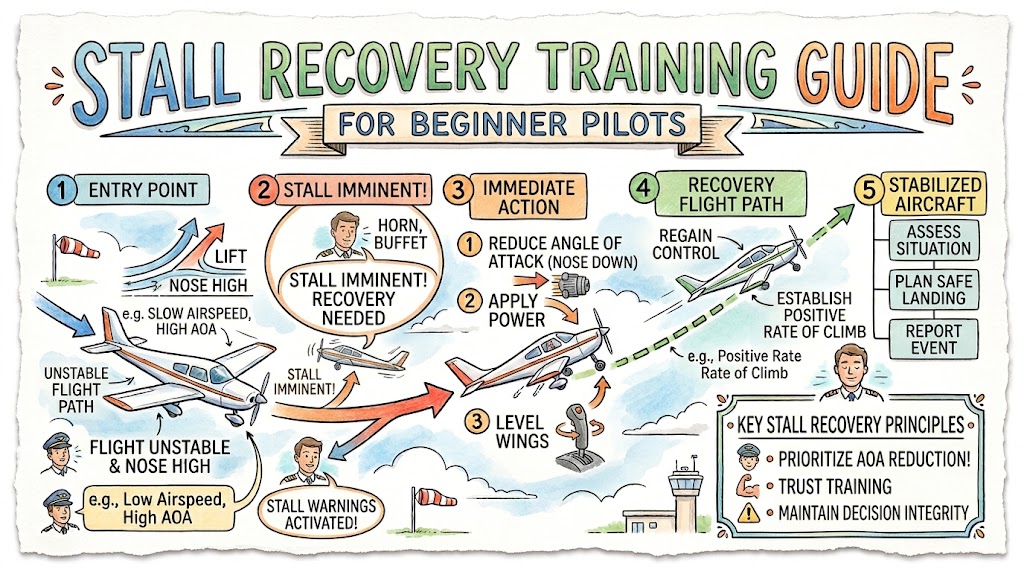
The first priority in any stall recovery is to reduce the angle of attack.
Adding power alone does not guarantee recovery. Attempting to hold altitude while the wing remains stalled can worsen the condition. The pilot must first move the controls as necessary to reduce the angle of attack below the critical value.
The amount of forward control movement required will depend on:
- Aircraft type
- Stall severity
- Power setting
- Aircraft attitude
- Configuration
- Centre of gravity
- Manufacturer guidance
The pilot does not always need to push the nose into an extremely steep descent. The objective is to reduce the angle of attack enough to remove the stall warning and restore normal airflow over the wing.
General Stall Recovery Sequence
The following sequence provides a general training framework. The aircraft manufacturer’s approved procedure always takes priority.
Recognise the Stall
Identify the warning through aircraft feel, sound, visual attitude, instruments, or the installed stall-warning system.
Do not delay recovery while trying to confirm every indication.
Reduce the Angle of Attack
Apply sufficient forward control input to reduce the angle of attack and eliminate the stall warning.
This is the essential recovery action. The wing must be allowed to fly again before the aircraft can safely return to the desired flight path.
Maintain Coordinated Flight
Use the rudder as required to control yaw and prevent the aircraft from developing a spin.
Avoid using large or abrupt aileron inputs while the wing remains stalled. An aggressive aileron input may increase the angle of attack and drag on one wing, potentially worsening the roll.
Level the Wings
Once the angle of attack is reduced and control effectiveness begins to return, level the wings using smooth and coordinated control inputs.
Apply Power as Required
Apply power smoothly according to the aircraft’s approved recovery procedure.
Power may:
- Reduce altitude loss
- Increase airflow over parts of the aircraft
- Help accelerate back to a safe flying speed
- Support the return to a climb or level flight
Pilots must anticipate yawing and pitching tendencies caused by power application, especially in propeller-driven aircraft.
Adjust the Aircraft Configuration
Retract speed brakes or spoilers when required. Adjust flaps and landing gear according to the aircraft’s operating procedure.
Do not retract all flap abruptly at low airspeed. Sudden configuration changes can reduce lift and produce another stall.
Return to the Desired Flight Path
After the stall has been broken and sufficient airspeed has been regained, return smoothly to the desired attitude.
Avoid pulling up too aggressively. Excessive back pressure during recovery can create a secondary stall.
Power-Off Stall Training
Power-off stalls are commonly used to represent situations associated with approach and landing.
During training, the aircraft may be configured with:
- Reduced or idle power
- Landing flaps
- Landing gear extended, where applicable
- A descent or approach attitude
The exercise teaches the student to recognise a developing stall during the landing phase and recover without excessive altitude loss.
The pilot should maintain coordination throughout the entry and recovery. When power is applied, yaw must be controlled with the correct rudder input.
Power-On Stall Training
Power-on stalls are used to represent situations that may occur during takeoff, departure, climb, or go-around.
The aircraft normally has:
- A higher power setting
- A nose-high attitude
- Takeoff or clean configuration
- Stronger torque and yawing tendencies
Power-on stalls can be more challenging for beginner pilots because the aircraft may yaw or roll more noticeably. Good rudder coordination is therefore essential.
The exercise should be introduced gradually and demonstrated by the instructor before the student attempts it.
Impending Stall and Full Stall Training
Impending Stall
An impending stall occurs when the aircraft produces a stall warning but has not yet fully exceeded the critical angle of attack.
The student should recover at the first clear warning by:
- Reducing the angle of attack
- Maintaining coordination
- Levelling the wings
- Applying power as needed
- Returning to the desired flight path
Full Stall
A full stall occurs after the critical angle of attack has been exceeded. The aircraft may lower its nose, roll, or become difficult to control normally.
The recovery principle remains the same: reduce the angle of attack first, maintain coordination, restore normal airflow, and return smoothly to controlled flight.
Safe Stall Training Preparation
Stall practice must begin with a complete safety briefing.
Before starting the exercise, the student and instructor should confirm:
- The aircraft is approved for the manoeuvre
- Weight and balance are within limits
- The aircraft is properly configured
- The training area is suitable
- Weather conditions are acceptable
- The area is clear of other aircraft
- Adequate altitude is available
- The recovery procedure is understood
- The transfer-of-control procedure is clear
- Engine and aircraft limitations will be respected
The FAA handbook recommends that stall training in a single-engine aeroplane be conducted at an altitude that allows recovery to be completed no lower than 1,500 feet above ground level, or higher when required by the manufacturer or operating authority. Local regulations, school procedures, and instructor requirements may demand a greater margin.
Common Mistakes During Stall Recovery
Pulling Back to Prevent Altitude Loss
A beginner may instinctively pull back when the nose drops. This maintains or increases the angle of attack and delays recovery.
Correction: Accept the initial altitude loss and reduce the angle of attack.
Applying Power Before Reducing the Angle of Attack
Power can help the recovery, but it does not replace the need to unstall the wing.
Correction: Reduce the angle of attack first, then use power as required.
Using Excessive Aileron
Trying to raise a dropped wing with aggressive aileron while stalled can worsen the roll.
Correction: Reduce the angle of attack, control yaw with rudder, and level the wings smoothly as control effectiveness returns.
Poor Rudder Coordination
Uncontrolled yaw near the stall can increase the possibility of spin entry.
Correction: Keep the aircraft coordinated and respond promptly to yaw.
Fixating on the Airspeed Indicator
The pilot may miss buffet, control changes, yaw, or external attitude cues.
Correction: Maintain an effective outside scan and cross-check the instruments.
Recovering Too Aggressively
Pulling sharply after the initial recovery can exceed the critical angle again.
Correction: Allow the aircraft to accelerate and return gradually to the desired flight path.
Retracting Flaps Too Quickly
Sudden flap retraction can reduce lift while the aircraft is still slow.
Correction: Follow the aircraft-specific flap-retraction schedule.
Practical Training Tips for Beginner Pilots
Study Before the Flight
Review the aircraft’s stall characteristics, warning systems, approved speeds, limitations, and recovery procedure.
Practise the Control Sequence on the Ground
Use a cockpit trainer or stationary aircraft to rehearse the sequence. This helps make the correct response more automatic.
Say the Recovery Actions Aloud
During early training, verbalising the steps can improve memory and prevent hesitation.
A simple mental flow is:
Recognise – reduce angle of attack – coordinate – level – power – recover.
This memory aid is only a study tool and does not replace the aircraft’s approved procedure.
Focus on Aircraft Feel
Notice changes in:
- Control pressure
- Airflow noise
- Pitch attitude
- Rudder requirement
- Buffet
- Response delay
The goal is to recognise the developing condition before a full stall occurs.
Expect Some Altitude Loss
Altitude loss may occur during recovery. Trying to avoid every foot of altitude loss can cause the pilot to maintain the stalled condition.
Debrief Every Exercise
After landing, discuss:
- What warning appeared first
- Whether the aircraft remained coordinated
- How much control input was required
- Whether power application was smooth
- Whether a secondary stall risk developed
- What should be improved during the next lesson
Example Training Scenario
A student is practising a simulated approach at a safe training altitude. The power is reduced, landing flaps are selected, and the aircraft begins descending.
The student raises the nose to maintain altitude. Airspeed decreases, the controls feel less responsive, and the stall warning activates.
The correct response is to reduce the angle of attack immediately. The student applies sufficient forward control pressure, maintains coordination with the rudder, levels the wings, and adds power smoothly. As the airspeed increases, the student adjusts the flaps according to the aircraft procedure and returns to the desired flight path.
The main lesson is that the stall was stopped by reducing the angle of attack—not by pulling back or using power alone.
Quick Stall Recovery Revision Checklist
- Recognise the stall warning
- Reduce the angle of attack
- Maintain coordinated flight
- Control yaw with rudder
- Level the wings smoothly
- Apply power as required
- Adjust configuration correctly
- Regain safe airspeed
- Avoid a secondary stall
- Return to the desired flight path
This checklist is for educational revision only. Always use the approved aircraft checklist, flight manual, and instructor guidance.
Frequently Asked Questions
Can an aircraft stall at high airspeed?
Yes. A stall depends on exceeding the critical angle of attack, not simply reaching a low airspeed. High load factors and abrupt manoeuvres can produce a stall at a higher-than-expected speed.
What is the first action during stall recovery?
The first essential action is to reduce the angle of attack sufficiently to restore normal airflow over the wing.
Should power be applied immediately?
Power should be applied as required by the aircraft’s approved procedure, but power alone will not recover a stalled wing. The angle of attack must be reduced.
Why should pilots avoid aggressive aileron use during a stall?
An aggressive aileron input can increase the angle of attack and drag on one wing, potentially worsening a wing drop. The pilot should first reduce the angle of attack and maintain coordination.
How much altitude is lost during recovery?
Altitude loss depends on the aircraft, stall type, pilot response, configuration, and severity of the stall. Early recognition generally helps reduce altitude loss.
What is a secondary stall?
A secondary stall occurs when the pilot recovers from the initial stall but pulls up too quickly, causing the wing to exceed its critical angle of attack again.
Are power-on stalls more dangerous than power-off stalls?
Both require proper training. Power-on stalls may involve stronger yawing tendencies and a higher nose attitude, while power-off stalls are particularly relevant to approach and landing situations.
Can a stall develop with the nose below the horizon?
Yes. Aircraft attitude and angle of attack are not the same. An aircraft can exceed its critical angle of attack even when the nose is level with or below the horizon.
Can stall recovery be practised without an instructor?
Beginner pilots should not practise intentional stalls alone. Stall exercises should be conducted with a qualified instructor, at a suitable altitude, and in an approved aircraft.
Does every aircraft use the same recovery procedure?
No. The basic aerodynamic principle is universal, but control inputs, power use, flap handling, and other actions may differ. The aircraft manufacturer’s approved procedure must always be followed.
Conclusion
Stall recovery training helps beginner pilots recognise high-angle-of-attack conditions and respond without panic or hesitation. The most important recovery action is reducing the angle of attack, followed by coordinated control, appropriate power, correct configuration management, and a smooth return to the desired flight path. Regular instruction, disciplined practice, and strict use of the aircraft’s approved procedures are essential for safe and confident flying.
Aviation Safety Disclaimer
This article is intended for general aviation education only. It does not replace instruction from a qualified flight instructor, an approved training syllabus, the Pilot’s Operating Handbook, aircraft flight manual, official checklist, or applicable aviation regulations.
