
Introduction
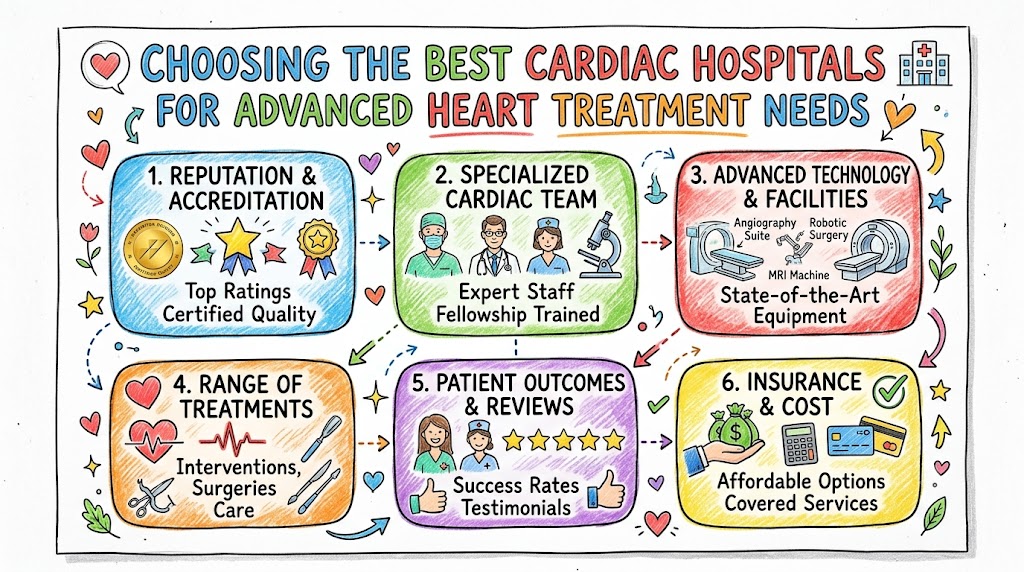
Choosing a hospital for advanced heart treatment is an important decision that requires more than checking a hospital’s popularity, location, or treatment cost. Patients may need to compare the hospital’s cardiac specialties, medical team, diagnostic facilities, surgical infrastructure, patient safety systems, intensive care support, rehabilitation services, and experience with the required procedure.
The best cardiac hospitals are not necessarily the same for every patient. A hospital that is highly experienced in bypass surgery may not be the most appropriate choice for a complex heart rhythm disorder, congenital heart condition, advanced heart failure, or minimally invasive valve procedure.
A careful comparison helps patients understand which hospital is better equipped for their individual diagnosis and treatment requirements. This guide explains the most important factors to review while selecting a cardiac hospital for advanced heart care.
Understanding Advanced Heart Treatment
Advanced heart treatment refers to specialized medical, interventional, or surgical care for heart and blood vessel conditions that may not be managed through routine consultations alone.
Depending on the diagnosis, treatment may involve:
- Advanced cardiac imaging
- Coronary angiography
- Angioplasty and stent placement
- Coronary artery bypass grafting
- Heart valve repair or replacement
- Pacemaker or defibrillator implantation
- Electrophysiology procedures
- Minimally invasive heart surgery
- Congenital heart surgery
- Structural heart procedures
- Heart failure management
- Mechanical circulatory support
- Cardiac rehabilitation
The recommended treatment depends on the patient’s diagnosis, symptoms, age, overall health, previous treatments, test results, and personal risk factors. Therefore, hospital selection should begin only after a qualified cardiologist or cardiac surgeon has evaluated the patient.
Why Choosing the Right Cardiac Hospital Matters
Heart treatment often involves several specialists, departments, and stages of care. A patient may require diagnostic tests, specialist consultations, surgery, intensive care, medication management, rehabilitation, and long-term follow-up.
The World Health Organization describes quality healthcare as care that is effective, safe, people-centred, timely, equitable, integrated, and efficient. These qualities are especially important when patients require complex cardiac procedures or surgery.
The right hospital should be able to provide coordinated care before, during, and after treatment. It should also have systems for managing emergencies, preventing infections, monitoring complications, communicating with families, and arranging follow-up support.
A well-known hospital name alone does not establish that it is suitable for every cardiac condition. Patients should evaluate the specific department, medical team, treatment programme, and facilities relevant to their needs.
Important Factors for Comparing Cardiac Hospitals
Cardiac specialities available
Start by confirming that the hospital regularly treats the patient’s specific condition. Major cardiac hospitals may offer different combinations of services, including:
- Interventional cardiology
- Cardiothoracic surgery
- Electrophysiology
- Structural heart care
- Paediatric cardiology
- Congenital heart surgery
- Heart failure management
- Preventive cardiology
- Cardiac imaging
- Cardiac rehabilitation
A hospital with a dedicated programme for the required condition may provide more coordinated care than a general facility offering the procedure occasionally.
Accreditation and quality standards
Hospital accreditation indicates that an independent organisation has assessed certain systems, processes, and safety standards. In India, the National Accreditation Board for Hospitals and Healthcare Providers establishes benchmarks related to healthcare quality and patient safety. Internationally, Joint Commission International standards are used to assess and improve healthcare performance and safety.
Accreditation can be an important comparison factor, but it should not be treated as a guarantee of a successful outcome. Patients should combine accreditation information with procedure-specific experience, medical expertise, facilities, safety practices, and follow-up support.
Experience with the required procedure
Patients should ask how frequently the hospital and medical team perform the recommended procedure. General hospital experience is less useful than experience related to the patient’s specific condition.
For example, patients considering valve repair should ask about the hospital’s valve programme rather than relying only on its overall cardiac surgery reputation. Similarly, someone requiring treatment for an abnormal heart rhythm should evaluate the electrophysiology department and its available technology.
Multidisciplinary heart team
Complex cardiac cases may benefit from evaluation by a multidisciplinary heart team. Such a team may include cardiologists, cardiac surgeons, interventional cardiologists, imaging specialists, anaesthesiologists, heart failure specialists, nurses, rehabilitation professionals, and other experts.
Clinical guidance for severe heart valve disease supports evaluation by a multidisciplinary heart valve team when an intervention is being considered. This approach allows different specialists to review treatment alternatives and individual risk factors together.
Diagnostic and imaging facilities
Reliable diagnosis is the foundation of appropriate treatment. Depending on the condition, patients may require facilities such as:
- Electrocardiography
- Echocardiography
- Stress testing
- Holter monitoring
- CT coronary angiography
- Cardiac magnetic resonance imaging
- Nuclear cardiac imaging
- Cardiac catheterisation
- Electrophysiology testing
- Laboratory testing
Patients should ask whether important diagnostic tests are available within the hospital and whether imaging is reviewed by specialists experienced in cardiac conditions.
Emergency and intensive care support
Advanced cardiac treatment requires strong emergency and critical care systems. The hospital should have access to:
- A cardiac intensive care unit
- Emergency cardiology services
- Critical care specialists
- Blood bank support
- Advanced monitoring equipment
- Emergency operating facilities
- Ventilatory support
- Infection-control systems
- Rapid-response teams
These resources may be especially important for high-risk patients and those undergoing complex procedures.
Cardiac Hospital Comparison Table
| Comparison Factor | What Patients Should Review | Why It Matters |
|---|---|---|
| Cardiac speciality | Dedicated programme for the diagnosed condition | Different conditions require different expertise |
| Specialist experience | Qualifications and procedure-specific experience | Experience should match the required treatment |
| Accreditation | Current national or international accreditation | Indicates assessment of quality and safety systems |
| Diagnostic facilities | Availability of required imaging and tests | Supports accurate diagnosis and treatment planning |
| Surgical infrastructure | Operating theatres, equipment and cardiac anaesthesia | Important for complex or high-risk procedures |
| Critical care | Cardiac ICU, emergency response and monitoring | Supports patients before and after treatment |
| Multidisciplinary care | Access to cardiologists, surgeons and other specialists | Helps evaluate complex treatment choices |
| Patient safety | Infection control, medication safety and surgical checks | Reduces preventable risks |
| Rehabilitation | Supervised recovery and lifestyle support | Helps patients regain strength safely |
| Follow-up care | Post-discharge reviews and emergency contact process | Supports recovery after leaving the hospital |
| Cost transparency | Detailed written estimate and exclusions | Helps families prepare financially |
| International support | Visa letters, travel coordination and language assistance | Important for overseas patients |
Common Advanced Cardiac Treatments
Treatment recommendations should be based on individual medical evaluation rather than general online comparisons.
| Procedure or Service | General Purpose | Hospital Resources Commonly Required | Important Patient Considerations |
|---|---|---|---|
| Coronary angiography | Examines blood flow through coronary arteries | Catheterisation laboratory and imaging team | May be diagnostic or guide further treatment |
| Angioplasty and stenting | Opens selected narrowed or blocked arteries | Cath lab and interventional cardiology team | Not appropriate for every coronary blockage |
| Bypass surgery | Creates an alternative route for blood flow | Cardiac operating theatre, surgical team and ICU | Recovery and rehabilitation planning are important |
| Valve repair or replacement | Treats damaged or narrowed heart valves | Valve specialists, imaging and surgical facilities | Open, minimally invasive or catheter-based options may be considered |
| Electrophysiology procedure | Diagnoses or treats certain rhythm disorders | Electrophysiology laboratory and rhythm specialists | Treatment depends on the type of arrhythmia |
| Pacemaker implantation | Helps control selected slow or irregular rhythms | Cardiac device team and monitoring facilities | Requires device checks after implantation |
| Congenital heart surgery | Treats structural conditions present from birth | Specialised congenital cardiac team | Experience with the specific defect is important |
| Heart failure management | Controls symptoms and improves heart function | Multidisciplinary medical and monitoring support | May involve medicines, devices or advanced therapies |
| Cardiac rehabilitation | Supports safe recovery and risk reduction | Supervised exercise, education and counselling | Participation depends on medical clearance |
Evaluating Cardiologists and Cardiac Surgeons
Choosing a hospital and choosing a specialist are related but separate decisions. A reputable hospital may have several cardiologists and surgeons with different areas of expertise.
Patients should review:
- Medical qualifications
- Professional registration
- Cardiac subspeciality
- Years of clinical experience
- Experience with the recommended procedure
- Experience treating similar medical conditions
- Hospital affiliation
- Participation in a multidisciplinary team
- Communication style
- Follow-up availability
During the consultation, patients should notice whether the specialist explains the diagnosis clearly, discusses reasonable alternatives, describes important risks, answers questions patiently, and considers the patient’s personal circumstances.
The American Heart Association recommends asking about a specialist’s experience and evaluating whether the specialist’s communication style is suitable for the patient.
Reviewing Patient Safety Systems
Patient safety should be treated as a major selection factor rather than an administrative detail. The World Health Organization explains that patient safety involves organised activities, procedures, technologies, behaviours, and healthcare environments designed to reduce avoidable harm.
Patients may ask the hospital about:
- Surgical safety checklists
- Patient identification procedures
- Medication verification
- Infection-prevention practices
- Hand-hygiene protocols
- Blood transfusion safety
- Equipment maintenance
- ICU monitoring
- Emergency escalation procedures
- Discharge instructions
- Reporting and reviewing complications
The WHO Surgical Safety Checklist was created to reduce errors, strengthen communication, and improve teamwork during surgical care.
Patients should also ask how the hospital communicates unexpected complications and what support is available if urgent treatment is needed after discharge.
Comparing Hospital Outcomes Responsibly
Some hospitals publish information about treatment outcomes, mortality, infection rates, readmissions, complications, and patient experience. Such data can be helpful, but comparisons require context.
A hospital treating a larger number of highly complex or critically ill patients may appear to have different outcomes from a hospital treating lower-risk patients. Patients should ask whether published statistics are adjusted for case complexity and whether they relate to the exact procedure being considered.
Quality measures may examine clinical outcomes, healthcare processes, patient experiences, organisational systems, safety, efficiency, and timeliness.
Instead of relying on a single ranking or score, patients should examine several indicators and discuss them with a qualified medical professional.
Understanding Cardiac Treatment Costs
Treatment cost is important, but the least expensive hospital is not automatically the safest or most appropriate choice.
The final cost may depend on:
- Patient diagnosis and condition
- Type of procedure
- Complexity of treatment
- Surgeon and specialist fees
- Diagnostic investigations
- Operating theatre charges
- Room category
- Intensive care requirements
- Medicines and consumables
- Stents, valves, pacemakers or other devices
- Blood products
- Length of hospital stay
- Unexpected complications
- Rehabilitation
- Follow-up consultations
When comparing heart surgery cost in India or another destination, patients should request a written estimate. The document should clearly identify what is included, what is excluded, how long the estimate remains valid, and how additional treatment will be charged.
Patients should never postpone emergency cardiac care solely to compare prices. Sudden chest discomfort, severe breathing difficulty, collapse, or symptoms of a possible heart attack require immediate local medical attention.
Medical Tourism for Advanced Heart Treatment
India is considered by some international patients because of its large cardiac centres, specialist availability, range of procedures, and comparatively different treatment costs. However, medical tourism for heart surgery in India requires careful clinical and travel planning.
International patients should consider:
- Independent confirmation of the diagnosis
- Remote review of complete medical records
- Preliminary treatment recommendations
- Current hospital accreditation
- Specialist credentials
- A detailed cost estimate
- Medical visa requirements
- Travel fitness
- Accommodation for the patient and caregiver
- Language assistance
- Local transportation
- Expected recovery period
- Emergency arrangements
- Follow-up after returning home
Patients should not book return travel based only on an average recovery period. Recovery varies according to the procedure, overall health, complications, and the treating team’s advice.
The hospital should provide written discharge information, medication instructions, warning signs, follow-up dates, and a clear method for contacting the medical team.
Cardiac Rehabilitation and Recovery Support
Treatment does not end when the procedure is completed. Recovery may involve wound care, medication management, activity restrictions, nutrition guidance, supervised exercise, psychological support, and follow-up testing.
A comprehensive cardiac rehabilitation service may include:
- Medical evaluation
- Supervised physical activity
- Heart-health education
- Medication guidance
- Risk-factor management
- Emotional support
- Lifestyle counselling
- Return-to-work planning
Patients should ask whether rehabilitation begins during hospitalisation and whether it can continue near their home. Recovery time differs between individuals and depends on the procedure, the patient’s condition before treatment, and any complications.
Important Questions to Ask the Hospital
Before making a final decision, patients and caregivers should ask:
- Does the hospital have a dedicated programme for this condition?
- Which specialist will lead the treatment?
- How frequently does the team perform this procedure?
- What treatment alternatives are available?
- Will the case be reviewed by a multidisciplinary heart team?
- What are the major risks and expected benefits?
- What critical care services are available?
- What is included in the written cost estimate?
- What rehabilitation will be required?
- How will follow-up care be managed after discharge?
- Who should be contacted if symptoms worsen?
- Is a second opinion recommended for this case?
Seeking another medical opinion can be particularly useful before a major or complex operation. The American Heart Association notes that second and even third opinions may be encouraged for significant procedures such as heart valve replacement.
Common Mistakes to Avoid
Choosing only by hospital reputation
A hospital may be widely recognised but have limited experience with a particular rare condition or specialised procedure.
Focusing only on price
A low estimate may exclude specialist fees, devices, intensive care, medicines, rehabilitation, or treatment of complications.
Depending entirely on online rankings
Rankings may use different methods and may not reflect the patient’s individual diagnosis.
Ignoring specialist experience
Patients should review procedure-specific expertise rather than relying only on the hospital’s overall reputation.
Failing to share complete medical records
Incomplete records can affect preliminary recommendations and cost estimates.
Assuming accreditation guarantees outcomes
Accreditation is useful, but outcomes also depend on the patient’s condition, treatment complexity, medical team, and recovery.
Overlooking rehabilitation
Recovery support can be as important as the hospital procedure itself.
Making travel plans without medical clearance
Long journeys may be unsafe before or soon after certain cardiac treatments.
Ignoring communication quality
Patients should understand their diagnosis, alternatives, risks, costs, and follow-up plan before providing informed consent.
Practical Cardiac Hospital Selection Checklist
Use this checklist while comparing hospitals:
- Confirm the exact diagnosis and recommended treatment.
- Obtain copies of medical reports and imaging.
- Compare hospitals with dedicated experience in the condition.
- Verify current hospital accreditation.
- Review the specialist’s qualifications and relevant experience.
- Ask whether a multidisciplinary team will evaluate the case.
- Confirm diagnostic, surgical, ICU, and emergency facilities.
- Request a written treatment and cost estimate.
- Ask about possible additional charges.
- Review infection-control and patient-safety systems.
- Understand the expected hospital stay.
- Ask about rehabilitation and recovery support.
- Confirm post-discharge contact arrangements.
- Obtain a second opinion for complex or major treatment.
- Avoid choosing solely by price, advertising, or online rankings.
Frequently Asked Questions
1. How can patients identify the best cardiac hospitals?
Patients should compare condition-specific expertise, specialist experience, accreditation, diagnostic facilities, surgical infrastructure, intensive care, safety practices, rehabilitation, follow-up care, and cost transparency.
2. Are the best heart hospitals in the world suitable for every patient?
No. A globally recognised hospital may not be the most practical or clinically appropriate choice for every condition. Diagnosis, specialist expertise, treatment availability, travel safety, cost, and follow-up needs should guide the decision.
3. What makes a hospital one of the best cardiology hospitals?
Strong cardiology hospitals generally provide experienced specialists, modern diagnostic services, interventional cardiology, emergency support, multidisciplinary evaluation, patient-safety systems, and organised follow-up care.
4. How should patients compare the best heart surgery hospitals?
Patients should examine surgical expertise, procedure volume, operating facilities, cardiac anaesthesia, ICU support, infection control, reported outcomes, rehabilitation services, and the team’s experience with similar cases.
5. Is hospital accreditation important for heart treatment?
Accreditation shows that a hospital has been assessed against defined quality and safety standards. It is useful, but it should be considered alongside medical expertise, facilities, procedure-specific experience, and patient needs.
6. How can patients find experienced cardiac surgeons?
Patients can review qualifications, professional registration, speciality, years of experience, procedure-specific experience, hospital affiliation, multidisciplinary involvement, communication, and follow-up availability.
7. What should patients check before bypass surgery?
They should confirm the diagnosis, reason for recommending surgery, alternatives, surgeon experience, ICU facilities, expected risks, hospital stay, estimated cost, rehabilitation plan, and post-discharge follow-up.
8. What facilities are important when selecting a hospital for angioplasty?
Important facilities include a well-equipped catheterisation laboratory, experienced interventional cardiologists, cardiac imaging, emergency surgical backup, critical care, blood bank access, and post-procedure monitoring.
9. Why can heart surgery cost in India vary between hospitals?
Costs vary according to procedure complexity, hospital category, specialist fees, tests, room type, intensive care, devices, medicines, length of stay, complications, and rehabilitation requirements.
10. Should international patients arrange follow-up before travelling home?
Yes. They should obtain discharge records, medication instructions, warning signs, test results, follow-up dates, medical contact information, and a plan for continued care with a cardiologist in their home country.
Key Takeaways
- The best cardiac hospital depends on the patient’s diagnosis and treatment needs.
- Condition-specific expertise is more useful than general hospital popularity.
- Accreditation can support comparison but does not guarantee an outcome.
- Multidisciplinary evaluation is valuable for complex cardiac conditions.
- Patients should assess diagnostics, surgery, critical care, safety, and rehabilitation together.
- Written cost estimates should clearly explain inclusions and possible additional charges.
- Second opinions can provide clarity before major or complex procedures.
- International patients need careful travel, recovery, and follow-up planning.
Conclusion
Choosing among the best cardiac hospitals requires a balanced review of medical expertise, specialised services, safety systems, infrastructure, treatment experience, costs, and recovery support. Patients should avoid selecting a hospital solely because of advertising, rankings, location, or a low price estimate. The most appropriate hospital is one that can safely manage the patient’s specific condition and provide coordinated care throughout diagnosis, treatment, rehabilitation, and follow-up. BestCardiacHospitals.com can serve as an informational starting point for comparing cardiac hospitals, specialists, procedures, and treatment destinations. However, the final decision should always be made after reviewing complete medical records and consulting qualified cardiologists or cardiac surgeons.
