
Introduction
Choosing an eye hospital is an important decision because vision problems can affect independence, work, education, mobility, and overall quality of life. Patients may need anything from a routine examination to advanced treatment for cataracts, glaucoma, retinal disease, corneal disorders, refractive errors, or complex eye injuries.
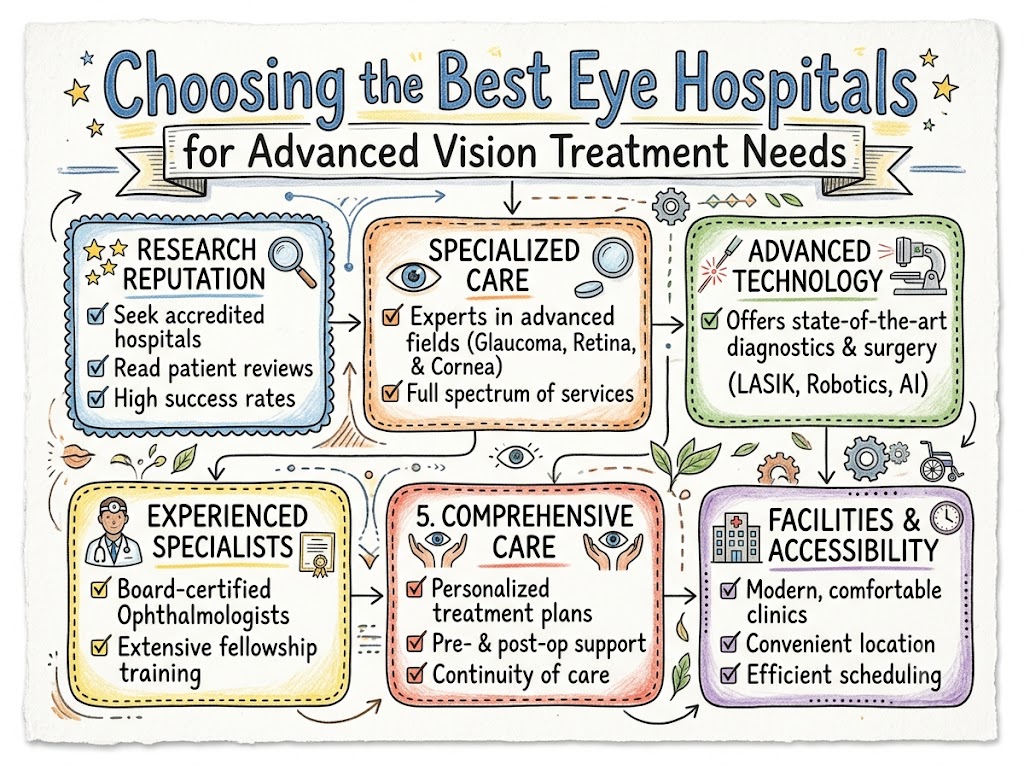
The best eye hospitals are not necessarily the largest or most expensive facilities. A suitable hospital should have qualified specialists, accurate diagnostic services, appropriate technology, established safety systems, transparent communication, and reliable follow-up care. The right choice depends on the patient’s condition, age, general health, treatment expectations, location, and budget.
This guide explains the essential factors patients should evaluate before choosing a hospital for advanced vision treatment.
Why Choosing the Right Eye Hospital Matters
Eye conditions differ greatly in their causes, urgency, treatment methods, and long-term effects. Some conditions can be corrected with glasses or a planned procedure, while others require urgent intervention or lifelong monitoring.
The World Health Organization identifies uncorrected refractive errors and cataracts among the leading causes of vision impairment. Glaucoma, diabetic retinopathy, age-related macular degeneration, infections, and eye injuries also require timely diagnosis and appropriate management.
Choosing an appropriate hospital can help patients receive:
- A correct diagnosis at the right stage
- Access to the relevant ophthalmology specialist
- Treatment suited to their specific eye condition
- Proper management of surgical risks
- Clear explanations of benefits and limitations
- Structured postoperative monitoring
- Timely referral for complex or emergency care
Hospital selection becomes especially important when a patient has an advanced condition, has previously undergone eye surgery, has only one functional eye, or has health concerns such as diabetes, hypertension, autoimmune disease, or bleeding disorders.
Understanding Advanced Vision Treatment
Advanced vision treatment does not refer to one particular procedure. It includes specialized diagnostic, medical, laser, and surgical services used to manage complex eye conditions.
Depending on the diagnosis, treatment may involve:
- Cataract surgery with an appropriate intraocular lens
- Laser vision correction such as LASIK or PRK
- Glaucoma medication, laser treatment, or surgery
- Retinal injections, laser procedures, or vitreoretinal surgery
- Corneal transplantation or corneal strengthening procedures
- Squint correction
- Pediatric eye treatment
- Oculoplastic and orbital surgery
- Treatment for eye injuries and infections
- Low-vision assessment and rehabilitation
A hospital should not recommend an advanced procedure simply because the technology is available. The procedure must be medically suitable for the patient after a complete examination.
Match the Hospital to the Eye Condition
Different eye conditions require different specialists, diagnostic systems, and surgical facilities. A hospital known for cataract surgery may not necessarily be the most appropriate centre for a complex retinal or corneal disorder.
| Eye Condition or Need | Relevant Specialist | Common Evaluation Requirements | Possible Treatment Direction |
|---|---|---|---|
| Cataract | Cataract or anterior-segment surgeon | Eye examination, lens assessment and ocular measurements | Cataract removal and lens implantation |
| Refractive error | Refractive surgeon | Corneal mapping, prescription stability and eye-surface evaluation | Glasses, contact lenses, LASIK, PRK or another suitable option |
| Glaucoma | Glaucoma specialist | Eye-pressure testing, optic-nerve examination and visual-field assessment | Medication, laser treatment, surgery or monitoring |
| Retinal disease | Retina specialist | Dilated retinal examination and retinal imaging | Injections, laser treatment or retinal surgery |
| Corneal disease | Cornea specialist | Corneal examination, mapping and thickness assessment | Medication, corneal procedure or transplantation |
| Childhood eye condition | Pediatric ophthalmologist | Age-appropriate vision and alignment assessment | Glasses, patching, therapy or surgery |
| Eye injury | Trauma or emergency ophthalmology team | Immediate structural and visual assessment | Medication, wound management or emergency surgery |
| Eyelid or tear-duct problem | Oculoplastic specialist | Eyelid, orbit and tear-drainage assessment | Medical treatment or reconstructive surgery |
Patients should confirm that the hospital has the relevant subspecialist instead of relying only on the hospital’s general reputation.
Important Factors for Selecting the Best Eye Hospitals
1. Qualified and Relevant Eye Specialists
The doctor’s training and experience should match the patient’s condition. Ophthalmology contains several subspecialties, including cataract, glaucoma, retina, cornea, pediatric ophthalmology, refractive surgery, neuro-ophthalmology, and oculoplastic surgery.
Patients should ask:
- Is the ophthalmologist trained in the required subspecialty?
- How regularly does the doctor treat this condition?
- Does the doctor perform the recommended procedure personally?
- Is a second specialist available for complex cases?
- Can the hospital coordinate care when multiple eye conditions are present?
A famous surgeon is not automatically the right surgeon for every eye disorder. Relevant experience is more valuable than general popularity.
2. Comprehensive Diagnostic Facilities
Accurate diagnosis is the foundation of appropriate treatment. A hospital should be able to perform the examinations required for the patient’s condition before recommending surgery.
Depending on the problem, evaluation may include:
- Visual-acuity testing
- Refraction assessment
- Eye-pressure measurement
- Slit-lamp examination
- Dilated retinal examination
- Corneal mapping
- Optical measurements for lens selection
- Retinal or optic-nerve imaging
- Visual-field testing
- Eye-surface and tear-film assessment
Patients should ask why each test is required and how the result may affect the treatment plan.
3. Appropriate Technology Rather Than Marketing Claims
Modern equipment can improve diagnostic precision and support specialized procedures, but technology alone does not guarantee a successful outcome. Results also depend on patient selection, the surgeon’s judgement, equipment maintenance, surgical protocols, and postoperative care.
Patients should be cautious when a hospital uses terms such as “latest,” “bladeless,” “robotic,” or “permanent” without explaining:
- Whether the technology is suitable for the condition
- How it differs from alternative methods
- Its possible benefits and limitations
- Additional costs involved
- The surgeon’s experience with the system
- Whether another treatment may be equally appropriate
A responsible hospital explains why a particular technology is being recommended instead of presenting it as the only acceptable option.
4. Accreditation and Patient-Safety Systems
Accreditation can help patients identify hospitals that follow structured standards for clinical care, medication management, infection control, patient rights, facility safety, and quality improvement.
In India, the NABH Eye Care Organisations Accreditation Programme is designed for standalone eye hospitals and ophthalmology departments. Its standards address areas such as patient assessment, continuity of care, infection control, medication management, safety, and quality systems.
Patients can also examine practical safety indicators, including:
- Preoperative identity and eye-site verification
- Sterilization and infection-control procedures
- Emergency response arrangements
- Medication documentation
- Surgical consent processes
- Equipment maintenance
- Monitoring and reporting of complications
- Clear discharge instructions
Accreditation is useful, but it should be considered alongside specialist expertise and the hospital’s suitability for the specific condition.
5. Transparent Explanation of Benefits and Risks
Before agreeing to a procedure, the patient should receive a balanced explanation of:
- The diagnosis
- Available treatment options
- Why a particular treatment is recommended
- Expected improvement
- Realistic limitations
- Possible risks and complications
- Alternatives to surgery
- Recovery requirements
- Need for glasses, medication, or future procedures
This is particularly important for elective procedures such as LASIK. The US Food and Drug Administration advises patients to understand candidacy requirements, limitations, possible visual symptoms, and postoperative expectations before choosing refractive surgery. LASIK may reduce dependence on corrective lenses, but it does not guarantee perfect vision or freedom from glasses.
Patients should be given enough time to ask questions rather than being pressured to book surgery immediately.
6. Experience with Complex and High-Risk Cases
Patients with complicated eye conditions may require a hospital with multiple subspecialists and stronger emergency support.
Additional expertise may be necessary when the patient has:
- Advanced glaucoma
- Retinal detachment
- Corneal scarring
- Diabetic retinopathy
- Previous unsuccessful eye surgery
- Severe dry-eye disease
- Eye trauma
- Childhood eye disease
- Multiple simultaneous eye disorders
- Significant general health conditions
For complicated cases, ask whether the treatment plan will be discussed by more than one specialist and whether medical specialists are available if general health issues affect surgery.
7. Surgical Infrastructure and Infection Control
Eye surgery requires strict infection-control practices because even a small infection can threaten vision. Patients can ask how the hospital manages:
- Operation-theatre sterilization
- Surgical instruments
- Disposable materials
- Medication storage
- Staff hygiene
- Patient preparation
- Postoperative infection monitoring
The hospital should provide written instructions explaining how to use eye drops, protect the operated eye, recognize warning symptoms, and contact the clinical team after discharge.
8. Follow-Up and Recovery Support
Eye treatment does not end when the procedure is completed. Follow-up visits help the doctor examine healing, measure vision, adjust medication, and identify complications.
Before choosing a hospital, confirm:
- How many follow-up appointments are normally required
- Whether follow-up charges are included
- Who will examine the patient after surgery
- How urgent concerns are handled
- Whether remote consultations are available
- What happens if the patient lives in another city or country
- Whether another doctor can receive the medical records
For procedures such as LASIK, patients may experience temporary blurred vision, watering, irritation, or sensitivity during early recovery. Following postoperative instructions and avoiding eye rubbing are important parts of care.
9. Clear and Detailed Treatment Costs
The cheapest quotation may not include every part of treatment. Patients should request a written estimate before making a decision.
Possible cost components include:
- Specialist consultation
- Diagnostic testing
- Surgeon’s fee
- Operation-theatre charges
- Lens, implant, laser, or surgical consumables
- Anaesthesia or sedation
- Medicines and eye drops
- Hospital admission
- Follow-up visits
- Additional procedures
- Management of complications
- Travel and accommodation
Actual costs may vary according to the city, hospital, specialist, technology, medical condition, implant choice, room category, and follow-up requirements.
Patients comparing the cataract surgery cost in India or LASIK surgery cost in India should compare complete treatment packages rather than only the advertised starting price.
Practical Eye Hospital Comparison Scorecard
Patients can use the following table while comparing shortlisted hospitals.
| Selection Area | Questions to Ask | Signs of a Suitable Hospital |
|---|---|---|
| Specialist expertise | Is the doctor trained in my condition? | Relevant subspecialty training and regular case experience |
| Diagnostic services | Are all necessary tests available? | Complete evaluation before recommending treatment |
| Treatment choices | Are alternatives explained? | Balanced discussion of medical, laser and surgical options |
| Safety standards | Are recognized protocols followed? | Documented infection control and patient-verification systems |
| Communication | Are risks and limitations explained clearly? | No pressure, exaggerated promises or guaranteed results |
| Cost transparency | Is a written estimate available? | Clear inclusions, exclusions and follow-up charges |
| Recovery care | Who manages postoperative concerns? | Accessible clinical support and scheduled follow-up |
| Complex-care support | Are other specialists available? | Multidisciplinary coordination when necessary |
| Patient records | Will reports be provided? | Complete test results, prescriptions and discharge records |
| Accessibility | Is travel and follow-up manageable? | Suitable location and realistic continuity-of-care plan |
Questions to Ask the Ophthalmologist
Before approving treatment, patients should ask:
- What is my exact diagnosis?
- How advanced is the condition?
- What could happen without immediate treatment?
- Are non-surgical options available?
- Why is this procedure suitable for me?
- What are the possible risks and limitations?
- What improvement can reasonably be expected?
- Will I still need glasses or medication?
- How long is the recovery period?
- Which symptoms require urgent medical attention?
- How many follow-up visits will be needed?
- What is included in the total estimated cost?
Patients may write down the answers or attend the consultation with a family member.
Special Considerations for Cataract Surgery
Patients choosing among the best hospitals for cataract surgery should examine more than the lens brand or package price.
Important factors include:
- Accuracy of preoperative eye measurements
- Surgeon’s experience
- Condition of the retina, cornea, and optic nerve
- Presence of glaucoma or diabetes
- Lens options and realistic expectations
- Infection-control procedures
- Follow-up arrangements
Premium lenses may not be suitable for every patient. The ophthalmologist should explain expected distance and near vision, possible visual limitations, and whether glasses may still be required.
Special Considerations for LASIK Surgery
LASIK is an elective procedure used to correct certain refractive errors, but not every person who wears glasses is an appropriate candidate.
A responsible LASIK hospital should evaluate:
- Prescription stability
- Corneal shape and thickness
- Eye-surface health
- Dry-eye symptoms
- Pupil characteristics
- Age and general health
- Previous eye disease
- Lifestyle and visual expectations
The FDA notes that possible LASIK risks can include dry-eye symptoms, glare, halos, double vision, under-correction, over-correction, or continuing dependence on glasses. Patients should understand these possibilities before giving consent.
A hospital should be willing to advise against LASIK when screening results suggest that another option would be safer.
Guidance for International Patients
International patients considering treatment at the best eye hospitals in India should plan both the procedure and the recovery period carefully.
Before travelling, request:
- A preliminary review of current medical reports
- An estimated treatment plan
- Expected length of stay
- A detailed cost estimate
- Visa-document guidance where available
- Information about accommodation
- Follow-up requirements
- A fit-to-fly recommendation after surgery
- Copies of all reports and prescriptions
Patients should avoid planning immediate travel after a procedure until the treating ophthalmologist confirms that it is appropriate.
It is also important to identify an ophthalmologist in the home country who can provide continued care after returning.
Common Mistakes to Avoid
Selecting a Hospital Only by Price
A low quotation may exclude tests, implants, medicines, follow-up visits, or additional procedures.
Believing Guaranteed Outcome Claims
No responsible eye hospital can guarantee perfect vision, zero complications, or permanent freedom from glasses.
Choosing Technology Before Diagnosis
Patients should first understand their condition. The most heavily advertised procedure may not be the most suitable treatment.
Ignoring the Doctor’s Subspecialty
General ophthalmology experience may not be sufficient for a complex retinal, corneal, pediatric, or glaucoma condition.
Skipping a Second Opinion
A second opinion can be useful when the diagnosis is uncertain, surgery is complex, the cost is substantial, or different treatments are available.
Failing to Discuss General Health
Diabetes, hypertension, medication use, allergies, pregnancy, and previous surgery can influence treatment planning.
Ignoring Follow-Up Requirements
Choosing a distant hospital without a recovery plan can make postoperative care difficult.
Depending Only on Online Reviews
Reviews may provide general impressions, but they cannot confirm medical quality or whether a hospital is right for a specific condition.
Patient Checklist Before Finalizing an Eye Hospital
Use this checklist before scheduling treatment:
- Confirm the diagnosis in writing.
- Check the ophthalmologist’s relevant subspecialty.
- Review the required diagnostic tests.
- Understand all available treatment options.
- Ask about benefits, risks, and limitations.
- Verify the hospital’s safety and infection-control systems.
- Request a complete written cost estimate.
- Confirm which services are included.
- Ask about recovery time and activity restrictions.
- Understand the follow-up schedule.
- Keep copies of reports, prescriptions, and consent documents.
- Seek a second opinion for complex or irreversible procedures.
Frequently Asked Questions
1. How can I identify the best eye hospital for my condition?
Start by identifying the ophthalmology subspecialty required for your diagnosis. Compare hospitals based on relevant specialists, diagnostic facilities, safety standards, treatment options, communication, and follow-up support.
2. Is a multispecialty hospital better than a dedicated eye hospital?
Neither is automatically better. A dedicated eye hospital may offer extensive ophthalmology services, while a multispecialty hospital may be helpful when the patient has serious medical conditions requiring coordinated care.
3. Should I choose a hospital based on its technology?
Technology is only one selection factor. It should be evaluated alongside the specialist’s experience, accurate patient selection, safety systems, equipment maintenance, and postoperative care.
4. How important is hospital accreditation?
Accreditation indicates that a hospital has been evaluated against defined quality and patient-safety standards. However, patients should also examine the doctor’s expertise and the hospital’s suitability for the required procedure.
5. When should I seek a second opinion?
Consider a second opinion when surgery is complex, the diagnosis is uncertain, the recommended treatment is irreversible, different options are available, or the expected cost is high.
6. How should I compare eye surgery costs?
Request an itemized estimate covering consultations, tests, surgeon charges, implants or consumables, medicines, hospital services, follow-up visits, and possible additional expenses.
7. Does expensive eye surgery provide better results?
A higher price does not automatically mean better care. Costs may vary due to location, technology, implant choice, facilities, and specialist fees. Medical suitability and safety should remain the priority.
8. What should international patients check before travelling?
They should confirm the diagnosis, proposed procedure, required stay, complete cost, postoperative restrictions, fit-to-fly timing, follow-up arrangements, and access to medical records.
9. Can an eye hospital guarantee perfect vision after surgery?
No. Treatment outcomes vary according to the condition, eye health, healing response, procedure, surgeon, and other medical factors. Hospitals should provide realistic expectations rather than guarantees.
10. What warning signs require urgent attention after eye surgery?
Severe or increasing pain, sudden vision reduction, increasing redness, eye injury, unusual discharge, flashes, new floaters, or a curtain-like shadow may require urgent assessment. Patients should follow the emergency instructions provided by their treating ophthalmologist.
Key Takeaways
- Select an eye hospital according to the specific diagnosis and required subspecialty.
- Give importance to specialist experience, diagnostic accuracy, safety systems, and recovery support.
- Do not choose a procedure based only on advertising, technology, or price.
- Ask for a balanced explanation of benefits, limitations, risks, and alternatives.
- Request a written estimate that includes testing, surgery, medicines, and follow-up.
- Plan continuity of care before travelling to another city or country.
- Seek a second opinion when the procedure is complex or the treatment decision is unclear.
Conclusion
Choosing among the best eye hospitals requires careful comparison rather than depending on rankings, advertisements, or package prices. Patients should focus on the ophthalmologist’s relevant expertise, quality of diagnosis, suitability of treatment, hospital safety systems, cost transparency, and availability of postoperative care. A well-informed decision begins with understanding the eye condition and asking clear questions about treatment choices, realistic outcomes, risks, and recovery. Taking time to compare suitable hospitals and obtain a second opinion when necessary can help patients approach advanced vision treatment with greater clarity and confidence.
