
Introduction
Starting a blog is one of the simplest ways to create a visible presence on the internet. A personal blog gives you a place to share your knowledge, experiences, opinions, stories, and creative ideas in your own voice. It can also help readers understand who you are, what you care about, and the subjects in which you have experience.
A free blogging platform makes this process easier for beginners because it removes many of the costs and technical challenges connected with building a website. You can focus on writing instead of learning coding, purchasing hosting, or managing complicated website tools.
Building an online writing identity does not happen through one article alone. It develops gradually through clear topics, useful content, consistent publishing, and a recognisable writing style. Whether you are a student, professional, educator, storyteller, or independent writer, starting a free blog can become the first step toward creating a meaningful digital presence.
The Meaning of an Online Writing Identity
Your online writing identity is the image readers develop about you through your published work. It includes your writing style, preferred subjects, personal experiences, professional knowledge, opinions, and the value you provide through your articles.
For example, a software professional who regularly publishes simple technology guides may become known as a helpful technical writer. A traveller who shares honest destination experiences may develop an identity as a practical travel storyteller. An educator who publishes learning resources may become recognised for making difficult subjects easier to understand.
A strong writing identity usually contains several elements:
- A clear subject or group of related topics
- A consistent tone and writing style
- Useful and original content
- A recognisable author profile
- Regular publishing activity
- Honest communication with readers
- A personal publishing space
Your identity should reflect your real interests and knowledge. It does not need to look perfect from the beginning. It becomes clearer as you continue writing and understand which topics are most meaningful to you and your readers.
Free Blogging Removes Common Publishing Barriers
Traditional website creation may involve purchasing a domain, selecting hosting, installing software, choosing a design, and managing technical settings. These steps can feel difficult for people who simply want to write.
A free blogging site reduces these barriers by providing a ready-to-use publishing environment. Beginners can create an account, prepare their profile, choose a blog identity, and begin working on articles without building an entire website from the beginning.
Free blogging can be especially useful for:
- Students creating a public writing portfolio
- Professionals sharing industry knowledge
- Educators publishing useful explanations
- Storytellers presenting original work
- Poets sharing creative writing
- Travellers recording personal experiences
- Hobby writers developing confidence
- Teams managing a shared publication
A free platform gives new writers room to experiment. They can explore different subjects, practise writing, understand reader interests, and build a collection of published work before making larger investments.
Personal Blogs Support Long-Term Digital Growth
Social media posts often disappear quickly from people’s feeds. A personal blog provides a more organised place where your articles can remain connected to your profile and publishing identity.
When you start a personal blog for free, you create a central location for your ideas. Instead of sharing disconnected thoughts across different platforms, you can organise your knowledge into detailed and meaningful articles.
A personal blog may support several long-term goals:
Building a Public Portfolio
Students, freelancers, writers, and professionals can use blog articles as examples of their communication skills and subject knowledge. A portfolio made from original articles can show how you research, explain, and present ideas.
Developing Professional Credibility
Publishing clear and useful content can help readers understand your experience. A professional does not need to present themselves as an expert in every subject. Sharing practical lessons, work experiences, and thoughtful explanations can gradually build credibility.
Improving Writing Skills
Regular blogging encourages better planning, editing, grammar, and communication. Each published article gives you an opportunity to improve sentence structure, organise ideas, and explain information more clearly.
Expressing Personal Ideas
A personal blog gives writers space to explore opinions, memories, lessons, and experiences in greater depth. This is particularly valuable for people who feel limited by short social media formats.
Connecting with Relevant Readers
People interested in your subject may discover your work and return for future articles. Reader relationships often develop slowly through useful content and consistent publishing.
A Clear Blog Purpose Creates a Stronger Identity
Before creating your blog, define its main purpose. A clear purpose makes it easier to choose topics, write introductions, organise categories, and attract the right readers.
Your blog may focus on:
- Sharing professional knowledge
- Teaching beginner-friendly concepts
- Publishing creative stories
- Recording personal growth
- Discussing books or films
- Exploring travel experiences
- Writing about technology
- Sharing career advice
- Publishing poetry
- Documenting a learning journey
Avoid choosing a very broad direction at the beginning. A blog about technology, business, travel, food, fashion, education, and personal life may feel confusing if these subjects are not connected.
You do not need to limit yourself to one narrow topic forever. Start with one main area and a few related themes. This approach helps readers understand what they can expect from your blog.
For example, a career-focused blog could include job preparation, communication skills, workplace lessons, and professional development. These subjects are different but still connected to one central identity.
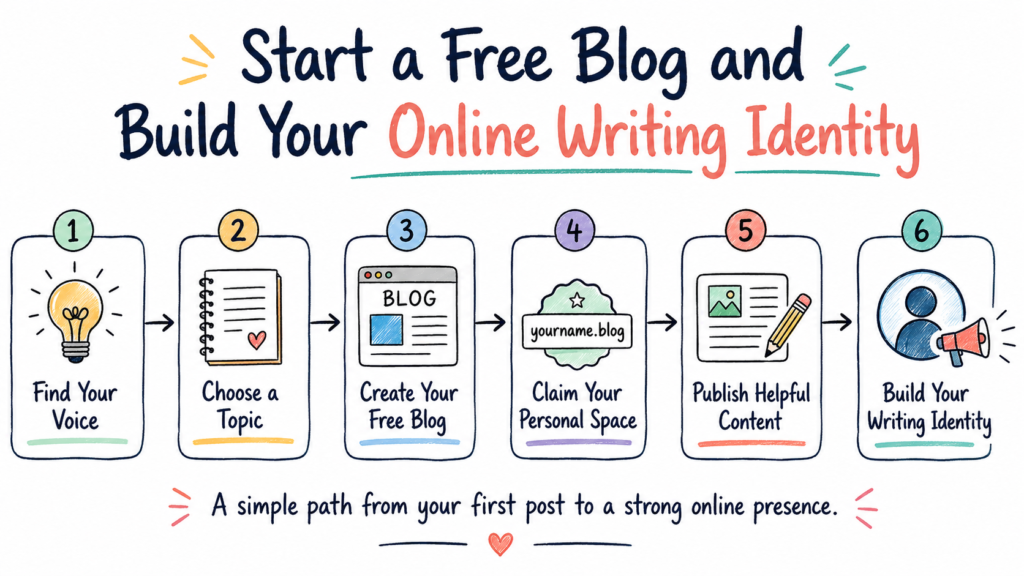
Steps for Starting a Free Blog
A simple plan can help you move from an idea to your first published article.
1. Define Your Main Goal
Decide why you want to blog. Your goal may be to improve your writing, share knowledge, build a portfolio, express personal ideas, or connect with readers.
Your goal will guide the type of content you publish.
2. Select a Suitable Topic
Choose a subject that you understand, enjoy, or want to explore deeply. You do not need to know everything about the topic. You should, however, have enough interest to continue learning and publishing.
3. Identify Your Intended Reader
Think about the person who will benefit from your writing. A beginner-friendly technology article will use different language from a technical article written for experienced engineers.
Understanding your reader helps you select examples, explanations, and vocabulary.
4. Choose a Free Blogging Platform
Look for a blogging website for beginners that provides a simple writing environment, a clear publishing process, and a suitable space for building your profile.
A no-code blogging platform is useful when you want to concentrate on content rather than website development.
5. Create a Memorable Blog Identity
Select a blog name that matches your subject and style. Keep it simple, readable, and easy to remember.
Your blog name may use:
- Your personal name
- A professional subject
- A creative phrase
- A combination of your name and niche
- A short description of the blog’s purpose
Avoid names that are difficult to spell or unrelated to your content.
6. Prepare Your Author Profile
Your profile should briefly explain who you are and what you write about. It does not need to include your complete personal history.
A useful profile may include:
- Your name or writing name
- Your main subject
- Your professional or creative interest
- The type of content readers can expect
- A short personal statement
Keep the profile honest and focused.
7. Plan Your First Articles
Prepare a list of five to ten article ideas before publishing. This reduces the pressure of finding a new topic every time.
Beginner-friendly article ideas may include:
- Lessons from personal experience
- Simple guides
- Common mistakes
- Practical checklists
- Industry explanations
- Personal stories
- Educational resources
- Opinion-based articles
- Book or tool reviews
- Creative writing pieces
Choose topics that offer clear value to readers.
8. Write and Edit Carefully
Create a simple structure before writing. Most useful articles include an introduction, several clear sections, practical examples, and a conclusion.
After completing the first draft:
- Remove repeated information
- Correct grammar and spelling
- Shorten long sentences
- Check the article’s main message
- Add headings for readability
- Confirm that the title matches the content
- Make sure the content is original
Editing often makes an article more effective than adding unnecessary length.
9. Publish with a Realistic Schedule
You do not need to publish every day. Select a schedule you can maintain.
For many beginners, one useful article each week or every two weeks is more realistic than daily publishing. Consistency matters more than publishing large amounts of rushed content.
10. Review Your Progress
After publishing several articles, review your work.
Consider:
- The topics you enjoyed writing
- The articles that received reader interest
- Areas where your writing improved
- Subjects that require better research
- New ideas connected to your main theme
Use these observations to improve future content.
Personal Subdomains and Online Recognition
A subdomain gives your blog a distinct address within a larger blogging platform. It can help separate your publishing space from other users and make your blog identity easier to recognise.
A free blog with subdomain is useful for beginners who want an individual publishing area without purchasing separate hosting or managing a full website.
Your subdomain should usually connect with:
- Your name
- Your blog title
- Your main topic
- Your professional identity
- Your creative writing name
Keep it short and avoid unnecessary numbers or complicated spellings.
A subdomain does not automatically create a strong identity. It simply provides a recognisable publishing space. The quality, usefulness, and consistency of your articles will shape how readers remember you.
Content Quality Shapes Reader Trust
Readers are more likely to remember writers who publish useful, clear, and honest content. A beautiful profile cannot replace weak or copied articles.
High-quality blog content generally has these characteristics:
Original Thinking
Your article should include your own explanation, perspective, research, experience, or examples. Even when writing about a common topic, present the information in your own words.
Clear Structure
Use headings, short paragraphs, and logical sections. Readers should be able to understand the flow of the article without struggling through large blocks of text.
Practical Value
Give readers something useful. This may be a solution, lesson, process, idea, checklist, warning, or new perspective.
Honest Claims
Avoid promising guaranteed success, instant traffic, or rapid popularity. Blogging growth varies depending on content quality, consistency, topic, audience, and many other factors.
Reader-Focused Language
Write for the reader rather than trying to sound impressive. Simple explanations often create more value than complicated vocabulary.
Careful Editing
Spelling mistakes, unfinished sentences, and repeated paragraphs can reduce trust. Review your article before publishing.
A Recognisable Writing Voice Develops Naturally
Your writing voice is the personality readers notice in your articles. It may feel friendly, professional, thoughtful, practical, humorous, reflective, or educational.
Do not force a writing style that feels unnatural. Your voice becomes clearer when you publish regularly.
To develop a recognisable voice:
- Write about subjects you genuinely understand
- Use language that feels natural to you
- Explain ideas in your own way
- Include relevant personal observations
- Avoid copying another writer’s tone
- Maintain a consistent level of formality
- Focus on clarity before creativity
- Read your article aloud during editing
Your voice may change as your skills and interests develop. This is a normal part of building an online writing identity.
Community Blogging Supports Discovery and Learning
A community blogging platform brings writers and readers into a shared publishing environment. Instead of creating content in complete isolation, bloggers can discover other authors, explore new topics, and learn from different writing styles.
A global blogging community may introduce readers to perspectives from different professions, cultures, interests, and locations. This can make online publishing more diverse and engaging.
Writers can benefit from community participation by:
- Reading articles from other creators
- Supporting meaningful content
- Learning different presentation styles
- Discovering new topics
- Developing respectful professional connections
- Understanding reader expectations
- Contributing to collaborative publications
Community participation should remain genuine. Avoid commenting only to attract attention or copying popular topics without adding original value.
Multi-Author Blogs Create Shared Publishing Opportunities
A multi-author blogging platform allows several contributors to publish within one blog or publication. This format can work well for educational groups, professional teams, creative communities, and organisations.
A collaborative publication may cover more subjects and perspectives than a single-author blog. However, it also requires planning.
A successful multi-author blog should define:
- The publication’s main purpose
- The subjects contributors can cover
- Writing and formatting guidelines
- Editing responsibilities
- Publishing permissions
- Quality expectations
- Contributor roles
Clear guidelines help maintain a consistent reader experience even when different people have different writing styles.
iBlogUp as a Free Publishing Option
iBlogUp provides a simple environment for people who want to create a blog for free and begin developing an online writing identity.
Writers can create a personal publishing space, claim an iBlogUp subdomain, and publish articles without coding knowledge. The platform also includes a shared discovery feed where readers can explore content from different independent voices.
Google-based sign-in simplifies account access, while multi-contributor support can help users build collaborative or multi-author publications. The reading experience is designed to work across different devices, helping readers access content on computers and mobile screens.
iBlogUp can be considered by beginners, professionals, educators, and storytellers looking for a free blogging platform for writers. Its role is to provide the publishing space, while the writer remains responsible for creating original content, developing a clear identity, and maintaining a useful publishing routine.
Common Blogging Mistakes to Avoid
Publishing Without a Clear Direction
Posting unrelated articles can confuse readers. Select a central topic and connect most articles to that theme.
Copying Existing Content
Copied content damages credibility and does not help you develop your own voice. Research topics carefully and write original explanations.
Expecting Immediate Popularity
A new blog may take time to attract regular readers. Focus first on creating useful work rather than expecting instant attention.
Ignoring Article Titles
A weak or unclear title may fail to communicate the article’s value. Use specific titles that accurately describe the content.
Writing Long, Unreadable Paragraphs
Break detailed ideas into shorter paragraphs and clear sections. This improves readability across devices.
Publishing Without Editing
Always review your work. Editing improves clarity, professionalism, and reader trust.
Choosing an Unrealistic Schedule
Daily publishing may become difficult for beginners. Choose a routine that supports quality and consistency.
Changing Topics Too Frequently
Constantly changing your main subject can weaken your identity. Explore related themes while maintaining a recognisable direction.
Practical Tips for Strengthening Your Online Identity
Building a writing identity requires patience and regular effort.
Use these practical approaches:
- Publish articles connected to a clear subject.
- Use a consistent author name and profile.
- Choose a memorable blog title and subdomain.
- Write introductions that clearly explain the article’s purpose.
- Use examples that reflect real situations.
- Maintain a natural and recognisable tone.
- Create original content instead of rewriting popular articles.
- Update your profile as your interests develop.
- Participate respectfully in the blogging community.
- Review older work and improve future articles.
- Build a realistic publishing schedule.
- Focus on helping readers rather than chasing attention.
Your identity becomes stronger when readers can clearly describe the value of your writing.
Frequently Asked Questions
1. Can a beginner start a blog without technical knowledge?
Yes. A simple blogging platform allows beginners to create profiles, write articles, and publish content without coding. The platform manages much of the technical structure, allowing the writer to concentrate on ideas, editing, and reader value.
2. Is it possible to start a personal blog for free?
Yes. Many platforms offer free blogging access and basic publishing tools. A free option can help beginners practise writing, build a portfolio, and understand online publishing before deciding whether they need additional services.
3. What is the benefit of using a personal subdomain?
A personal subdomain gives your blog a separate and recognisable publishing address within the platform. It can support your online identity by connecting your name, subject, or blog title with your published work.
4. Which topics are suitable for a personal blog?
Suitable topics include professional knowledge, education, technology, travel, lifestyle, poetry, personal development, creative stories, career experiences, and hobbies. Select a subject you can explore consistently and explain clearly.
5. How often should a new blogger publish?
A beginner should choose a realistic schedule based on available time. Publishing one well-prepared article weekly or every two weeks may be more effective than publishing rushed content every day.
6. Can blog articles support a professional portfolio?
Yes. Original articles can demonstrate knowledge, communication ability, research, and clear thinking. Students, freelancers, educators, and professionals can use relevant blog posts as examples of their skills and interests.
7. Can several writers contribute to one blog?
A multi-author platform may allow several contributors to publish within a shared blog. This arrangement is useful for teams, educational groups, creative communities, and organisations that want to present different perspectives.
8. How long does it take to build an online writing identity?
There is no fixed timeline. A writing identity develops through consistent topics, original content, a recognisable voice, and regular publishing. Some writers find their direction quickly, while others refine it gradually through experience.
Conclusion
Starting a free blog can help you move from private ideas to organised public writing. It gives you a place to share knowledge, document experiences, practise communication, and create a collection of original work.
A strong online writing identity develops through clear topics, useful articles, honest communication, and consistent publishing. Your blog name, profile, and subdomain can support recognition, but the quality of your content will have the greatest influence on reader trust.
iBlogUp offers a simple option for writers who want to begin publishing without coding or separate hosting costs. Its personal subdomains, shared discovery environment, and multi-contributor support can help individual writers and collaborative teams create their own publishing space.
Begin with one clear purpose, prepare a few useful topics, and publish at a pace you can maintain. Every thoughtful article can become another step toward a stronger and more recognisable writing identity.
