
Introduction
Becoming a pilot is a goal that requires dedication, preparation, technical knowledge, and continuous learning. While students spend a significant amount of time studying aviation subjects and developing their flying skills, personal qualities also play an important role in their training journey.
A good pilot needs more than the ability to operate an aircraft. Pilots must be able to communicate clearly, follow procedures, manage pressure, make responsible decisions, recognize their limitations, and work effectively with others. These qualities are not necessarily something a student must already possess before starting flight training. They can be developed gradually through practice, experience, self-awareness, and proper guidance.
For aspiring pilots, developing the right personality traits can make training more productive and help create professional habits that remain valuable throughout an aviation career. In this article, we will look at the key personality traits every pilot student should build and practical ways to develop them.
Why Personality Traits Matter in Pilot Training
Pilot training involves much more than learning how to control an aircraft. Students must understand procedures, interpret information, communicate with others, respond to changing situations, and make decisions based on their training and available information.
A student’s attitude toward learning can influence how effectively they handle these responsibilities. Someone who prepares carefully, accepts feedback, remains patient, and takes responsibility for mistakes can make better use of training opportunities.
Personality traits do not replace technical knowledge or formal flight training. Instead, they support the development and application of those skills. Building these qualities from the beginning can help students develop a professional approach to aviation.
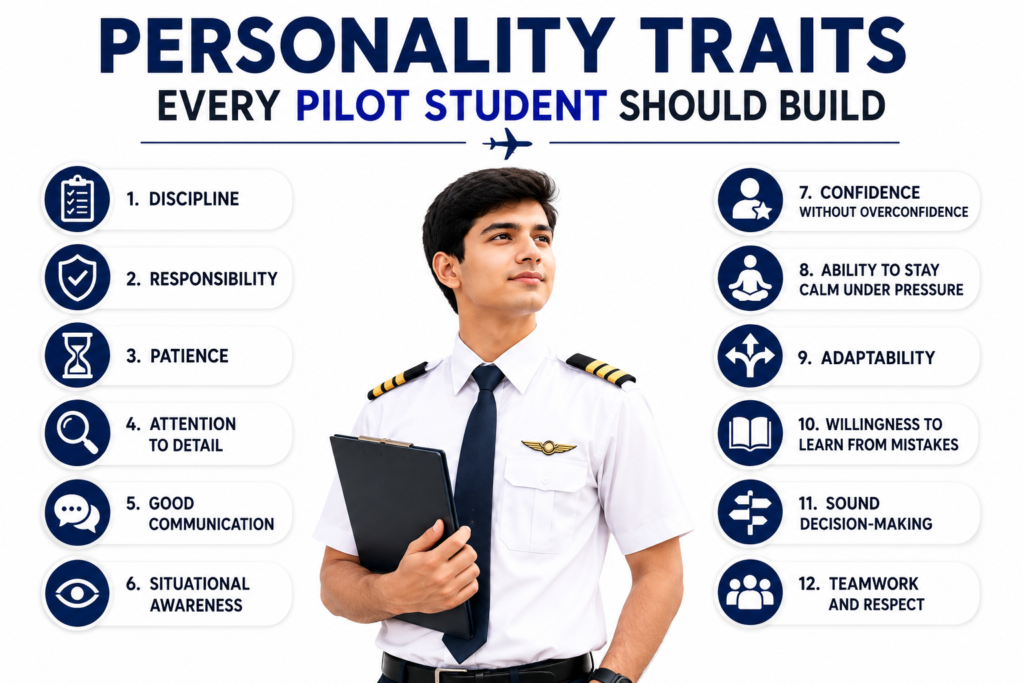
1. Discipline
Discipline is one of the most important qualities a pilot student can develop. Aviation requires people to follow established procedures consistently, even when a task seems familiar or routine.
For students, discipline can involve preparing before each lesson, completing study requirements, reviewing previous training, arriving on time, and following checklists properly.
A disciplined student does not depend entirely on last-minute preparation. Instead, they create regular habits that support steady progress.
For example, reviewing flight procedures before a lesson can help a student arrive better prepared and understand what the instructor expects. Over time, these habits can become part of the student’s normal approach to aviation.
2. Responsibility
Responsibility is closely connected to aviation safety and professionalism. Pilot students should learn to take ownership of their preparation, performance, decisions, and mistakes.
If a student struggles during a flight lesson, blaming someone else may not help solve the problem. A more productive approach is to identify what happened, understand the reason, and determine how to improve.
Responsibility also means recognizing when you need additional guidance. If a student does not understand a procedure or feels uncertain about a particular task, asking for clarification is a responsible action.
Developing this quality helps students become more honest and realistic about their abilities.
3. Patience
Learning to fly takes time, and every student develops at a different pace. Some skills may feel natural while others may require repeated practice.
Patience helps students deal with these differences without becoming unnecessarily frustrated.
A difficult lesson does not mean a student is incapable of becoming a pilot. It may simply indicate that more practice or explanation is needed. Students who remain patient can focus on gradual improvement instead of expecting immediate perfection.
Patience is particularly valuable when learning complex concepts, practicing maneuvers, or adjusting to new training environments.
4. Attention to Detail
Aviation involves many details that need to be considered carefully. Students may need to review aircraft information, weather, instruments, navigation information, procedures, and instructions.
Developing strong attention to detail helps students avoid overlooking important information.
This quality can be developed by avoiding unnecessary rushing, carefully reviewing instructions, using checklists correctly, and taking the time to understand procedures.
Being detail-oriented does not mean becoming inefficient. The goal is to develop a habit of being thorough while maintaining an organized approach to tasks.
5. Good Communication
Communication is an important part of everyday aviation operations. Pilots may communicate with instructors, air traffic controllers, other pilots, crew members, and ground personnel.
Pilot students should learn to communicate information clearly and accurately. They should also become comfortable listening carefully and asking questions when something is unclear.
Good communication is not only about speaking. It also involves understanding instructions and making sure important information is properly received.
Students can improve their communication by practicing concise explanations, listening actively, and avoiding assumptions.
6. Situational Awareness
Situational awareness involves understanding what is happening around you and recognizing how circumstances may change.
For a pilot student, this may include maintaining awareness of the aircraft, surrounding traffic, weather conditions, navigation, instructions, and other relevant factors.
Students can develop situational awareness by learning to manage their attention effectively. Focusing too heavily on one task can sometimes cause a person to overlook other important information.
With training and practice, students can become better at monitoring different aspects of a flight while maintaining an understanding of the overall situation.
7. Confidence Without Overconfidence
Confidence can help a student perform tasks effectively and communicate decisions clearly. However, confidence must be balanced with self-awareness.
Overconfidence can cause a student to underestimate challenges, ignore feedback, or attempt tasks beyond their current level of training.
Healthy confidence develops through preparation, practice, knowledge, and experience. A student should feel comfortable performing skills they have properly learned while remaining open to correction.
Knowing your limitations is not a weakness. It is an important part of responsible aviation behavior.
8. Ability to Stay Calm Under Pressure
Flight training can sometimes be challenging. Students may experience difficult exercises, unexpected changes, communication problems, or situations that require quick thinking.
Learning to remain calm can help students process information more effectively and avoid making rushed decisions.
Staying calm does not mean ignoring stress. Instead, it involves learning how to manage pressure and continue following appropriate procedures.
Students can gradually build this quality through preparation, repeated practice, scenario-based learning, and guidance from instructors.
9. Adaptability
Aviation does not always follow a fixed plan. Weather conditions may change, instructions can be revised, schedules may shift, and unexpected circumstances can arise.
Adaptability helps pilot students respond appropriately when plans need to change.
Being adaptable does not mean making decisions without thinking. It means being willing to reassess a situation when new information becomes available.
Students who learn to accept reasonable changes can become more comfortable dealing with the unpredictable nature of aviation.
10. Willingness to Learn From Mistakes
Mistakes and setbacks can be part of the learning process. What matters is how a student responds to them.
A student who accepts constructive feedback can use mistakes to identify areas that require more attention.
After a difficult lesson, students can review what happened and ask themselves what they could do differently next time. This type of self-reflection can help turn a challenging experience into a useful learning opportunity.
Being willing to learn from mistakes also requires honesty. Students should avoid hiding weaknesses and instead work with their instructors to improve them.
11. Sound Decision-Making
Decision-making is an important skill in aviation. Pilot students gradually learn to evaluate information, consider different factors, and make decisions appropriate to their level of training.
Good decision-making involves avoiding unnecessary assumptions and taking relevant information into account.
Students should also learn that asking for guidance when they are uncertain can be part of good decision-making.
Decision-making skills develop over time through classroom knowledge, flight experience, instructor feedback, and exposure to different scenarios.
12. Teamwork and Respect
Aviation involves many people working together. Pilots interact with instructors, controllers, engineers, ground staff, cabin crew, and other aviation professionals.
A pilot student should learn to respect the responsibilities and knowledge of other people involved in flight operations.
Teamwork also means listening to others, sharing relevant information, and communicating concerns appropriately.
A respectful and cooperative attitude can help students build professional relationships and understand the importance of coordinated aviation operations.
How Pilot Students Can Develop These Traits
Personality traits are developed through repeated behavior and experience. Students can work on these qualities throughout their training by adopting practical habits.
Prepare Before Every Flight Lesson
Review the relevant material before a training session. Understanding what you are expected to learn can make the lesson more productive.
Follow Procedures Consistently
Avoid developing shortcuts. Consistent use of appropriate procedures helps establish reliable habits.
Ask Questions When You Are Unsure
If something is unclear, ask the instructor for an explanation. Understanding a concept properly is more valuable than pretending to know it.
Accept Constructive Feedback
Instructor feedback is an important part of flight training. Use corrections to identify areas that need improvement.
Review Difficult Lessons
After a challenging flight, take some time to consider what happened and what you can improve before your next lesson.
Stay Organized
Keep study materials, notes, schedules, and training information organized. Good organization can make preparation easier.
Recognize Your Limitations
Understand which skills you have mastered and which still require practice. Being honest about your abilities supports responsible decision-making.
Practice Communication
Work on speaking clearly and listening carefully. Effective communication becomes easier through regular practice.
Common Personality Mistakes Pilot Students Should Avoid
While developing positive traits, students should also be aware of habits that can interfere with their progress.
Overconfidence: Assuming that a skill has been mastered before it has been consistently demonstrated can create unnecessary risks.
Ignoring feedback: Refusing to accept corrections can make it harder to identify weaknesses.
Poor preparation: Arriving at a lesson without reviewing relevant material can reduce the effectiveness of training.
Being afraid to ask questions: Remaining silent when something is unclear can create gaps in understanding.
Becoming frustrated after mistakes: One difficult lesson should not determine how a student views their overall progress.
Taking shortcuts: Skipping procedures can create habits that may be difficult to correct later.
Poor communication: Failing to communicate concerns or important information can affect teamwork.
Ignoring personal limitations: Recognizing when additional guidance is needed is an important part of responsible training.
How These Traits Support a Pilot Career
The personality traits developed during flight training can remain useful long after a student completes their initial training.
Discipline can support consistent preparation. Good communication can help with teamwork. Attention to detail can support careful task management. Adaptability can help when plans change, while self-awareness can help pilots recognize their limitations.
These qualities do not guarantee success in aviation, and they do not replace technical competence, formal training, medical requirements, regulations, or practical experience. However, they can support the professional mindset needed to apply aviation knowledge and skills responsibly.
Developing these traits early can therefore be a valuable part of a student’s overall preparation for an aviation career.
FAQs
1. What personality traits are important for a pilot student?
Important traits include discipline, responsibility, patience, attention to detail, communication, situational awareness, adaptability, balanced confidence, calmness, teamwork, and sound decision-making.
2. Do I need to have all these traits before starting pilot training?
No. Students do not need to be perfect before beginning training. Many of these qualities can be developed gradually through education, practice, experience, feedback, and self-reflection.
3. Why is discipline important for pilot students?
Discipline helps students develop consistent habits such as preparing for lessons, following procedures, studying regularly, and using checklists properly.
4. How can I improve my confidence as a pilot student?
Confidence can be developed through proper preparation, repeated practice, knowledge, and experience. It is important to build confidence without ignoring personal limitations or instructor feedback.
5. Why is communication important in aviation?
Pilots regularly communicate with instructors, air traffic controllers, crew members, ground personnel, and other aviation professionals. Clear communication helps information and instructions be understood correctly.
6. How can a student develop better situational awareness?
Students can develop situational awareness by practicing effective attention management, monitoring relevant information, understanding the aircraft’s status, and learning to recognize changes in their surroundings.
7. Is making mistakes normal during pilot training?
Mistakes can occur during the learning process. What is important is identifying what happened, accepting appropriate feedback, and using the experience to improve future performance.
8. Why should pilot students learn to stay calm under pressure?
Remaining calm can help students think more clearly, process information, and follow appropriate procedures during challenging situations.
9. How does adaptability help a pilot?
Aviation conditions can change unexpectedly. Adaptability helps pilots reassess situations and adjust their plans appropriately when new information or circumstances arise.
10. Can personality traits make someone a better pilot?
Positive personality traits can support effective learning, professional behavior, communication, and decision-making. However, they are only one part of becoming a pilot. Technical knowledge, flight training, practical skills, regulations, and other requirements are also essential.
Conclusion
Becoming a pilot is a continuous process of learning, practice, and personal development. Technical knowledge and flying skills are essential, but the way a student approaches training can also influence their progress and professional development.
Traits such as discipline, responsibility, patience, attention to detail, communication, situational awareness, balanced confidence, adaptability, calmness, teamwork, and sound decision-making can help students build a stronger foundation for their aviation journey.
The good news is that these qualities do not have to be fully developed on the first day of flight training. Students can strengthen them through consistent preparation, honest self-assessment, instructor feedback, practical experience, and a willingness to keep learning.
A successful pilot is not simply someone who knows how to operate an aircraft. Professional aviation also requires responsible behavior, clear communication, good judgment, respect for procedures, and an understanding of personal limitations.
By developing these traits alongside their technical skills, pilot students can prepare themselves for the responsibilities of flight training and build habits that can remain valuable throughout their future aviation careers.
