
Introduction
Learning to fly an aircraft requires a combination of technical knowledge, practical training, decision-making ability, and effective communication. While student pilots spend considerable time learning about aircraft systems, navigation, weather, and flight procedures, communication is another essential part of becoming a professional pilot.
English has a particularly important role in aviation because pilots may communicate with air traffic controllers, other flight crews, cabin crew, ground personnel, and aviation professionals from different countries. Clear communication helps pilots understand instructions, provide accurate information, and manage routine as well as unexpected situations.
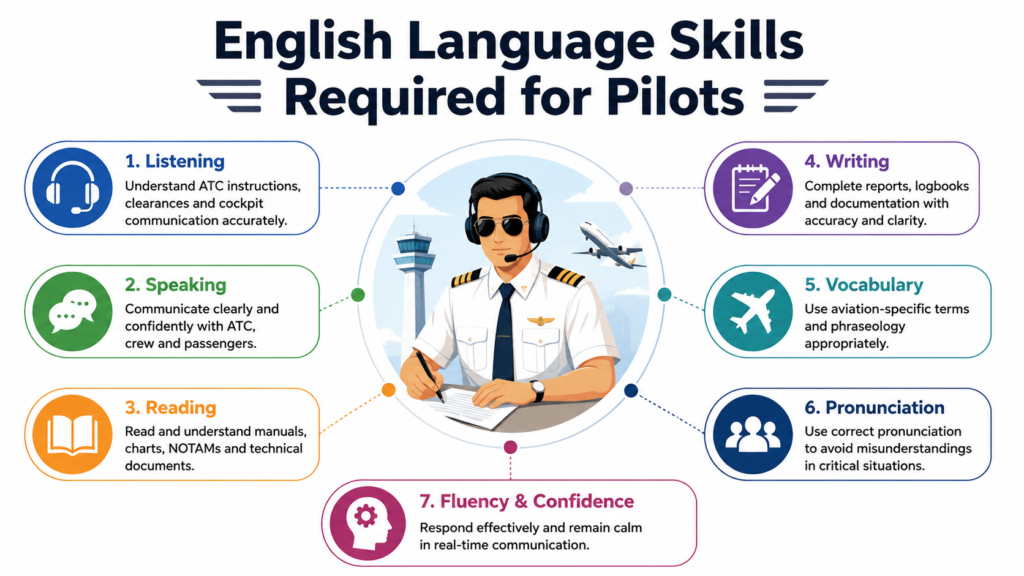
For this reason, English language skills required for pilots go beyond ordinary conversational English. Pilots need to listen carefully, speak clearly, understand aviation terminology, use appropriate phraseology, and explain situations effectively when standard communication is not enough.
Why English Is Important for Pilots
Aviation is an international industry in which people from different linguistic backgrounds regularly work together. English is widely used for international aviation communication, particularly in pilot and air traffic control communications.
During a flight, a pilot may need to communicate about departure clearances, altitude, routing, weather, traffic, aircraft conditions, and arrival procedures. These communications need to be understood correctly and delivered clearly.
A misunderstanding may create confusion, especially when communication involves time-sensitive information. Strong English skills therefore support effective coordination between pilots and other aviation professionals.
English is also important during pilot training. Students may encounter English in flight manuals, training materials, aviation examinations, technical documents, radio communication, and instructor briefings.
Understanding English Language Proficiency for Pilots
English proficiency for pilots is not simply the ability to have an everyday conversation in English. Aviation communication requires pilots to understand and use language appropriately in a professional environment.
A pilot should be able to understand spoken communication, express information clearly, use suitable vocabulary, and communicate effectively when circumstances change.
The International Civil Aviation Organization (ICAO) uses a language proficiency framework that evaluates areas including pronunciation, vocabulary, structure, fluency, comprehension, and interactions. ICAO’s framework is designed around communication in aviation contexts rather than general academic English.
The exact licensing and assessment requirements can vary depending on the applicable aviation authority, licence, and type of operation. Student pilots should therefore confirm the requirements that apply to their particular training and licensing pathway.
Key English Language Skills Required for Pilots
Pilots need several interconnected English skills. Strong performance in one area cannot always compensate for significant difficulty in another.
Listening Skills
Listening is one of the most important skills for pilots.
Pilots regularly receive information through radio communication and must understand instructions from air traffic controllers and other aviation personnel. They may also need to interpret weather information, clearances, traffic information, and operational messages.
Radio communication can sometimes be challenging because of background noise, signal quality, fast speech, or unfamiliar accents.
Developing strong listening skills helps pilots identify important information without becoming confused or relying on repeated transmissions.
Speaking Skills
Pilots must be able to communicate information clearly and confidently.
They may need to request information, report their position, confirm an instruction, communicate a change in circumstances, or coordinate with other crew members.
Effective aviation speaking does not require unnecessarily complicated sentences. In many situations, simple and precise language is more useful.
Student pilots should practice expressing information clearly rather than focusing only on conversational fluency.
Pronunciation
Clear pronunciation is particularly important during radio communication.
Words and numbers need to be understandable even when communication conditions are not perfect. Pronunciation that is difficult to understand can increase the chance of confusion.
Pilots do not necessarily need to sound like native English speakers. The focus should be on intelligibility and consistent pronunciation.
Regular speaking practice can help students become more comfortable with aviation terminology and improve the clarity of their speech.
Aviation Vocabulary
Pilots need a working vocabulary related to aviation.
This includes terminology associated with:
- Aircraft systems
- Navigation
- Weather
- Airports
- Flight operations
- Air traffic control
- Safety
- Emergencies
- Maintenance
- Human factors
Understanding these terms makes it easier for students to follow training and communicate during flight operations.
However, aviation vocabulary should not be learned in isolation. Pilots also need sufficient general English to explain situations that cannot be communicated completely through standardized terminology.
Grammar and Sentence Structure
Pilots do not need advanced literary English to communicate effectively in aviation.
They do, however, need enough grammar and sentence structure to express information accurately. A pilot should be able to describe a situation, ask a question, provide an explanation, and respond appropriately.
Clear grammar can become particularly important during unusual situations when a pilot needs to move beyond standard phraseology and describe what is happening in their own words.
Reading and Comprehension
Reading skills are an important part of pilot training and professional aviation.
Pilots may need to read:
- Aircraft operating manuals
- Flight procedures
- Weather information
- Safety documentation
- Training material
- Aviation notices
- Technical information
- Charts and related documentation
Good reading comprehension allows pilots to understand instructions and technical information without overlooking important details.
Fluency and Communication Confidence
Pilots need to communicate without excessive hesitation, particularly when information is time-sensitive.
Fluency does not mean speaking extremely quickly. Instead, it involves expressing information at an appropriate pace while maintaining clarity and accuracy.
Confidence also matters. A student who understands English but becomes too nervous to communicate may struggle during actual flight training.
Regular practice can make aviation communication feel more natural over time.
Aviation English vs. General English
Aviation English and general English overlap, but they are not exactly the same.
Everyday English may involve casual conversations, social situations, and general topics. Aviation English is more focused on precise communication involving aircraft operations, procedures, weather, navigation, and safety.
Standardized phraseology is commonly used for routine aviation communication because it helps reduce ambiguity.
However, standardized phraseology cannot describe every possible situation. When an unusual circumstance occurs, pilots may need to use plain language to explain the situation clearly.
This means effective aviation communication requires both familiarity with standard phraseology and the ability to communicate naturally when circumstances require additional explanation.
Importance of English in Pilot-to-ATC Communication
Communication between pilots and air traffic controllers is one of the most visible uses of English in aviation.
Pilots may use English when:
- Requesting departure or arrival clearances
- Reporting their position
- Confirming instructions
- Requesting changes
- Reporting weather conditions
- Communicating traffic information
- Asking for clarification
- Reporting unusual circumstances
- Coordinating during operational situations
The pilot needs to listen carefully to the instruction and respond appropriately.
Simply knowing individual English words is not enough. Pilots need to understand the meaning of the complete communication and recognize the information that requires action.
Importance of English in Cockpit Communication
English communication is not limited to conversations with air traffic control.
Pilots also communicate with other flight crew members throughout the flight. They may discuss checklists, aircraft systems, navigation, weather, flight planning, and operational decisions.
Clear cockpit communication helps both crew members maintain a shared understanding of the situation.
For student pilots, learning to communicate clearly during training can help establish good professional habits early in their careers.
Challenges Student Pilots May Face With English
Learning aviation English can be challenging, especially when a student is still becoming familiar with both flying and professional communication.
Some common difficulties include:
- Understanding fast radio transmissions
- Becoming familiar with aviation vocabulary
- Understanding unfamiliar accents
- Speaking clearly under pressure
- Remembering standard phraseology
- Understanding technical training material
- Responding quickly to instructions
- Explaining unexpected situations in English
- Maintaining concentration while listening to multiple transmissions
These difficulties do not necessarily indicate poor English ability. Aviation communication has its own terminology, pace, and context.
Consistent practice can help students become more comfortable.
How Pilots Can Improve Their English Language Skills
Improving English for pilots requires regular exposure and practical use. Students should make communication practice part of their normal flight-training routine.
Listen to Aviation Communications
Listening to aviation communication can help students become familiar with common terminology, speech patterns, and communication structures.
Students can gradually expose themselves to different speakers to improve their ability to understand variations in pronunciation and accent.
Practice Speaking Regularly
Speaking practice helps students become more comfortable expressing aviation-related information.
They can practice describing a flight, explaining weather conditions, discussing aircraft systems, or responding to simulated ATC situations.
The objective should be clear communication rather than using complicated vocabulary.
Learn Aviation Vocabulary
Students should build a strong foundation of aviation terminology.
Instead of simply memorizing definitions, they should learn how terms are used in actual aviation contexts. Using new vocabulary in sentences and realistic scenarios can make it easier to remember.
Practice Radio Communication Scenarios
Scenario-based practice can help students prepare for real communication.
For example, they can practice requesting information, confirming instructions, reporting conditions, or asking for clarification.
This can help connect English knowledge with practical flight situations.
Read Aviation Material
Reading aviation-related material regularly can improve vocabulary and comprehension.
Students can review appropriate training materials, operating procedures, aviation articles, and other relevant resources as part of their studies.
Work on Pronunciation and Clarity
Students should pay attention to how they pronounce commonly used aviation terms, numbers, names, and technical words.
Speaking clearly and at an appropriate pace is generally more useful than attempting to imitate a particular accent.
Practice Unexpected Situations
Students should also practice explaining situations that cannot be handled entirely through memorized phraseology.
This develops the ability to organize information and communicate it clearly when something unusual happens.
English Communication During Emergency and Unusual Situations
Routine communication often follows familiar patterns. Unexpected situations can be more challenging because pilots may need to describe circumstances that they have not encountered before.
For example, a pilot may need to explain an aircraft problem, report an unusual condition, request assistance, or clarify information.
In these situations, communication needs to remain clear and organized. The pilot should be able to explain the essential information without becoming overly complicated.
This is why aviation English training should include realistic scenarios rather than focusing exclusively on memorizing standard phrases.
Actual emergency communication must always follow the applicable aviation procedures, operational guidance, and training provided by the relevant authorities and operator.
English Language Assessment for Pilots
Aviation English assessments are designed to evaluate whether a pilot can communicate effectively in an aviation environment.
Depending on the applicable assessment system, areas may include:
- Pronunciation
- Vocabulary
- Grammar and structure
- Fluency
- Listening comprehension
- Interaction
- Ability to communicate in unexpected situations
ICAO’s language proficiency framework includes six areas of assessment and uses proficiency levels to describe aviation communication ability.
Students preparing for an assessment should therefore avoid focusing only on grammar exercises. Listening, speaking, comprehension, pronunciation, and practical communication should also receive regular attention.
How Strong English Skills Support a Pilot Career
Strong communication skills can benefit pilots throughout their training and professional careers.
During flight training, English helps students communicate with instructors and understand technical material. As pilots gain experience, communication becomes important for interactions with air traffic control, flight crew, dispatchers, ground personnel, and other aviation professionals.
For pilots interested in international aviation, being comfortable with English can be particularly important because they may encounter different accents, communication styles, and operational environments.
Good English should therefore be viewed as a professional aviation skill rather than simply an academic requirement.
Common Mistakes Pilots Should Avoid When Learning Aviation English
Memorizing Phrases Without Understanding Them
Memorizing standard phrases can be useful, but students should also understand their meaning and context.
This becomes especially important when they encounter a situation that cannot be handled using a familiar phrase.
Focusing Only on Grammar
Grammar is useful, but aviation communication requires more than grammatical knowledge.
Listening, pronunciation, vocabulary, comprehension, and interaction also need regular practice.
Ignoring Listening Practice
Some students spend more time reading and writing than listening.
Because pilots receive important information through spoken communication, listening should be an important part of aviation English preparation.
Being Afraid of Making Mistakes
Students may become hesitant because they are worried about making grammatical or pronunciation mistakes.
Practice is necessary for improvement. Students should focus on communicating their meaning clearly and use feedback to improve.
Trying to Imitate a Particular Accent
Pilots do not need to copy a specific English accent.
The goal should be clear and understandable speech rather than sounding like a particular group of speakers.
Using Unnecessarily Complicated Language
Long or complicated sentences can sometimes make communication less clear.
Pilots should prioritize concise, accurate, and understandable communication.
Not Practicing Unexpected Situations
Knowing routine phrases does not automatically prepare a pilot for unusual circumstances.
Students should practice explaining situations in plain English so that they can communicate effectively when standard phraseology is insufficient.
Practical English Skills Checklist for Student Pilots
Student pilots can regularly review the following areas:
- Listen to aviation communication from different speakers.
- Practice speaking clearly and at a controlled pace.
- Learn commonly used aviation terminology.
- Review standard aviation phraseology.
- Practice understanding different accents.
- Read aviation-related training material.
- Practice describing weather and flight situations.
- Work on pronunciation of important aviation terms.
- Practice asking for clarification when communication is unclear.
- Practice explaining unusual situations in plain English.
- Seek feedback from qualified instructors.
- Develop confidence through regular communication practice.
Frequently Asked Questions
1. Why is English important for pilots?
English is widely used in international aviation communication. Pilots need English to communicate with air traffic controllers, other flight crews, and aviation personnel and to understand important operational information.
2. Do pilots need to speak fluent English?
Pilots need sufficient English proficiency to communicate effectively in aviation situations. The focus is on clear, understandable, and appropriate communication rather than speaking English exactly like a native speaker.
3. What English skills are most important for pilots?
Listening and speaking are particularly important because pilots regularly receive and transmit information through spoken communication. Pronunciation, vocabulary, comprehension, grammar, and interaction skills are also important.
4. Is aviation English different from general English?
Yes. Aviation English includes specialized terminology and standardized phraseology used in flight operations. Pilots also need general language skills so they can explain situations when standard phraseology is not enough.
5. Do pilots need a native English accent?
No. Pilots do not need a particular accent. Their speech should be sufficiently clear and understandable for effective aviation communication.
6. How can student pilots improve their aviation English?
Students can improve by listening to aviation communications, practicing speaking, learning aviation vocabulary, reading aviation material, practicing realistic radio scenarios, and receiving feedback from instructors.
7. What is aviation English proficiency?
Aviation English proficiency refers to the ability to use English effectively in aviation communication. It involves areas such as pronunciation, vocabulary, structure, fluency, comprehension, and interaction.
8. Why are listening skills important for pilots?
Pilots receive important information through spoken communication, particularly during interactions with air traffic control. Strong listening skills help them understand instructions and respond appropriately.
9. How is English used between pilots and air traffic controllers?
Pilots use English to communicate requests, receive and confirm instructions, report positions and conditions, coordinate flight movements, and communicate other operational information.
10. Why is English important during unexpected aviation situations?
Unexpected situations may require pilots to explain circumstances that cannot be communicated completely through standard phraseology. The ability to use clear plain English can help pilots communicate the situation effectively.
Conclusion
English language skills are an important part of pilot training and professional aviation. Pilots need more than basic conversational English. They need to listen carefully, speak clearly, understand aviation vocabulary, use appropriate phraseology, read technical information, and communicate effectively when situations change.
Strong aviation English is not about using complicated words or adopting a particular accent. It is about making communication clear, accurate, understandable, and appropriate for the situation.
For student pilots, developing these skills alongside technical and practical flight training can build confidence and prepare them for the communication demands of the aviation profession. Regular listening, speaking, reading, vocabulary development, and realistic communication practice can help pilots become more effective communicators throughout their careers.
