
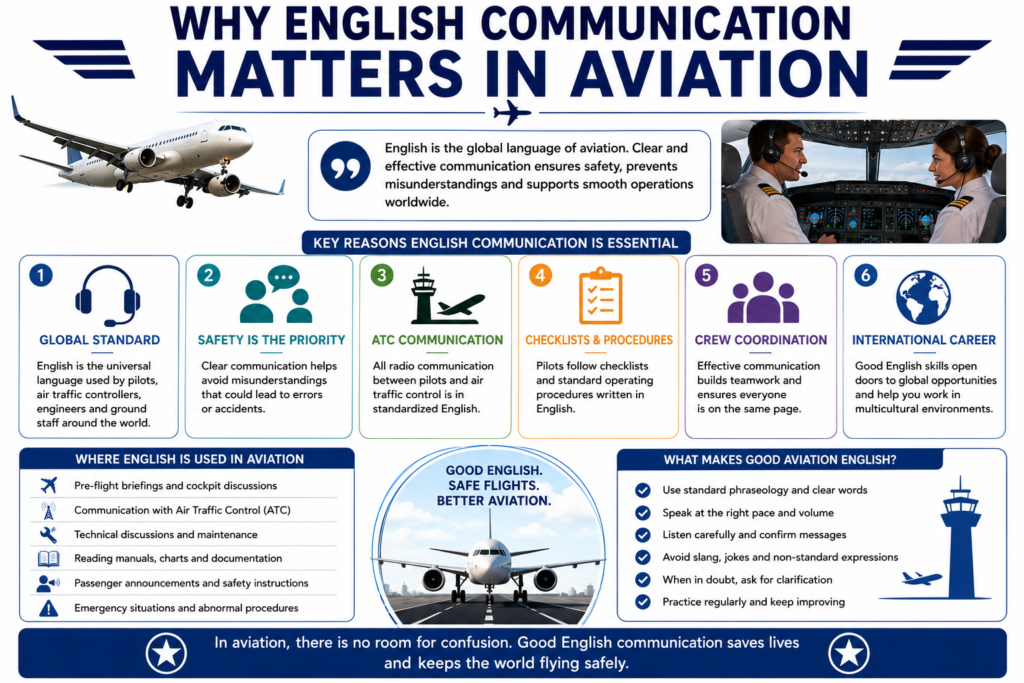
Introduction
Communication is one of the most important skills in aviation. Pilots do not operate aircraft in isolation. During a typical flight, they communicate with air traffic controllers, other pilots, cabin crew, ground personnel, maintenance teams, dispatchers, and other aviation professionals.
Because aviation is an international industry, English plays an important role in many areas of flight operations. Pilots may fly through different countries, communicate with controllers from different linguistic backgrounds, and work with crew members from diverse cultures. Clear and effective English communication helps everyone exchange important information accurately and efficiently.
Aviation English is also different from ordinary conversational English. Pilots need to understand specific terminology, standardized phraseology, instructions, aviation documents, and radio communication. They must also be able to communicate clearly when something unexpected happens.
Strong English communication does not guarantee flight safety by itself, but it is an important part of effective teamwork, situational awareness, training, and operational coordination.
Understanding the Role of English in Aviation
English has an important international role in aviation communication. Pilots operating internationally may need to communicate with air traffic services and aviation professionals in different countries.
During a flight, communication can involve information about:
- Altitude
- Heading
- Speed
- Route
- Weather
- Traffic
- Runways
- Clearances
- Navigation
- Aircraft conditions
- Operational requirements
The information exchanged during these communications needs to be understood correctly.
For a pilot, knowing English therefore means more than being able to hold an everyday conversation. It includes understanding aviation terminology, listening carefully to radio transmissions, speaking clearly, and communicating information without unnecessary ambiguity.
Why English Communication Matters in Aviation
Clear Communication Between Pilots and Air Traffic Controllers
Pilots and air traffic controllers constantly exchange information during flight operations.
This communication can involve departure clearances, taxi instructions, altitude changes, route information, traffic information, approach instructions, and other operational matters.
A pilot needs to understand the instruction and respond appropriately. When a readback is required, important information must also be repeated accurately.
Clear communication helps both sides maintain a shared understanding of what is expected.
Reducing Misunderstandings
Aviation communication often takes place in environments where workload can be high and information needs to be exchanged quickly.
Problems can occur when someone:
- Speaks too quickly
- Uses unclear pronunciation
- Misunderstands a word
- Provides incomplete information
- Assumes rather than confirms
- Uses an inappropriate expression
Good aviation English helps reduce unnecessary ambiguity.
If a pilot does not understand an instruction, asking for clarification is generally safer than making an assumption.
Supporting Flight Safety
Communication is closely connected with aviation safety because pilots need to exchange important information throughout a flight.
For example, a pilot may need to communicate:
- A technical concern
- Unexpected weather
- A change in flight conditions
- A navigation issue
- A medical situation
- A request for assistance
- An operational concern
Clear communication allows other people involved in the operation to understand the situation and coordinate an appropriate response.
Communication During Emergencies
Communication becomes particularly important during abnormal and emergency situations.
When workload increases, pilots may need to communicate important information quickly and clearly.
Depending on the situation, communication may involve:
- Identifying the nature of the problem
- Providing relevant aircraft information
- Requesting assistance
- Communicating intentions
- Coordinating with the flight crew
- Responding to instructions
Pilots are trained to use established procedures and appropriate communication techniques rather than relying on improvised language during stressful situations.
International Flight Operations
International flying can expose pilots to different accents, speech patterns, and communication styles.
A pilot may communicate with people who have English as their first language as well as people who use English as an additional language.
This makes listening and comprehension particularly important.
Pilots need to focus on the meaning of the communication rather than becoming dependent on a particular accent or speech pattern.
Cockpit Crew Communication
English is also important inside the cockpit, particularly in multinational flight operations.
Pilots need to communicate about:
- Flight plans
- Aircraft systems
- Checklists
- Navigation
- Weather
- Workload
- Operational decisions
- Abnormal situations
Effective cockpit communication allows crew members to share information and cross-check one another.
Aviation English vs General English
Pilots need general English skills, but aviation communication has additional requirements.
| General English | Aviation English |
|---|---|
| Used for everyday conversations | Used for operational aviation communication |
| Allows more informal expressions | Relies heavily on standardized terminology |
| Meaning can often be understood from context | Important information needs to be clear and precise |
| Conversational pace can vary | Speech should support accurate understanding |
| Vocabulary is usually general | Includes specialized aviation terminology |
| Communication may be flexible | Communication often follows established conventions |
This does not mean pilots need to speak like a textbook. Aviation English still requires natural communication skills, particularly when standard phraseology does not adequately describe an unusual situation.
Important English Skills Pilots Need
Listening Skills
Listening is one of the most important communication abilities for a pilot.
Pilots may need to understand radio transmissions while dealing with other cockpit tasks. They may also hear speakers with different accents and speech patterns.
Strong listening skills help pilots understand:
- ATC instructions
- Radio transmissions
- Weather information
- Operational briefings
- Crew communication
- Safety information
Students can improve listening ability by regularly practicing with appropriate aviation communication material.
Speaking Skills
Pilots need to speak clearly and confidently.
Important characteristics include:
- Clear pronunciation
- Appropriate speaking speed
- Correct terminology
- Concise communication
- Suitable volume
- Logical delivery
Speaking too quickly can make otherwise correct communication difficult to understand.
Reading Skills
Pilots encounter written English throughout their training and careers.
They may need to understand:
- Aviation manuals
- Checklists
- Flight documentation
- Weather information
- NOTAMs
- Training material
- Operational procedures
Strong reading skills allow pilots to understand important information without depending unnecessarily on others.
Writing Skills
Although radio communication is primarily spoken, pilots also encounter written communication.
Examples include:
- Reports
- Operational records
- Safety reports
- Training documentation
- Maintenance-related information
- Aviation notes
Written communication needs to be clear enough for other professionals to understand the information correctly.
Aviation Vocabulary
Pilots need to develop vocabulary related to different areas of aviation.
Important categories include:
- Aircraft systems
- Navigation
- Weather
- Airports
- Flight operations
- Emergencies
- Maintenance
- Human factors
A strong aviation vocabulary makes it easier to understand training material and communicate accurately.
ICAO Aviation English Proficiency
International aviation places importance on English language proficiency for operational communication.
The International Civil Aviation Organization, commonly known as ICAO, has established language-proficiency standards for relevant aviation communication.
Aviation English proficiency is commonly considered across areas such as:
- Pronunciation
- Structure
- Vocabulary
- Fluency
- Comprehension
- Interaction
These areas are broader than simply knowing English grammar.
A pilot needs to be able to understand and communicate information effectively in aviation situations.
Specific licensing and language-testing requirements can vary according to the applicable aviation authority, license, operation, and regulatory framework. Students should therefore follow the requirements that apply to their particular training and licensing pathway.
Standard Phraseology and Plain English
Aviation communication uses standardized phraseology for many routine situations.
Standard Phraseology
Standard phraseology provides predictable terminology for common aviation communications.
Using established terminology can reduce unnecessary variation and make routine communication more efficient.
Plain English
There are situations where standard phraseology may not fully explain an unusual or unexpected situation.
In such circumstances, pilots may need to use plain language to explain what is happening.
The objective remains the same: communicate the situation clearly enough for the other person to understand it.
A pilot therefore needs to understand both standardized aviation phraseology and effective general communication.
Communication Between Pilots and Air Traffic Control
Before Departure
Communication before departure may include information related to:
- Clearances
- Taxiing
- Runway use
- Departure procedures
- Traffic
- Airport conditions
Pilots need to listen carefully and ensure they understand relevant instructions.
During Flight
Once airborne, communication may involve:
- Altitude
- Heading
- Route
- Position
- Traffic
- Weather
- Frequency changes
- Operational requests
The information can change rapidly, particularly in busy airspace.
During Approach
Communication during approach can involve:
- Approach instructions
- Runway assignment
- Altitude restrictions
- Traffic information
- Landing clearance
- Missed-approach information
Pilots need to maintain accurate situational awareness while managing other cockpit responsibilities.
After Landing
Communication continues after touchdown.
Pilots may receive taxi instructions and other information relating to movement on the airport surface.
This demonstrates that English communication is not only important while an aircraft is in the air. It can be relevant throughout the entire flight operation.
How Poor English Communication Can Create Aviation Challenges
Communication difficulties do not necessarily mean that someone lacks general English ability. Even a person with good conversational English can experience challenges in aviation environments.
Common problems include:
Misheard Instructions
Radio transmissions may be difficult to understand because of noise, signal quality, workload, or unfamiliar speech patterns.
Unclear Pronunciation
Words that sound too similar or are pronounced unclearly can create confusion.
Speaking Too Quickly
Fast speech may make it difficult for another person to identify important information.
Incomplete Communication
Leaving out important details can make a message difficult to interpret.
Failure to Ask for Clarification
Trying to guess what someone said can be more problematic than simply asking for the message to be repeated.
Difficulty Understanding Accents
International aviation involves people with different accents. Students should develop listening skills that allow them to understand a range of speakers.
Using Unnecessarily Complex Language
Simple, direct communication is often more effective than complicated sentences.
Common Aviation Communication Mistakes Students Should Avoid
Speaking Too Quickly
Students may speak faster when they become nervous.
Instead, they should concentrate on a controlled pace that allows the listener to understand each important part of the message.
Using Unnecessary Words
Aviation communication generally benefits from being concise.
Students should avoid adding unnecessary explanations when a clear and direct message is sufficient.
Guessing When Something Is Not Understood
If an instruction is unclear, students should develop the habit of seeking clarification instead of assuming what was said.
Poor Pronunciation
Pronunciation should be clear enough for the listener to understand the intended words.
Students can identify weak areas by practicing aloud and reviewing their speech.
Ignoring Readback Requirements
When a readback is required, students need to understand which information must be repeated and communicate it accurately.
Using Informal Expressions
Casual language may be appropriate in everyday conversations but is not always suitable for operational aviation communication.
Becoming Afraid of Making Mistakes
Language improvement takes practice.
Students should focus on communicating clearly, learning from mistakes, and developing confidence rather than trying to sound perfect.
Communication During Emergencies and Abnormal Situations
Emergency communication can be challenging because pilots may be managing several tasks simultaneously.
Clear communication can help organize the situation.
Important principles include:
- State the problem clearly.
- Communicate relevant information.
- Avoid unnecessary details.
- Follow applicable procedures.
- Ask for clarification when needed.
- Keep communication organized.
- Coordinate with other crew members.
The exact communication used depends on the situation and applicable procedures.
Training and simulator practice can help pilots become more comfortable communicating under pressure.
How English Supports Crew Resource Management
Crew Resource Management, or CRM, emphasizes effective teamwork and communication in aviation.
Communication helps crew members share information and maintain awareness of what is happening.
Good cockpit communication can support:
- Team coordination
- Information sharing
- Cross-checking
- Decision-making
- Workload management
- Situational awareness
- Error identification
An effective crew environment should allow members to raise concerns clearly and respectfully.
Communication is therefore not simply about speaking correctly. It is also about listening, confirming, questioning, and sharing relevant information.
How Aviation Students Can Improve Their English Communication
Listen to Aviation Communication
Regular listening practice can help students become familiar with aviation terminology, speech patterns, and radio communication.
Students can use appropriate training resources and supervised aviation communication exercises.
Practice Speaking Clearly
Students should practice:
- Pronunciation
- Aviation terminology
- Short communication patterns
- Structured responses
- Appropriate speaking speed
Speaking aloud is more useful than simply reading aviation vocabulary silently.
Build Aviation Vocabulary
Students can organize vocabulary into categories.
For example:
Weather:
Visibility, turbulence, wind, cloud, icing
Navigation:
Heading, altitude, waypoint, route, position
Airport operations:
Runway, taxiway, apron, holding point
Aircraft:
Engine, fuel, landing gear, flight controls
This makes it easier to remember terminology within its operational context.
Practice Listening to Different Accents
Students should not practice only with one speaker.
Exposure to different accents and speech patterns can help develop stronger listening comprehension.
Use Aviation Role-Play
Role-play can simulate situations such as:
- Pilot and ATC communication
- Pilot and cabin crew communication
- Pilot and ground personnel communication
- Abnormal situation communication
Practicing scenarios helps students become more comfortable communicating under realistic conditions.
Record and Review Your Speech
Recording practice sessions can help students identify:
- Unclear pronunciation
- Excessive pauses
- Speaking too quickly
- Repeated words
- Unnecessary expressions
Students can then work specifically on those areas.
Ask for Clarification During Training
Students should develop the habit of asking when something is unclear.
This is a useful communication behavior that can carry over into real operational environments.
English Communication in Pilot Training
English communication should be developed alongside other pilot skills rather than treated as a separate subject that only matters after training.
Students may encounter English throughout:
- Ground school
- Flight briefings
- Simulator training
- Radio communication
- Navigation exercises
- Debriefing
- Aviation examinations
- Technical training
Regular exposure helps students become more comfortable with aviation terminology and communication patterns.
Over time, students can learn to communicate more naturally without mentally translating every sentence before speaking.
Benefits of Strong English Communication Skills for Pilots
Better ATC Coordination
Clear communication helps pilots exchange operational information effectively with air traffic services.
Improved Situational Awareness
Understanding relevant information allows pilots to maintain a better picture of the flight environment.
More Effective Crew Communication
Pilots can communicate plans, concerns, and observations more effectively with other crew members.
Greater Confidence During International Operations
Strong English skills can make communication more manageable when operating in unfamiliar international environments.
Better Understanding of Aviation Documentation
Reading ability helps pilots understand manuals, procedures, weather information, and other documents.
More Effective Emergency Communication
The ability to communicate important information clearly can be particularly valuable when workload is high.
Improved Training and Learning
Good English skills can make it easier for students to understand instructors, technical material, procedures, and aviation concepts.
Better Professional Communication
Pilots interact with many professionals throughout their careers. Strong communication can support effective coordination across different areas of aviation.
English Communication Challenges for Student Pilots
Nervousness While Speaking
Students may know the correct words but struggle to speak confidently.
How to improve: Practice regularly in realistic scenarios rather than studying vocabulary alone.
Difficulty Understanding Accents
Students may initially find unfamiliar accents difficult to understand.
How to improve: Listen to a variety of appropriate aviation communication examples.
Limited Aviation Vocabulary
A student may have good general English but limited aviation terminology.
How to improve: Build vocabulary gradually through flight training and aviation-related reading.
Translating Mentally
Some students first think in their native language and then translate into English.
How to improve: Practice common aviation communication patterns until they become more natural.
Speaking Too Quickly
Nervousness can cause students to increase their speaking speed.
How to improve: Focus on controlled, deliberate speech.
Lack of Radio Practice
Knowing aviation terminology is different from using it during communication.
How to improve: Practice through supervised radio and simulator exercises.
Difficulty Communicating Under Pressure
Stress can affect both comprehension and speech.
How to improve: Use realistic training scenarios and practice structured communication.
English Communication vs Aviation Phraseology
| Area | General English | Aviation Communication |
|---|---|---|
| Purpose | Everyday communication | Safe and efficient operational communication |
| Language | Flexible | More standardized |
| Vocabulary | General terms | Aviation-specific terminology |
| Clarity | Important | Particularly important |
| Context | Often informal | Operational context must be clear |
| Response | Conversational | Often structured and concise |
Pilots need both forms of communication.
General English provides the foundation for understanding and expressing ideas, while aviation communication adds specialized vocabulary, phraseology, and operational conventions.
How Strong English Skills Help Future Pilots
English communication can remain important throughout a pilot’s career.
It can support:
- Flight training
- Simulator sessions
- Airline operations
- International flying
- Crew coordination
- ATC communication
- Safety reporting
- Professional development
However, English proficiency is only one part of becoming a competent pilot. Aviation knowledge, technical skills, decision-making, situational awareness, teamwork, training, and adherence to procedures are equally important parts of professional flying.
Frequently Asked Questions
1. Why is English important for pilots?
English is important because it is widely used for international aviation communication. Pilots may need to communicate with air traffic controllers and aviation professionals from different countries and backgrounds.
2. Do pilots need to speak fluent English?
Pilots need an appropriate level of English communication ability for their aviation duties. The required proficiency can depend on the applicable aviation authority, license, and operation.
3. What is aviation English?
Aviation English refers to the English communication skills used in aviation environments. It includes aviation vocabulary, standardized phraseology, pronunciation, listening, comprehension, speaking, and the ability to communicate effectively in operational situations.
4. What is ICAO English proficiency?
ICAO language proficiency standards provide a framework for assessing relevant aviation communication abilities. Areas commonly considered include pronunciation, structure, vocabulary, fluency, comprehension, and interaction.
5. Why is English used in international aviation?
English has an established international role in aviation and is widely used for communication between pilots and air traffic services in international operations.
6. How can student pilots improve their English?
Students can improve by practicing listening and speaking, learning aviation vocabulary, listening to different accents, participating in role-play exercises, and regularly practicing aviation communication.
7. Is general English enough for pilot training?
General English provides an important foundation, but pilots also need aviation-specific terminology, phraseology, listening ability, and communication skills.
8. Why is pronunciation important in aviation?
Clear pronunciation helps listeners understand spoken information accurately, particularly during radio communication where signal quality and background noise may affect comprehension.
9. What English skills are most important for pilots?
Listening, speaking, pronunciation, comprehension, vocabulary, reading, and writing are all useful. Listening and clear spoken communication are particularly important during operational activities.
10. How does English communication contribute to flight safety?
Clear communication can help pilots, controllers, and crew members exchange important information and maintain a shared understanding of the situation. It is one component of a broader aviation safety system.
Conclusion
English communication is an important part of modern aviation because pilots constantly exchange information with air traffic controllers, crew members, ground personnel, maintenance teams, and other aviation professionals.
Effective aviation communication requires more than general conversational English. Pilots need clear pronunciation, strong listening skills, appropriate vocabulary, concise speaking habits, reading ability, and an understanding of aviation phraseology.
For student pilots, developing these skills early can make flight training and operational communication more manageable. Regular listening practice, speaking exercises, aviation vocabulary development, role-play, and exposure to different accents can gradually build confidence and communication ability.
