
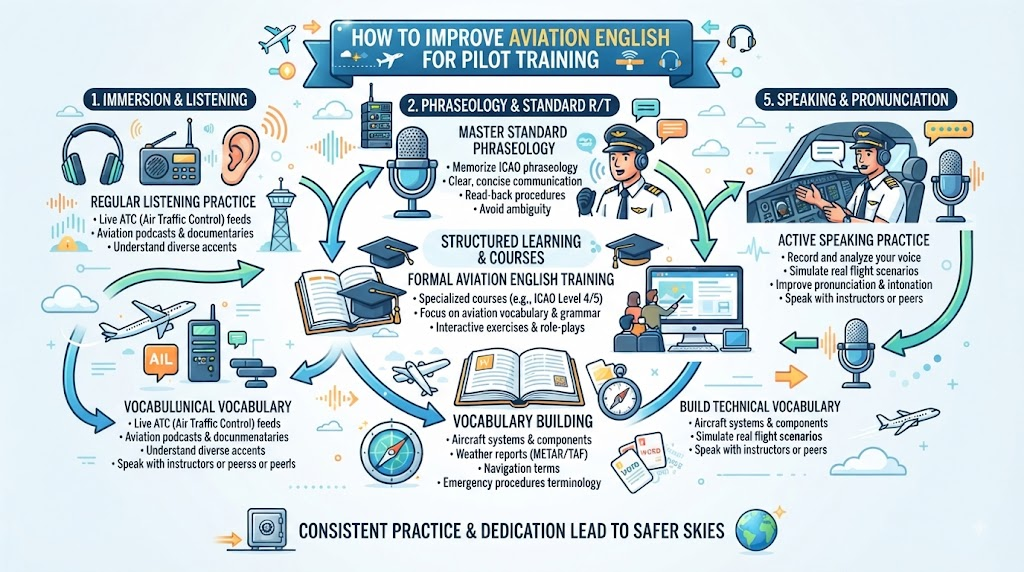
Introduction
English is an important part of modern aviation communication. Pilots use English when communicating with air traffic controllers, flight instructors, other pilots, ground personnel, and operations teams. During pilot training, students must learn not only how to fly an aircraft but also how to communicate information clearly and accurately.
Aviation English is different from ordinary conversational English. It combines general language ability with aviation terminology, standard phraseology, listening comprehension, pronunciation, and the ability to communicate effectively in routine and unexpected situations.
Students do not need to use complicated English to communicate effectively in aviation. The goal is to communicate information in a way that is clear, understandable, accurate, and appropriate for the situation.
Developing these skills early can make flight training, radio communication, briefings, and aviation examinations easier to manage.
What Is Aviation English?
Aviation English refers to the language skills used for communication in aviation operations.
It includes more than knowing words such as “runway,” “altitude,” or “aircraft.” Pilots need to understand what other aviation professionals are saying and provide accurate information in return.
Aviation English involves several important areas:
- General English proficiency
- Aviation vocabulary
- Standard phraseology
- Listening comprehension
- Clear pronunciation
- Speaking fluency
- Understanding different accents
- Describing aviation situations
- Communicating during unexpected circumstances
For a student pilot, developing these abilities means learning how to use English in realistic aviation situations rather than simply memorizing vocabulary.
Why Aviation English Is Important for Pilot Training
Communication is involved in almost every stage of flight training.
Communication With Air Traffic Control
Pilots need to understand instructions, clearances, traffic information, weather information, and other operational messages.
A misunderstanding involving an altitude, heading, runway, or frequency can create serious operational problems. This is why aviation communication places strong emphasis on clarity and accuracy.
Communication With Flight Instructors
Student pilots regularly communicate with instructors during:
- Pre-flight briefings
- Flight lessons
- Post-flight discussions
- Aircraft inspections
- Training exercises
- Emergency and abnormal-procedure practice
Students need enough English ability to understand explanations and ask questions when something is unclear.
Communication With Other Crew Members
As pilots progress into professional aviation, communication with other crew members becomes increasingly important.
Pilots may need to discuss aircraft systems, weather, navigation, fuel, operational decisions, and unexpected situations.
Communication With Ground Personnel
Aviation operations also involve communication with ground staff, maintenance personnel, dispatchers, and other airport teams.
This means that aviation English extends beyond cockpit-to-ATC communication.
Communication During Unexpected Situations
Normal communication can become more challenging when workload increases.
A pilot may need to explain an aircraft problem, request assistance, describe weather conditions, or communicate an unexpected change in circumstances.
Clear language becomes particularly important when there is limited time to communicate.
General English vs Aviation English
General English provides the foundation for aviation communication, but aviation English has additional requirements.
| General English | Aviation English |
|---|---|
| Everyday conversation | Operational communication |
| General vocabulary | Aviation-specific vocabulary |
| Flexible expressions | Standardized phraseology where applicable |
| Social and professional communication | Pilot, ATC, and operational communication |
| General listening | Radio and aviation communication comprehension |
| Everyday pronunciation | Clear pronunciation of aviation information |
A student with strong general English may still need additional practice before becoming comfortable with aviation communication.
Similarly, someone with limited general English can gradually develop aviation communication skills through structured practice.
Important Aviation English Skills for Student Pilots
Several language skills are particularly useful during pilot training.
Listening Skills
Listening is one of the most important aviation English skills.
Pilots may hear communication through radio equipment, which can make understanding more difficult than normal face-to-face conversation.
Students should practice understanding:
- Different accents
- Different speaking speeds
- Callsigns
- Numbers
- Frequencies
- Altitudes
- Headings
- Runway information
- Weather information
- Clearances
- Instructions
The objective is not to understand every single word individually. Students should learn to identify the information that matters for the flight.
Speaking Skills
Pilots need to communicate clearly and efficiently.
Good aviation speaking skills include:
- Clear pronunciation
- Appropriate speaking speed
- Accurate terminology
- Logical sentence structure
- Concise communication
- Appropriate phraseology
- Confidence when responding
Using unnecessarily complicated vocabulary does not make communication better. Aviation communication should make important information easy to understand.
Pronunciation
Pronunciation matters because aviation communication often involves information that can easily be misunderstood.
Students should practice clearly pronouncing:
- Letters
- Numbers
- Callsigns
- Frequencies
- Altitudes
- Headings
- Locations
- Runway numbers
Students should also avoid speaking too quickly, particularly when communicating important information.
Aviation Vocabulary
Students should gradually develop a strong aviation vocabulary.
Useful categories include:
Aircraft
- Fuselage
- Wing
- Empennage
- Landing gear
- Flaps
- Ailerons
- Elevator
- Rudder
Flight Operations
- Takeoff
- Climb
- Cruise
- Descent
- Approach
- Landing
- Taxi
Weather
- Visibility
- Turbulence
- Crosswind
- Wind shear
- Thunderstorm
- Cloud base
Navigation
- Heading
- Track
- Bearing
- Altitude
- Waypoint
- Frequency
Learning these terms in context is generally more useful than memorizing long lists of isolated words.
Learn Standard Aviation Phraseology
Standard phraseology is an important part of aviation communication.
It provides commonly recognized expressions that can make communication more predictable and reduce ambiguity.
Students may encounter terms such as:
- Affirm
- Negative
- Confirm
- Stand by
- Unable
- Wilco
- Say again
- Readback
Students should learn what these terms mean and when they are appropriately used.
Standard phraseology should be learned through approved training materials and the procedures applicable to the student’s aviation authority and operating environment.
It is also important to understand that not every communication situation can be handled with a memorized phrase. Pilots need sufficient general English ability to communicate when standard phraseology does not completely describe the situation.
Practice Listening to Aviation Communication
Listening practice should become part of a student’s regular routine.
Listen to Aviation Recordings
Students can use legitimate aviation communication recordings and training resources to become familiar with real-world communication.
Initially, they can focus on identifying:
- The aircraft callsign
- The instruction
- Numbers
- Frequencies
- Altitudes
- Headings
- Runway information
With practice, students can gradually understand longer and more complex communications.
Start With Easier Material
Students who are new to aviation English should not begin with the most difficult radio recordings.
Start with instructional material where the speaker is relatively easy to understand.
Once comfortable, move toward more realistic communication involving multiple speakers and different accents.
Listen for Meaning
Instead of trying to translate every word, ask:
- Who is speaking?
- Who is being addressed?
- What instruction was given?
- What information is important?
- What action is expected?
This approach can improve both listening speed and comprehension.
Improve Aviation English Through Readback Practice
Readback practice can help student pilots develop both listening and speaking skills.
A student can listen to an instruction and then repeat the important information accurately.
Practice can include:
- Altitudes
- Headings
- Frequencies
- Runways
- Routes
- Squawk codes
- Clearances
The exercise is not simply about repeating words. Students need to identify important information and reproduce it accurately.
This can also help students become more comfortable with aviation numbers and terminology.
Build an Aviation Vocabulary Notebook
A dedicated aviation vocabulary notebook can be a simple but effective learning tool.
Instead of maintaining one long list, organize words by subject.
For example:
Aircraft Systems
- Engine
- Propeller
- Fuel system
- Electrical system
- Hydraulic system
Weather
- Visibility
- Pressure
- Wind
- Turbulence
- Precipitation
Airport Operations
- Apron
- Taxiway
- Runway
- Holding point
- Parking stand
Navigation
- Heading
- Bearing
- Track
- Waypoint
- VOR
- Frequency
Students should also write a simple example sentence for each new word.
This helps them understand how vocabulary is used in an aviation context.
Improve English Through Flight Briefings
Flight briefings provide a useful opportunity to practice aviation English.
Students can practice explaining:
- Weather conditions
- Planned route
- Aircraft status
- Fuel considerations
- Expected traffic
- Takeoff considerations
- Landing considerations
- Possible hazards
For example, instead of simply memorizing the word “crosswind,” a student can practice describing how crosswind conditions may affect a flight.
This connects language learning with actual aviation knowledge.
Practice Speaking Without Translating From Your Native Language
One common difficulty among language learners is mentally translating every sentence before speaking.
This can slow communication and make speech less natural.
Students should gradually learn common aviation expressions as complete communication patterns.
For example, rather than constructing every sentence from individual words, students can become familiar with commonly used aviation communication structures.
The goal is not to eliminate thinking before speaking. It is to reduce unnecessary translation and make communication more natural.
Improve Your Aviation English Pronunciation
Regular pronunciation practice can improve confidence.
A simple exercise involves:
- Selecting a list of aviation terms.
- Reading the terms aloud.
- Recording your voice.
- Listening to the recording.
- Identifying unclear words.
- Repeating the difficult terms.
Students can also practice letters and numbers because these are frequently used in aviation communication.
Speaking at a controlled pace is equally important. Trying to sound fast or overly fluent can make communication less understandable.
Learn to Communicate Under Pressure
Aviation communication does not always happen in relaxed conditions.
Workload can increase because of:
- Changing weather
- Heavy radio traffic
- Navigation problems
- Aircraft malfunctions
- Unexpected instructions
- Abnormal situations
Students can practice communication through simulated scenarios.
For example, they can practice explaining an aircraft problem while maintaining a logical sequence:
- What happened?
- What is the current situation?
- What information is important?
- What assistance is required?
This helps develop the ability to communicate clearly when the situation becomes more demanding.
Practice Aviation English Every Day
Regular practice is usually more effective than studying large amounts of material occasionally.
A 15-Minute Daily Routine
Five Minutes: Listening
Listen to aviation communication or an aviation-English learning resource.
Five Minutes: Vocabulary
Review aviation terminology and learn a few new terms.
Five Minutes: Speaking
Read aviation phrases aloud or describe a simple aviation situation.
A 30-Minute Routine
Students with more time can divide their practice into:
- 10 minutes of listening
- 10 minutes of vocabulary and phraseology
- 10 minutes of speaking
The routine can gradually become more difficult as the student’s communication ability improves.
Use Flight Simulation for English Practice
Flight simulation can provide opportunities to practice aviation communication in a realistic environment.
Students can simulate:
- Taxi communication
- Departure communication
- En-route communication
- Arrival communication
- Weather changes
- Radio frequency changes
- Unexpected situations
Simulation should be treated as an additional learning tool rather than a replacement for formal flight instruction.
The main purpose is to become comfortable processing aviation information and responding clearly.
Practice With a Flight Training Partner
Students can also practice with classmates.
One student can act as the pilot while the other acts as ATC or a flight instructor.
They can create simple scenarios involving:
- Taxi instructions
- Departure clearances
- Weather information
- Navigation
- Arrival procedures
- Unexpected situations
After each exercise, they can review:
- Was the communication clear?
- Were important numbers repeated correctly?
- Was the pronunciation understandable?
- Was unnecessary language used?
- Was clarification requested when necessary?
This type of practice can make aviation English less intimidating.
Common Aviation English Mistakes Students Should Avoid
Speaking Too Fast
Speaking quickly can make pronunciation less clear.
Students should focus on a controlled pace, especially when transmitting important information.
Using Unnecessarily Complicated English
Aviation communication is not the place to demonstrate an extensive vocabulary.
Clear and simple language is often more effective.
Mispronouncing Numbers and Letters
A small pronunciation problem can change important information.
Students should practice standardized aviation pronunciation carefully.
Ignoring Readbacks
When a readback is required, students need to accurately repeat the relevant information.
This requires both listening and speaking accuracy.
Using Slang
Slang and informal expressions can create confusion.
Students should become familiar with appropriate aviation terminology and phraseology instead.
Translating Word-for-Word
Direct translation can produce unnatural or confusing expressions.
Students should learn aviation communication patterns rather than translating every sentence from another language.
Being Afraid to Ask for Clarification
If a pilot does not understand an important communication, guessing is not an appropriate solution.
Students should learn the correct procedure for requesting clarification or repetition.
How to Improve Aviation English Listening for Different Accents
Pilots may communicate with people from many linguistic and cultural backgrounds.
As a result, students should gradually become comfortable listening to different accents and speech patterns.
Useful approaches include:
- Listening to multiple speakers
- Practicing with realistic aviation recordings
- Avoiding dependence on a single speaker’s pronunciation
- Focusing on context
- Identifying key information
- Repeating difficult recordings
- Practicing unfamiliar pronunciation patterns
The objective is not to imitate every accent. It is to develop reliable comprehension.
Aviation English and ICAO Language Proficiency
The International Civil Aviation Organization (ICAO) has established language proficiency standards for aviation communication.
Language proficiency is commonly considered across areas such as:
- Pronunciation
- Structure
- Vocabulary
- Fluency
- Comprehension
- Interactions
These areas look at more than grammatical accuracy.
For example, a pilot may know many aviation terms but still have difficulty understanding radio communication. Another student may have good grammar but speak too quickly or unclearly.
Effective aviation English requires a combination of these skills.
Students should always check the current requirements applicable to their licence, country, aviation authority, and training organization because specific requirements can differ.
How to Prepare for an Aviation English Assessment
Preparation should focus on actual communication ability rather than memorizing model answers.
Students can:
- Practice listening regularly
- Review aviation vocabulary
- Improve pronunciation
- Practice spontaneous speaking
- Describe aviation situations
- Listen to different speakers
- Practice unexpected scenarios
- Record their own speech
- Review areas where communication breaks down
Students should also become comfortable communicating situations they have not specifically memorized.
This helps build flexibility and confidence.
How to Describe an Aviation Situation in English
A pilot may need to explain a situation rather than simply use standard phraseology.
Students can practice describing:
- Weather
- Aircraft problems
- Traffic
- Runway conditions
- Navigation difficulties
- Passenger-related situations
- Abnormal circumstances
A useful structure is:
What Happened?
Clearly identify the problem or situation.
What Is Happening Now?
Explain the current condition.
What Information Is Important?
Provide relevant details such as location, altitude, aircraft status, or weather, as appropriate.
What Is Required?
Explain what assistance or action is needed.
This structure helps students communicate logically without becoming unnecessarily wordy.
Practical 30-Day Aviation English Improvement Plan
A structured month-long plan can help students develop consistent habits.
Week 1: Build the Foundation
Focus on:
- Basic aviation vocabulary
- Aircraft parts
- Flight phases
- Aviation numbers
- Aviation alphabet
- Basic phraseology
The goal is to become familiar with fundamental terminology.
Week 2: Improve Listening
Practice:
- ATC recordings
- Different speakers
- Numbers and frequencies
- Clearances
- Readbacks
The goal is to identify important information quickly.
Week 3: Improve Speaking
Practice:
- Flight briefings
- Aviation conversations
- Situation descriptions
- Radio-style communication
- Pronunciation
Students should record themselves where possible and review their speech.
Week 4: Combine All Skills
Practice complete scenarios involving:
- Listening
- Speaking
- Vocabulary
- Phraseology
- Unexpected situations
The objective is to use several language skills together rather than practicing each skill separately.
How Instructors Can Help Students Improve Aviation English
Flight instructors can play an important role in language development.
They can help students by:
- Correcting unclear communication
- Introducing appropriate aviation terminology
- Practicing radio scenarios
- Reviewing misunderstood instructions
- Allowing students to conduct flight briefings
- Encouraging questions
- Practicing abnormal communication scenarios
Students should also actively ask instructors when they do not understand a term, instruction, or communication pattern.
Aviation English Checklist for Student Pilots
| Skill | What Students Should Practice |
|---|---|
| Listening | Understand aviation communication and instructions |
| Speaking | Communicate clearly and concisely |
| Pronunciation | Make words, numbers, and letters understandable |
| Vocabulary | Learn aviation terminology in context |
| Phraseology | Understand standardized expressions |
| Comprehension | Identify important information |
| Fluency | Speak without excessive hesitation |
| Interaction | Respond appropriately and request clarification |
This checklist can be used to identify areas that need additional practice.
Frequently Asked Questions
1. Why is English important for pilot training?
English is widely used for aviation communication. Student pilots need English to communicate with instructors, air traffic controllers, other pilots, and aviation personnel.
2. Is general English enough for pilot training?
General English provides an important foundation, but students also need aviation-specific vocabulary, listening skills, pronunciation, phraseology, and communication practice.
3. How can I improve my aviation English quickly?
Regular practice is more useful than trying to improve everything at once. Listening to aviation communication, reviewing vocabulary, practicing speaking, and using realistic scenarios can help build skills.
4. How can I improve my aviation English listening skills?
Listen regularly to legitimate aviation recordings and training materials. Start with easier material and gradually practice communication involving different speakers, accents, and speaking speeds.
5. Do pilots need to speak English like native speakers?
No. The goal is not necessarily to sound like a native English speaker. Pilots need to communicate clearly, understandably, and effectively.
6. What aviation vocabulary should student pilots learn first?
Students can begin with aircraft parts, flight phases, weather, navigation, airport operations, aircraft systems, and common operational terminology.
7. How can I practice aviation English at home?
You can listen to aviation communication, review vocabulary, read aviation material aloud, record your voice, practice simulated conversations, and describe aviation situations in English.
8. What is aviation phraseology?
Aviation phraseology refers to standardized expressions used in aviation communication. It helps make routine communications predictable and reduces the possibility of misunderstanding.
9. What should I do if I do not understand an ATC transmission?
A pilot should follow the applicable communication procedure to request clarification or repetition rather than guessing what was said.
10. How long does it take to become comfortable with aviation English?
It varies from person to person. Existing English ability, aviation exposure, practice frequency, and the training environment all affect progress. Consistent practice can gradually improve confidence and communication ability.
Conclusion
Improving aviation English is an ongoing part of becoming a capable pilot. It is not simply about memorizing aviation words or learning a collection of standard phrases.
Student pilots need to develop several connected skills, including listening, speaking, pronunciation, vocabulary, comprehension, fluency, and effective interaction.
Regular exposure to aviation communication can help students become more comfortable with radio transmissions and different speaking styles. Speaking practice, flight briefings, simulation exercises, vocabulary review, and communication scenarios can further strengthen these skills.
