
Introduction
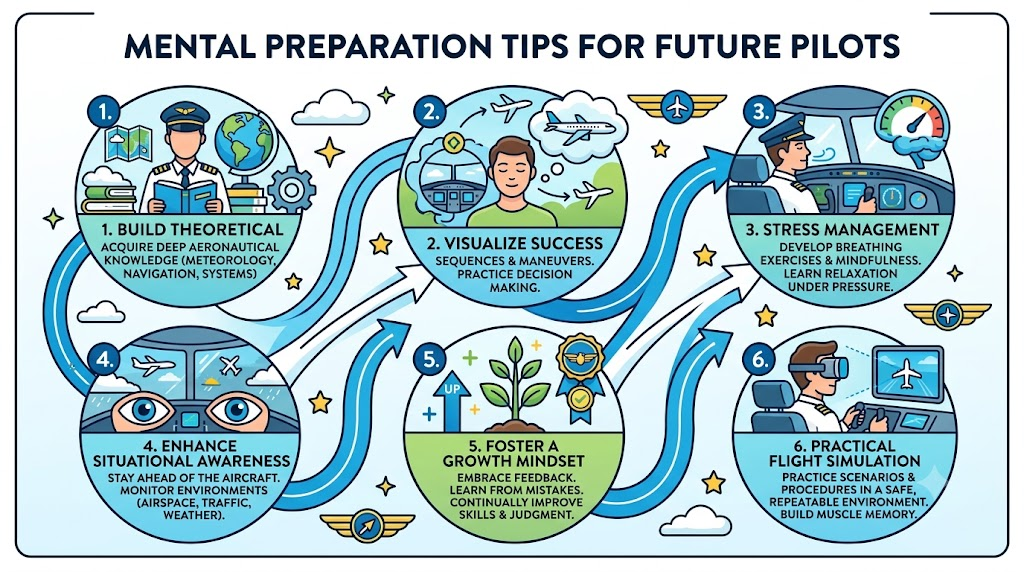
Becoming a pilot requires more than learning how to operate an aircraft. Future pilots also need the right mindset to handle pressure, follow procedures, learn from mistakes, and remain focused during training. Mental preparation can help students approach flight training with greater confidence and discipline. This guide explains practical ways aspiring pilots can prepare themselves mentally for the challenges of pilot training.
Why Mental Preparation Matters for Future Pilots
Flight training introduces students to situations that require concentration, quick thinking, discipline, and responsibility. A student may understand the theory well but still feel nervous when sitting in the cockpit for the first time.
Mental preparation helps future pilots understand that learning to fly is a gradual process. Students do not need to perform everything perfectly from the beginning. They need to learn, practice, receive feedback, and improve consistently.
A prepared mindset can also help students respond more effectively when something does not go according to plan. Instead of becoming overwhelmed by a mistake, a student can focus on understanding what happened and what needs to improve.
Understanding the Mental Demands of Pilot Training
Pilot training combines classroom learning, examinations, practical flying, instructor feedback, and regular preparation. Managing all these responsibilities can sometimes become challenging.
Students may experience nervousness before their first solo flight, frustration when a particular skill takes longer to master, or pressure before examinations. These experiences are common parts of learning and do not automatically mean that someone is unsuitable for aviation.
Future pilots should develop the ability to remain focused while dealing with these challenges. They should also learn when to slow down, review their preparation, and ask for guidance.
Building Confidence Without Becoming Overconfident
Confidence plays an important role in aviation, but good confidence comes from preparation rather than assumptions.
A student who studies procedures, practices regularly, understands limitations, and listens carefully to instructors can gradually develop genuine confidence. Each successful training session can reinforce that confidence.
Overconfidence creates a different problem. A pilot who assumes they already know everything may ignore procedures, underestimate risks, or dismiss useful feedback.
The goal is therefore to develop calm and realistic confidence. A good future pilot should be willing to say, “I need to learn more,” whenever a situation requires it.
Learning to Stay Calm Under Pressure
Pressure can affect concentration and decision-making. Future pilots should therefore become comfortable with the idea that stressful situations can occur during training and aviation operations.
One useful approach is to focus on the immediate task instead of thinking about everything that could go wrong. Breaking a difficult situation into smaller steps can make it easier to manage.
Students can also practice simple controlled breathing and deliberate pauses during stressful moments. These habits should support normal training and should never replace following aircraft procedures or instructor guidance.
Developing Strong Focus and Concentration
Pilots need to monitor several things while maintaining awareness of the aircraft and surroundings. Developing concentration during training can therefore be valuable.
Students can strengthen their focus by creating distraction-free study periods, reviewing lessons regularly, and completing one task properly before moving to another.
Good concentration also depends on adequate rest. Trying to study or train while excessively tired can make learning more difficult.
Managing Fear and Nervousness During Flight Training
Feeling nervous before a flight is not unusual, particularly when a student encounters something new. The important point is learning how to respond to nervousness constructively.
Preparation can reduce uncertainty. Reviewing the lesson plan, aircraft procedures, expected exercises, and personal learning objectives can make a student feel more prepared.
Students should also communicate with their instructor when they feel unsure about something. Asking a question is much better than allowing uncertainty to continue unnoticed.
Do Not Treat Nervousness as Failure
Nervousness does not necessarily indicate a lack of ability. New responsibilities naturally require an adjustment period.
With repeated exposure, preparation, and appropriate instruction, many students become more comfortable with tasks that initially seemed intimidating.
Building Discipline and Consistency
Pilot training rewards consistent effort. Studying only immediately before an examination or preparing for flights at the last moment can create unnecessary pressure.
Future pilots should establish routines for studying, reviewing lessons, preparing equipment, and reflecting on previous training.
Small habits can make a significant difference. Consistency also teaches an important aviation lesson: professional performance depends on preparation rather than last-minute effort.
Developing Better Decision-Making Skills
Pilots regularly need to assess information, consider available options, and make responsible decisions. Students can begin developing this mindset during training.
Before making a decision, they should learn to consider questions such as:
- What is happening right now?
- What information do I have?
- What are my options?
- What risks are involved?
- What procedures apply?
- Do I need help or additional information?
This approach encourages students to think systematically rather than react emotionally.
Learning From Mistakes Without Losing Confidence
Mistakes are an inevitable part of learning a complex skill. The important issue is how a student responds to them.
A mistake should become an opportunity to identify what went wrong and determine how to prevent the same problem in the future.
Instead of thinking, “I am not good at flying,” a student can ask, “What specifically do I need to improve?”
This shift from self-criticism to constructive analysis can make setbacks easier to handle.
Handling Instructor Feedback and Constructive Criticism
Flight instructors provide feedback because students need to understand where they can improve. Some feedback may be difficult to hear, especially when a student has invested significant effort into a particular skill.
Future pilots should avoid treating every correction as personal criticism. The purpose is to improve performance and maintain safe standards.
Listening carefully, asking for clarification, and applying the feedback during subsequent training can turn instructor comments into valuable learning opportunities.
Managing Study Pressure and Flight Training Stress
Aviation students often have multiple responsibilities at the same time. They may need to prepare for examinations while completing practical training and managing everyday commitments.
Creating a realistic schedule can help prevent last-minute pressure. Students can divide large topics into smaller study sessions and set achievable daily objectives.
It is also important to recognize when fatigue is affecting performance. Rest should not be viewed as wasted time because physical and mental readiness influence learning and concentration.
Developing Situational Awareness
Situational awareness means understanding what is happening around you, recognizing relevant information, and anticipating what may happen next.
Students can develop this mindset by actively observing their surroundings during training and understanding why particular procedures are followed.
Instead of simply memorizing actions, future pilots should try to understand the reasoning behind them. This encourages deeper learning and supports better decision-making.
Building Patience During the Learning Process
Every student learns at a different pace. One person may quickly understand a particular maneuver while another may require additional practice.
Comparing progress with other students can create unnecessary pressure. A healthier approach is to measure personal progress against previous performance.
Training is not a race. Developing strong skills safely and consistently is more important than trying to progress faster than someone else.
Maintaining a Healthy Study and Training Balance
Mental preparation also involves managing everyday habits that influence concentration and learning.
Students should make reasonable time for:
- Sleep and rest
- Regular meals
- Study
- Flight preparation
- Physical activity
- Personal responsibilities
- Relaxation and social time
A balanced routine can make it easier to maintain concentration throughout a demanding training schedule.
Practical Mental Preparation Tips for Future Pilots
Future pilots can begin developing the right mindset even before starting formal flight training.
1. Set Realistic Goals
Break the larger goal of becoming a pilot into smaller objectives. Completing one stage successfully can provide motivation for the next.
2. Prepare Before Every Training Session
Review relevant material before a flight. Knowing what the lesson will cover can reduce uncertainty and help you use training time effectively.
3. Accept That Learning Takes Time
Do not expect immediate perfection. Complex skills usually require repetition and correction.
4. Ask Questions
If something is unclear, ask your instructor. Clarifying uncertainty is an important part of responsible learning.
5. Review Your Performance
After training, consider what went well, what was difficult, and what you should practice next.
6. Avoid Comparing Yourself With Others
Focus on your own progress. Different students have different strengths, backgrounds, and learning speeds.
7. Practice Calm Thinking
When something feels difficult, pause mentally and focus on the task rather than allowing frustration to take over.
8. Treat Feedback as a Learning Tool
Use corrections to improve your skills instead of viewing them as evidence of failure.
9. Protect Your Rest
Adequate sleep and recovery support concentration, memory, and learning.
10. Develop Professional Habits Early
Punctuality, preparation, discipline, honesty, and respect for procedures are valuable habits throughout aviation training.
Common Mental Challenges and Practical Ways to Handle Them
| Mental Challenge | How It Can Affect Training | Practical Approach |
|---|---|---|
| Nervousness | May reduce concentration | Prepare thoroughly and discuss concerns with the instructor |
| Fear of mistakes | Can make students hesitant | Treat mistakes as opportunities to learn |
| Overconfidence | May encourage poor judgment | Base confidence on preparation and training |
| Examination pressure | Can affect study efficiency | Follow a structured revision schedule |
| Instructor criticism | May reduce motivation | Focus on the specific skill that needs improvement |
| Comparing yourself with others | Can create unnecessary stress | Track personal progress instead |
| Fatigue | Can reduce attention | Prioritize proper rest and recovery |
Common Mistakes Future Pilots Should Avoid
Mental preparation becomes more effective when students recognize behaviors that can make training unnecessarily difficult.
Expecting Immediate Perfection
Aviation involves many technical and procedural skills. Expecting to master everything immediately can create frustration.
Hiding Uncertainty
Students sometimes hesitate to admit that they do not understand something. This can make learning harder. Asking questions is a responsible part of training.
Becoming Overconfident After Early Success
Initial success can increase confidence, but students should continue following procedures and accepting instruction.
Ignoring Feedback
Repeatedly making the same mistake without addressing the underlying issue can slow progress.
Comparing Training Progress
Constantly comparing flight hours, examination results, or skill development with other students can distract from personal improvement.
Neglecting Rest
Studying or training while exhausted may reduce concentration and learning effectiveness.
Losing Motivation After a Setback
A difficult lesson does not define a student’s overall potential. Reviewing the problem and working on the specific weakness is usually more productive.
A Simple Mental Preparation Checklist
| Preparation Area | Helpful Habit | Why It Matters |
|---|---|---|
| Before training | Review the lesson and procedures | Creates familiarity and reduces uncertainty |
| Study routine | Follow consistent study periods | Supports long-term learning |
| Confidence | Prepare before performing | Builds realistic confidence |
| Mistakes | Review what happened objectively | Turns errors into learning opportunities |
| Feedback | Listen and ask questions | Helps correct weaknesses |
| Stress | Focus on one task at a time | Prevents unnecessary mental overload |
| Rest | Maintain adequate sleep | Supports concentration and learning |
| Progress | Track personal improvement | Encourages patience and motivation |
Important Considerations
Mental preparation should not be treated as something a student completes once before beginning flight training. It develops throughout the learning process.
Students should expect periods when training feels easy and other periods when progress feels slower. Both are normal parts of learning a demanding skill.
Confidence should remain connected to preparation, discipline, and awareness of personal limitations. A capable pilot is not someone who never experiences uncertainty; it is someone who recognizes uncertainty and responds responsibly.
It is also important to understand that persistent or severe stress that interferes with everyday functioning deserves appropriate professional attention. General preparation techniques are not a substitute for qualified mental-health support when someone needs it.
Frequently Asked Questions
1. Why is mental preparation important for future pilots?
Mental preparation helps aspiring pilots develop focus, discipline, confidence, patience, and responsible decision-making before and during flight training.
2. How can a student pilot build confidence?
Confidence develops through preparation, practice, instructor feedback, and gradual improvement. Students should focus on building skills rather than simply trying to feel confident.
3. Is it normal to feel nervous before flying?
Yes. New experiences can create nervousness. Proper preparation, regular training, and communication with an instructor can help students become more comfortable.
4. How can future pilots stay calm under pressure?
Students can focus on the immediate task, follow established procedures, avoid rushing, and use simple controlled breathing to remain composed.
5. Should students be afraid of making mistakes during training?
Students should take mistakes seriously but should not allow them to destroy their confidence. Training provides an environment where mistakes can be identified and corrected under instruction.
6. How can aspiring pilots improve concentration?
Consistent study, adequate rest, reducing distractions, and actively engaging with training material can support better concentration.
7. How should students respond to difficult instructor feedback?
They should listen carefully, understand the specific issue, ask questions if necessary, and apply the feedback during future training.
8. How can future pilots stay motivated when training becomes difficult?
Setting smaller goals, recognizing personal progress, and focusing on specific areas for improvement can help maintain motivation during challenging periods.
9. Why should student pilots avoid comparing themselves with others?
Students develop skills at different rates. Comparing progress can create unnecessary pressure and distract from personal learning objectives.
10. What mindset should someone develop before starting pilot training?
A future pilot should develop a mindset based on discipline, preparation, patience, humility, continuous learning, and respect for aviation procedures.
Conclusion
Mental preparation is an important part of becoming a capable and responsible pilot. Technical knowledge and flying skills matter, but students also need the ability to remain focused, manage pressure, accept feedback, learn from mistakes, and make thoughtful decisions.
Future pilots should not expect themselves to be perfect from the beginning. A stronger approach is to prepare consistently, learn from every training experience, and improve one skill at a time. With patience, discipline, realistic confidence, and a willingness to keep learning, aspiring pilots can build a mindset that supports them throughout their aviation journey.
