
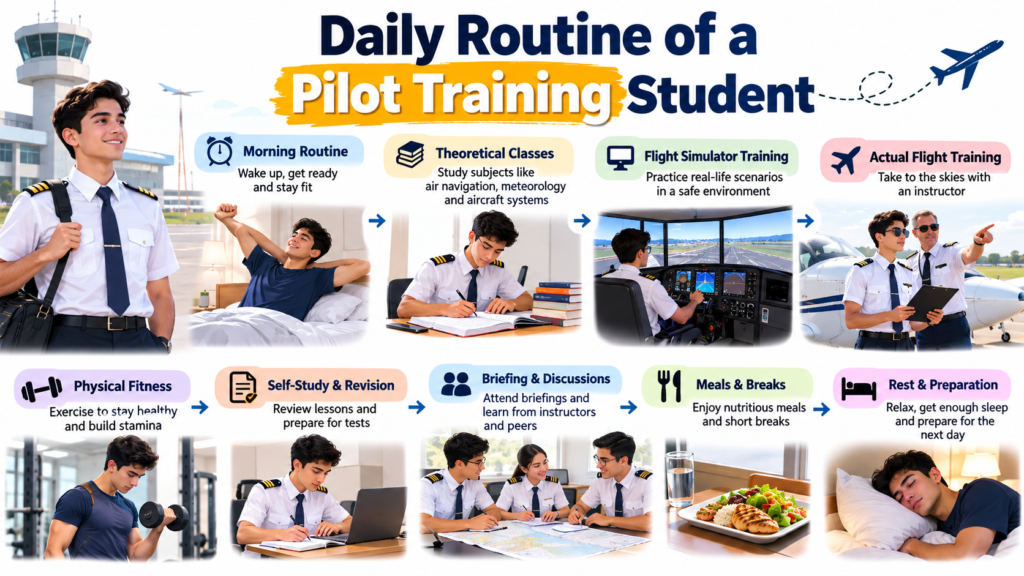
Introduction
Becoming a pilot takes more than learning how to fly an aircraft. It requires discipline, regular study, practical training, and good time management. A pilot training student must learn both inside and outside the cockpit. Some days include classroom lessons, while others focus on flight practice or simulator sessions. Students also need time to revise lessons, prepare for tests, and understand instructor feedback. Weather conditions and aircraft availability can change the day’s plans. Because of this, flexibility is just as important as following a schedule. A healthy routine helps students stay organised and make better use of their training time. It also helps them balance aviation studies with meals, exercise, sleep, and personal responsibilities. Although every flight school follows its own timetable, most students need a mix of theory, practice, and self-study. Understanding this daily routine can help aspiring pilots prepare for the demands of flight training.
Understanding a Typical Day in Pilot Training
A pilot training student’s daily routine depends on the training programme, flight school, and current stage of learning. Students in ground school may spend much of their day studying aviation subjects. Students who have started practical flying may follow a schedule based on flight slots and instructor availability.
Some training days begin early in the morning. Others may include afternoon classes or later flight sessions. Students may also have waiting periods when weather conditions prevent flying. These changes are a normal part of training and require careful planning.
Pilot training usually combines two main areas:
- Ground training: Students learn aviation theory, navigation, meteorology, aircraft systems, and flight rules.
- Practical training: Students apply their knowledge through supervised flight lessons, simulator sessions where available, and related exercises.
For example, a student may study aircraft controls in class before practising basic handling with an instructor. Later, the student may review the lesson and identify areas that need more practice.
The aim is not simply to complete daily tasks. It is to understand each lesson and build skills step by step. The balance between classroom learning and practical flying depends on the school’s programme and the student’s progress.
Morning Routine of a Pilot Training Student
The morning is often an important part of a student’s training day. A good start helps students arrive prepared and focus on the lessons ahead.
Students should aim to wake up early enough to eat breakfast, get ready, and reach the training centre on time. The exact wake-up time depends on the day’s timetable and travel distance. There is no single wake-up time for every pilot training student.
Before leaving, students can check their timetable and organise their study materials. They may need notebooks, navigation tools, training manuals, or other items required by their school.
A useful morning routine includes:
- Waking up at a consistent time.
- Eating a balanced breakfast and drinking enough water.
- Checking the day’s classes, briefings, and flight slots.
- Reviewing notes from the previous lesson.
- Packing the required books and training materials.
- Arriving early enough to prepare without rushing.
Students with a scheduled flight may also need to review weather information and other flight-related details as directed by their instructor. They should use approved sources and follow their school’s procedures.
A calm morning routine reduces last-minute stress. It also gives students time to think clearly before lessons begin.
Ground School and Classroom Learning
Ground school builds the knowledge students need before and during practical flight training. It explains how aircraft work, how pilots plan flights, and how they respond to different conditions.
Depending on the course and licensing pathway, students may study subjects such as:
- Aviation meteorology: Weather patterns, clouds, wind, visibility, and their effects on flying.
- Air navigation: Maps, directions, flight routes, and navigation calculations.
- Air regulations: Aviation rules, operating procedures, and relevant legal requirements.
- Aircraft technical knowledge: Aircraft systems, engines, instruments, and basic operating principles.
- Radio communication: The correct use of aviation communication procedures and phraseology.
These subjects require regular attention. Students should not depend only on classroom lectures or last-minute revision before examinations.
During lessons, it helps to write clear notes and mark topics that need more explanation. Students can ask instructors for examples when a concept seems difficult. They can also solve practice questions to check their understanding.
For example, a student learning navigation may practise calculating distance, speed, or estimated travel time. Another student may review weather charts to understand how conditions affect a planned flight.
A short revision session after class can make these topics easier to remember. It also helps students identify gaps before the next lesson.
Preparing for Flight Lessons
Flight preparation begins before the aircraft leaves the ground. Students must understand the purpose of the lesson and complete the preparation required by their instructor.
A pre-flight briefing usually explains the planned exercise, expected conditions, relevant procedures, and safety considerations. Students may review the aircraft handbook, checklists, and previous instructor feedback.
Depending on the lesson, preparation may include:
- Reviewing the planned flying exercise.
- Studying relevant aircraft systems and controls.
- Checking weather and other available flight information.
- Preparing navigation materials when required.
- Understanding the aircraft inspection process.
- Asking questions about unfamiliar procedures.
Weather preparation is especially important. Wind, visibility, cloud conditions, and other factors can affect whether a flight should proceed. Pilots must gather relevant information and assess the conditions before a flight. Student pilots do this under their instructor’s supervision and follow their training organisation’s procedures.
Students should never feel pressured to hide confusion or pretend they understand a procedure. Asking questions before a lesson is better than carrying uncertainty into the cockpit.
Good preparation helps students understand what they are expected to learn. It also makes the briefing and debriefing more useful.
Flight Training and Practical Lessons
Practical flying is an important part of becoming a pilot. It allows students to apply their classroom knowledge in a real aircraft under the supervision of a qualified flight instructor.
A training flight may include several stages. The exact sequence depends on the lesson, aircraft, school procedures, and student’s experience.
Before the flight
The student attends a briefing and prepares for the planned exercise. The instructor explains the learning goals and reviews relevant safety points. The student then participates in the required pre-flight inspection and cockpit preparation under supervision.
During the flight
The student practises the skills planned for that lesson. Early lessons may focus on familiarisation with the aircraft, basic controls, and simple handling exercises. Later lessons may introduce more advanced manoeuvres, navigation, or other required skills.
Students should listen carefully to instructions and follow the procedures taught by their instructor. They should focus on learning safely rather than trying to progress faster than their training allows.
After the flight
The instructor and student review the lesson. This discussion is often called a debriefing. It helps the student understand what went well and what needs improvement.
The student may record useful feedback in a training log or personal notes. Reviewing these points later can help prepare for the next session.
Not every training day includes a flight. Weather, maintenance, scheduling, and other operational factors may change the plan. When flying is postponed, students can often use the time for theory, planning practice, or revision.
Afternoon Study and Revision
Afternoon study gives students a chance to strengthen what they learned earlier in the day. This time may involve classroom work, simulator practice, independent study, or a review of flight lessons.
Students should focus on understanding rather than simply reading the same notes repeatedly. Solving problems and explaining concepts in their own words can help reveal gaps in knowledge.
A productive afternoon study routine may include:
- Revising the day’s classroom notes.
- Reviewing instructor feedback from a flight.
- Practising navigation calculations and theory questions.
- Reading relevant sections of training manuals.
- Preparing questions for the next instructor session.
- Updating a study planner or progress record.
For example, a student who struggles with aviation weather can spend 30 minutes reviewing the topic and then answer practice questions. If the answers remain unclear, the student can ask the instructor for help.
Short breaks can make longer study periods easier to manage. Students should also set realistic goals. Completing two topics carefully is often more useful than rushing through several topics without understanding them.
Consistent revision helps connect classroom lessons with practical flying. Over time, this approach can build confidence and improve the quality of preparation.
Physical Fitness, Meals, and Mental Well-Being
Pilot training can be demanding because students must manage new information, practical tasks, and changing schedules. Looking after physical and mental well-being helps them stay focused throughout the day.
Students do not need an extreme fitness routine to build healthy habits. Regular movement, balanced meals, enough water, and suitable rest are useful starting points.
Healthy habits to include in the daily routine
- Eat regular meals: Choose balanced meals that provide energy throughout the day.
- Stay hydrated: Drink water regularly, especially during warm weather.
- Exercise consistently: Walking, stretching, or other suitable activities can support general fitness.
- Get enough sleep: Maintain a regular sleep schedule and avoid late-night study whenever possible.
- Manage stress: Use short breaks, simple planning methods, and open communication with instructors.
- Allow recovery time: Avoid filling every free hour with additional study.
Sleep deserves particular attention. Tiredness can affect concentration, memory, and decision-making. These skills matter in both classroom learning and flight training.
Students should also avoid comparing their progress constantly with that of their classmates. Different students may need different amounts of practice to understand a subject or master a skill.
If a student feels unwell or too tired for a planned flight, they should report it to the instructor and follow the school’s fitness-for-flight procedures. Safety must take priority over completing a planned lesson.
A balanced routine helps students study consistently without neglecting their health.
Evening Routine and Preparation for the Next Day
The evening is a useful time to review the day and prepare for tomorrow. Students can complete important tasks without studying until very late at night.
A simple evening routine can include:
- Reviewing the day’s main lessons.
- Writing down questions that still need answers.
- Organising books, notes, and training materials.
- Checking the next day’s timetable.
- Preparing clothes, meals, and other essentials.
- Setting a realistic study goal for the following day.
- Going to bed at a suitable time.
Students who completed a flight lesson can spend a few minutes reviewing the instructor’s feedback. They should note the skills that went well and the areas that need more practice.
Students who attended ground school can revise key definitions or solve a few questions. They do not need to repeat every lesson in full each evening.
For example, a student who has a morning flight briefing might prepare the required materials before sleeping. This saves time and reduces the risk of forgetting something important.
The goal is to end the day feeling prepared, not exhausted. A steady evening routine supports the next day’s learning and helps students maintain a healthier training schedule.
Sample Daily Schedule of a Pilot Training Student
The following timetable shows one possible day for a student who has both ground classes and a planned flight lesson. It is an illustrative example, not an official timetable or a schedule followed by every flight school.
| Time | Typical Activity | Purpose |
|---|---|---|
| 6:00–7:00 AM | Wake up, get ready, and eat breakfast | Start the day with enough time to prepare |
| 7:00–8:00 AM | Travel and review the day’s plan | Arrive ready for training |
| 8:00–9:00 AM | Flight briefing and preparation | Understand the lesson and safety requirements |
| 9:00–11:00 AM | Planned flight training, if conditions allow | Practise supervised flying skills |
| 11:00 AM–12:00 PM | Debriefing and lesson notes | Review feedback and learning points |
| 12:00–1:00 PM | Lunch and rest | Recover and recharge |
| 1:00–3:00 PM | Ground school or simulator session | Build theoretical or practical knowledge |
| 3:00–4:00 PM | Revision and practice questions | Strengthen understanding |
| 4:00–5:00 PM | Personal study or instructor discussion | Address difficult topics |
| 5:00–7:00 PM | Exercise, personal time, and dinner | Maintain a balanced routine |
| 7:00–8:00 PM | Light revision and next-day planning | Prepare for upcoming lessons |
| 8:00–9:30 PM | Relaxation and bedtime preparation | Support adequate rest |
Actual timings may change because of weather, aircraft availability, instructor schedules, course requirements, and the student’s progress. A student may spend the entire day in ground school or have a different flight slot.
Some days may also involve waiting for an aircraft or rescheduling a lesson. Students should use such periods productively when possible, while following the instructions of their training organisation.
The important point is not to copy this timetable exactly. It is to develop a routine that supports regular learning, proper preparation, and sufficient rest.
How the Routine Changes During Different Training Stages
A pilot training student’s daily schedule changes as training progresses. Early lessons focus on building knowledge, while later stages may require more complex practical work.
During ground school
Students spend more time in classrooms, reading, solving questions, and preparing for examinations. Their routine often centres on theory and regular revision.
During initial flight training
Students begin applying their knowledge in the aircraft. They need time for briefings, supervised practical lessons, and feedback. Their study routine must support the skills being introduced during flight training.
During more advanced training
The schedule may include more demanding flight planning, navigation exercises, simulator sessions, and other activities required by the programme. Students must connect theoretical knowledge with practical decisions.
During examination preparation
Students may devote more time to revision and practice questions. However, they should still maintain healthy sleep and avoid relying on last-minute study alone.
Not every school follows these stages in exactly the same way. Some programmes combine ground and flight training, while others arrange them in separate phases. Students should follow their approved syllabus and instructor guidance.
Common Mistakes Pilot Training Students Should Avoid
A few poor habits can make training harder than it needs to be. Students can improve their routine by identifying these mistakes early.
- Poor time management: Plan the day in advance and allow extra time for travel and preparation.
- Skipping regular revision: Review important concepts daily instead of waiting until examinations approach.
- Arriving unprepared for flights: Read the assigned material and complete the required preparation before the briefing.
- Ignoring instructor feedback: Write down suggestions and use them to guide future practice.
- Neglecting sleep and meals: Protect time for rest and regular meals, even during busy training periods.
- Failing to adapt to weather changes: Keep alternative study tasks ready when a flight cannot proceed.
- Studying without clear goals: Choose specific topics or tasks for each study session.
- Comparing progress with other students: Focus on personal improvement and the training standards you need to meet.
- Leaving questions unanswered: Ask instructors to explain confusing topics before moving ahead.
- Trying to rush training: Prioritise safe, sound learning over speed.
These changes may seem small, but they can improve how students use their time. Good habits also make it easier to identify weak areas and prepare for upcoming lessons.
Practical Tips for Managing a Busy Training Schedule
A well-planned routine makes pilot training easier to manage. Students do not need to plan every minute, but they should know their priorities and keep track of important tasks.
Here are some practical ways to organise the day.
- Use a daily planner: Write down classes, flight slots, revision sessions, and personal tasks.
- Set small study goals: Divide large subjects into smaller topics that are easier to understand.
- Revise lessons regularly: Spend a short period reviewing notes after class or flight training.
- Prepare the night before: Keep books, stationery, and required training materials ready.
- Track your progress: Record completed topics, instructor feedback, and areas needing improvement.
- Use free time wisely: Review notes or practise questions when appropriate, but allow time for rest.
- Ask for help early: Discuss difficult concepts with instructors instead of allowing confusion to grow.
- Stay flexible: Keep alternative study tasks ready when weather or scheduling changes affect a flight.
- Protect your sleep: Avoid building a routine that depends on late-night studying every day.
Students should also learn to prioritise tasks. Preparing for a scheduled flight may take priority over optional reading. However, students must follow their instructor’s directions and the school’s training procedures.
A useful approach is to plan three important tasks each evening. For example, a student might revise meteorology, prepare for a flight briefing, and complete navigation questions. This keeps the next day manageable and provides a clear sense of progress.
Over time, these habits can help students become more organised and independent learners.
Important Considerations for Pilot Training Students
Although a regular routine is helpful, pilot training does not always follow a fixed timetable. Several factors can affect a student’s day.
Weather conditions: Wind, visibility, cloud conditions, and other weather factors may affect flight plans. Students should follow the instructor’s guidance and approved operating procedures.
Aircraft availability: Aircraft may be unavailable because of maintenance or scheduling changes. Students should use these periods for suitable study or other assigned activities.
Instructor availability: Flight slots and lessons depend on instructor schedules and training requirements.
Training stage: Beginners may need more time for basic theory and familiarisation. More advanced students may have different preparation and practice requirements.
Medical fitness: Students must meet the applicable medical requirements and follow the school’s procedures for reporting illness, fatigue, or other fitness concerns.
Personal responsibilities: Travel, family commitments, and living arrangements can affect available study time. A realistic timetable should account for these needs.
Students should also understand the rules that apply to their chosen licensing pathway. Requirements can differ between countries and aviation authorities. They should confirm official requirements through the relevant regulator and training organisation.
A flexible routine is more useful than a perfect timetable that cannot adapt to real conditions. Students who plan carefully and respond calmly to changes can make better use of their training time.
How BestPilotsschool.com Can Support Aviation Learners
Aspiring pilots need reliable information before choosing a training pathway. bestpilotsschool.com can serve as a starting point for exploring pilot training topics, understanding the learning process, and preparing questions about aviation education. Students should also check official aviation authority guidance and speak directly with training organisations before making important decisions. Comparing course requirements, training arrangements, and personal goals can help students understand which options suit their needs.
Frequently Asked Questions
1. What time does a pilot training student usually wake up?
There is no fixed wake-up time for every student. Those with early classes or morning flight slots may wake up around 5:30 or 6:00 AM. Others may start later, depending on their training schedule and travel time.
2. How many hours do pilot training students study each day?
Study time varies by programme and training stage. Students may attend several hours of ground classes and also need time for independent revision. Practical flight training adds briefings, preparation, and debriefing to the daily workload.
3. Do pilot training students fly every day?
No. Flight lessons depend on the school’s timetable, weather, aircraft availability, instructor availability, and training requirements. Some days focus mainly on classroom learning, simulator practice, or independent study.
4. What subjects do students study during ground school?
Common subjects include aviation meteorology, air navigation, air regulations, aircraft technical knowledge, and radio communication. The exact subjects depend on the course and licensing pathway.
5. How do students prepare for flight lessons?
Students review the assigned lesson, study relevant aircraft procedures, and attend a pre-flight briefing. They may also review weather information and prepare navigation materials when required. They must follow their instructor’s guidance and school procedures.
6. Can weather affect a pilot training schedule?
Yes. Weather conditions can affect whether a planned flight can proceed safely. When a lesson is postponed, students may use the available time for revision, flight planning exercises, or other assigned training activities.
7. How much free time do pilot training students get?
Free time depends on the course timetable, study workload, travel arrangements, and flight schedule. Students can manage their time more effectively by planning study sessions and protecting time for meals, exercise, and rest.
8. Why is sleep important during pilot training?
Sleep supports attention, memory, and clear thinking. Fatigue can affect learning and decision-making. Students should maintain healthy sleep habits and report concerns about their fitness to fly through the appropriate school procedures.
9. How can students manage ground school and flight practice?
Students should plan their week, revise lessons regularly, and prepare for flights in advance. They should also record instructor feedback and focus on the subjects that need improvement. A realistic schedule helps balance study and rest.
10. Does every flight school follow the same daily routine?
No. Schools may differ in course structure, class timings, aircraft availability, instructor schedules, and training methods. Students should follow their own school’s timetable and applicable aviation requirements.
Conclusion
The daily routine of a pilot training student involves much more than flying an aircraft. It combines ground school, flight preparation, practical lessons, independent study, and regular revision. Students also need time for meals, exercise, sleep, and personal responsibilities. A well-planned routine helps them manage these activities without unnecessary stress. However, every training day may look different because weather and operational needs can change the schedule. Students should learn to adapt while remaining focused on their training goals. They should prepare carefully, listen to instructors, and treat feedback as an opportunity to improve. Regular study is more useful than relying on last-minute revision. Healthy habits also support concentration and consistent learning. Aspiring pilots who develop discipline and flexibility can build a stronger foundation for their aviation journey. The key is to stay organised, learn at a steady pace, and place safety at the centre of every training activity.
