
Introduction
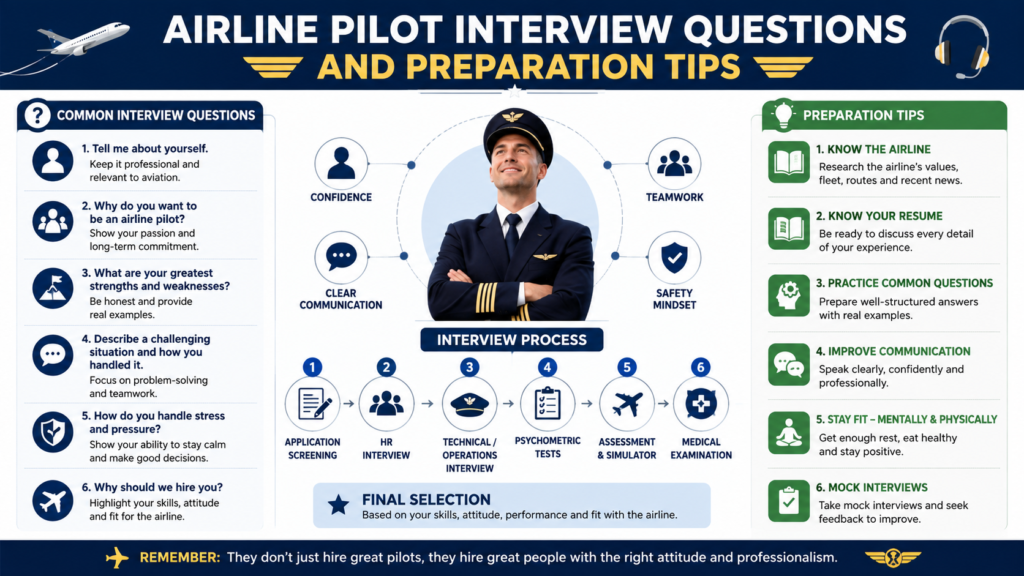
An airline pilot interview is an important stage in the journey from flight training to a professional aviation career. Candidates may be evaluated on their technical knowledge, communication skills, decision-making, teamwork, and professional attitude. Preparing for the interview involves more than memorizing common questions because interviewers may also ask candidates to explain real experiences and respond to practical situations. This guide explains common airline pilot interview questions and practical ways to prepare for them.
Main Content
Understanding an Airline Pilot Interview
An airline pilot interview is designed to help an airline understand whether a candidate is prepared for the responsibilities associated with professional flight operations.
The exact selection process varies between airlines and positions. Some organizations may use several stages, while others may combine different assessments.
A candidate may be assessed in areas such as:
- Technical aviation knowledge.
- Communication.
- Decision-making.
- Situational awareness.
- Teamwork.
- Professionalism.
- Motivation.
- Problem-solving.
- Safety awareness.
- Ability to learn from experience.
A strong candidate does not necessarily need to know the answer to every possible question. Instead, they should demonstrate sound preparation, honesty, clear communication, and an appropriate approach to safety and teamwork.
Common Stages of an Airline Pilot Selection Process
An airline recruitment process can involve multiple stages. The exact sequence depends on the airline, role, country, and recruitment program.
Possible stages may include:
- Application screening.
- Document verification.
- Aptitude or assessment testing.
- Technical assessment.
- Human resources or behavioral interview.
- Simulator assessment.
- Medical or other required assessments.
Not every airline uses all of these stages. Candidates should understand the specific process associated with the position for which they are applying.
Why Preparation Matters
Good preparation helps candidates communicate their knowledge and experience more effectively.
An interview can be stressful, particularly when technical and personal questions are mixed together. Preparing in advance allows candidates to focus on the question instead of trying to construct every answer from the beginning.
Preparation should include:
- Reviewing fundamental aviation subjects.
- Understanding your own flight-training history.
- Practicing common interview questions.
- Preparing genuine examples from your experience.
- Reviewing technical concepts.
- Practicing scenario-based questions.
- Improving communication.
- Conducting mock interviews.
Preparation should not mean memorizing complete answers word for word. Over-rehearsed answers can sound unnatural and may make it difficult to respond when the interviewer asks a slightly different question.
Airline Pilot Interview Questions
General and Personal Questions
Personal questions are often used to understand a candidate’s background, motivation, communication style, and career goals.
Examples include:
- Tell us about yourself.
- Why do you want to become an airline pilot?
- Why did you choose aviation as a career?
- What are your strengths?
- What is one area you are working to improve?
- Why do you want to work as an airline pilot?
- What has been the most important lesson from your flight training?
- Where do you see yourself in your aviation career?
The best approach is to answer honestly and directly.
For example, when answering “Tell us about yourself,” a candidate should focus on information relevant to aviation, education, training, experience, and professional development rather than providing a complete personal history.
Motivation Questions
Interviewers may want to understand why a candidate has chosen aviation and whether they understand the responsibilities of a professional pilot.
A weak response may simply focus on enjoying aircraft or traveling.
A stronger response explains the candidate’s genuine interest while demonstrating an understanding of the profession.
A candidate might discuss:
- Interest in aviation.
- Experiences that influenced their career choice.
- Enjoyment of technical learning.
- Interest in teamwork and responsibility.
- Lessons learned during flight training.
The answer should reflect the candidate’s actual experience rather than a memorized statement.
Behavioral Questions
Behavioral questions ask candidates to describe how they handled situations in the past.
Examples include:
- Tell us about a time you made a mistake.
- Describe a difficult situation you handled.
- Tell us about a disagreement within a team.
- Describe a time you had to make a difficult decision.
- Tell us about a time you received criticism.
- Describe a situation where you had to manage pressure.
- Tell us about a time you had to learn something difficult.
These questions are useful because past experiences can demonstrate how a person responds to challenges.
Using the STAR Method
The STAR method is a useful way to organize answers to behavioral questions.
Situation: Explain the background.
Task: Describe what needed to be achieved or resolved.
Action: Explain what you personally did.
Result: Describe what happened and what you learned.
The “Action” part is particularly important. Candidates should explain their own role instead of spending most of the answer describing what other people did.
For example, if asked about a mistake during training, a candidate can explain the situation, describe how they responded, and then explain what they changed afterward.
The goal is not to present yourself as someone who never makes mistakes. It is to demonstrate responsibility, learning, and professional development.
Technical Questions
Technical questions vary according to the position, training level, aircraft, and airline.
Possible areas of questioning include:
- Aerodynamics.
- Meteorology.
- Navigation.
- Aircraft systems.
- Flight planning.
- Performance.
- Human factors.
- Aviation regulations.
- Instrument procedures.
- Flight operations.
- Aviation safety.
Candidates should focus on understanding fundamental concepts rather than memorizing isolated definitions.
For example, if an interviewer asks about a particular aerodynamic concept, simply giving a textbook definition may not be enough. You may also be asked how that concept relates to actual flight.
Understanding the subject makes it easier to answer follow-up questions.
Situational and Scenario-Based Questions
Scenario-based questions present a hypothetical situation and ask how a candidate would respond.
Examples might involve:
- Changing weather conditions.
- A technical concern.
- A disagreement between crew members.
- Time pressure.
- A communication problem.
- An unexpected operational change.
The interviewer may be interested not only in the final answer but also in the reasoning behind it.
A good approach is to:
- Understand the situation.
- Identify the immediate concerns.
- Consider available information.
- Prioritize safety.
- Follow applicable procedures.
- Communicate appropriately.
- Involve other crew members when appropriate.
- Make a reasoned decision.
Candidates should avoid giving the impression that they would ignore procedures simply because they believe their personal judgment is better.
Crew Resource Management Questions
Crew Resource Management, commonly known as CRM, is an important part of airline operations.
CRM focuses on effective use of communication, teamwork, leadership, decision-making, and available resources.
Interviewers may ask questions such as:
- How would you handle a disagreement with another pilot?
- How would you respond if a senior crew member made a mistake?
- How do you manage workload within a team?
- What makes an effective cockpit team?
- How would you communicate a safety concern?
A good answer should demonstrate respect, assertive communication, teamwork, and a commitment to safety.
Being a good team member does not mean agreeing with everyone. A professional pilot should be able to raise concerns respectfully when something appears unsafe or inappropriate.
Practical Interview Preparation
Step 1: Review Your Pilot Training
Start by revising the subjects you have already studied.
Depending on your training level, this may include:
- Aerodynamics.
- Meteorology.
- Navigation.
- Aircraft systems.
- Performance.
- Regulations.
- Human factors.
- Flight operations.
Focus on understanding concepts rather than attempting to memorize every possible question.
Step 2: Understand Your Own Experience
Be prepared to discuss your own training history.
Think about experiences that demonstrate:
- Responsibility.
- Teamwork.
- Adaptability.
- Learning from mistakes.
- Problem-solving.
- Communication.
- Decision-making.
You should be able to explain your experiences clearly without exaggerating your role.
Step 3: Practice Common Questions
Practice answering questions aloud.
This can help you identify answers that are:
- Too long.
- Too short.
- Unclear.
- Repetitive.
- Overly rehearsed.
Try to answer naturally while keeping your response focused on the question.
Step 4: Prepare Genuine Examples
Prepare several real examples from flight training, education, employment, or other relevant experiences.
Think about situations where you:
- Made and corrected a mistake.
- Worked as part of a team.
- Received constructive criticism.
- Experienced pressure.
- Had to solve a problem.
- Learned something difficult.
- Adapted to an unexpected situation.
Do not invent stories simply because you think they sound impressive.
Step 5: Review Technical Knowledge
Technical revision should be an important part of preparation.
Instead of studying only frequently asked questions, review the underlying concepts.
For example, if you revise aircraft performance, make sure you understand why different factors influence aircraft performance rather than simply memorizing definitions.
Step 6: Practice Mock Interviews
A mock interview can make the actual interview feel more familiar.
Ask another person to question you without giving you the answers beforehand.
Afterward, review:
- How clearly you communicated.
- Whether your answers were relevant.
- Whether you spoke too quickly.
- Whether you avoided answering difficult questions.
- Whether you demonstrated confidence.
- Whether your technical explanations were understandable.
Step 7: Prepare Questions for the Interviewer
Candidates may sometimes have an opportunity to ask questions.
Thoughtful questions can demonstrate genuine interest in the role and a willingness to understand the professional environment.
Questions may relate to responsibilities, training, operational expectations, or the selection process.
Common Interview Areas and Preparation
| Interview Area | What May Be Assessed | How to Prepare |
|---|---|---|
| Personal questions | Communication and motivation | Prepare a concise and genuine introduction |
| Behavioral questions | Past behavior and learning ability | Prepare real examples using the STAR method |
| Technical questions | Aviation knowledge | Review fundamental concepts and understand their practical application |
| Situational questions | Judgment and decision-making | Practice analyzing scenarios step by step |
| CRM questions | Teamwork and communication | Review CRM principles and team experiences |
| Aviation knowledge | General professional awareness | Review relevant subjects and current training material |
Common Mistakes Candidates Should Avoid
Memorizing Complete Answers
Memorizing answers word for word can make responses sound unnatural.
It is better to understand the main points you want to communicate and explain them naturally.
Giving Extremely Long Answers
Some candidates continue speaking after they have already answered the question.
Long answers can make it difficult for the interviewer to identify the important information.
Answer the question directly and provide additional detail when it is useful.
Being Too Brief
The opposite problem is giving answers that are so short that they do not explain anything.
If an interviewer asks about an experience, provide enough context to explain what happened, what you did, and what you learned.
Exaggerating Experience
Candidates should always be honest about their training and experience.
Exaggerating flight hours, responsibilities, technical knowledge, or achievements can create serious problems during an interview.
Ignoring Technical Preparation
Good communication is important, but pilot interviews can also require technical understanding.
Candidates should not assume that a confident personality can compensate for weak preparation.
Speaking Negatively About Others
When discussing previous instructors, classmates, employers, or team members, avoid unnecessary criticism.
If you experienced a difficult situation, focus on what happened, how you handled it, and what you learned.
Blaming Others for Mistakes
Professional pilots are expected to understand the importance of accountability.
When discussing mistakes, explain your role honestly and focus on how you prevented the same problem from happening again.
Ignoring CRM
Airline flying is a team environment.
Candidates should demonstrate that they understand the importance of communication, cooperation, workload management, and respectful challenge.
Failing to Research the Role
Candidates should understand the position they are applying for.
Knowing the basic responsibilities of the role can help you give more relevant answers during the interview.
Poor Professional Presentation
Professional behavior begins before the first question is asked.
Being punctual, prepared, respectful, and appropriately presented can help create a professional impression.
Interview Preparation Checklist
| Preparation Area | What to Review | Practical Tip |
|---|---|---|
| Personal introduction | Background, training, and motivation | Keep your introduction focused and natural |
| Technical knowledge | Relevant aviation subjects | Focus on understanding concepts |
| Behavioral examples | Teamwork, mistakes, pressure, and learning | Use genuine experiences |
| CRM | Communication and teamwork | Practice explaining how you handle disagreements |
| Situational questions | Decision-making and safety | Explain your reasoning step by step |
| Aviation knowledge | Relevant operational concepts | Review your training material |
| Mock interview | Speaking and answering skills | Practice with someone who can give honest feedback |
| Interview day | Documents, timing, appearance, and preparation | Plan ahead to avoid unnecessary stress |
Important Considerations
Every Airline May Be Different
There is no universal airline pilot interview format.
Different airlines may use different assessments, interviews, simulator evaluations, technical tests, or recruitment procedures.
Candidates should therefore avoid assuming that one person’s interview experience will be identical to another’s.
Requirements Can Change
Airline recruitment requirements can change based on the position, operational needs, regulatory environment, and company policies.
If a specific license, qualification, medical standard, or other requirement is relevant to an application, candidates should verify the current requirement through appropriate official information.
Honesty Matters
If you do not know the answer to a technical question, it is better to be honest than to provide an invented answer.
You can explain what you know and acknowledge where your knowledge is limited.
A professional approach to uncertainty is more valuable than pretending to know something you do not.
Safety Should Remain Central
When answering situational questions, safety should be an important consideration.
Candidates should demonstrate that they understand the importance of gathering information, following procedures, communicating effectively, and involving appropriate resources.
Preparation Should Build Understanding
The goal of interview preparation is not to create a collection of memorized responses.
A well-prepared candidate understands their own experience, knows the fundamentals of aviation, and can explain their reasoning clearly.
Learn From Difficult Experiences
A difficult training experience does not automatically make a candidate look weak.
If handled correctly, it can demonstrate maturity.
Explain what happened, what you learned, what you changed, and how the experience influenced your future behavior.
Frequently Asked Questions
1. What questions are commonly asked in airline pilot interviews?
Questions may cover personal background, motivation, technical knowledge, behavioral experiences, decision-making, teamwork, CRM, and aviation scenarios. The exact questions vary between airlines and positions.
2. How should I prepare for an airline pilot interview?
Review relevant technical subjects, understand your own training experiences, practice common questions, prepare genuine examples, conduct mock interviews, and learn about the role you are applying for.
3. What technical subjects should a pilot revise?
Depending on the position, candidates may need to review subjects such as aerodynamics, meteorology, navigation, aircraft systems, performance, regulations, human factors, and flight operations.
4. What is the STAR method?
STAR stands for Situation, Task, Action, and Result. It provides a simple structure for answering behavioral questions by explaining what happened, what needed to be done, what you did, and what happened afterward.
5. How should I answer “Tell me about yourself”?
Keep the answer focused on your education, aviation training, relevant experience, motivation, and professional development. Avoid giving an unnecessarily long personal history.
6. What should I do if I do not know the answer to a technical question?
Be honest. Avoid inventing an answer. You can explain what you understand about the subject and acknowledge what you do not know.
7. How important is CRM in an airline pilot interview?
CRM can be very important because airline operations depend on effective teamwork and communication. Candidates should be prepared to discuss communication, conflict management, workload, leadership, and cooperation.
8. How can I prepare for scenario-based questions?
Practice analyzing situations step by step. Consider the available information, safety implications, applicable procedures, communication, available resources, and possible actions before explaining your decision.
9. Should I memorize interview answers?
It is better to prepare key points rather than memorize complete answers. Understanding your experiences and the subjects you have studied will help you respond naturally to different questions.
10. What are common mistakes candidates make?
Common mistakes include giving memorized answers, providing unnecessarily long responses, exaggerating experience, neglecting technical revision, blaming others for mistakes, ignoring CRM, and failing to prepare for scenario-based questions.
Conclusion
Preparing for an airline pilot interview requires more than learning a list of possible questions. Candidates need to understand their own experiences, review important aviation subjects, practice communicating clearly, and develop the ability to explain their reasoning in practical situations.
Technical knowledge is important, but so are teamwork, communication, professionalism, decision-making, and the ability to learn from mistakes. Behavioral and scenario-based questions can provide candidates with opportunities to demonstrate these qualities.
The most effective preparation is therefore based on understanding rather than memorization. Review your knowledge, practice genuine examples, participate in mock interviews, and approach difficult questions honestly.
An interview cannot guarantee a particular outcome, but thorough and realistic preparation can help a candidate present their knowledge, experience, and professional approach with greater clarity and confidence.
