
Introduction
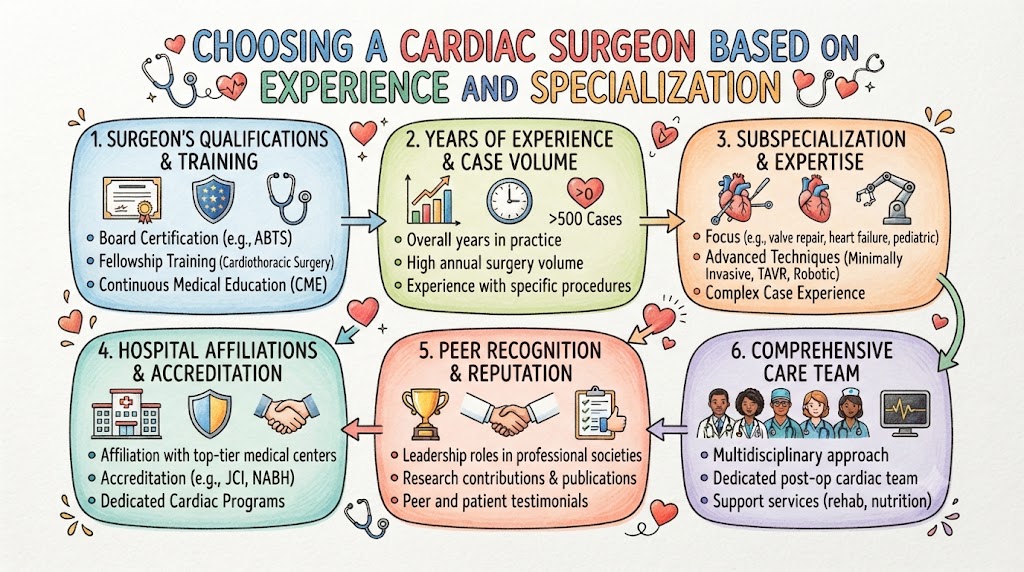
Choosing a cardiac surgeon is an important part of planning heart surgery. Patients may see impressive titles and technology claims but remain uncertain about what matters for their condition. The most suitable surgeon is not automatically the person with the most years in practice. A stronger match is usually a properly credentialed specialist who regularly performs the proposed operation, treats similar cases, works with an experienced cardiac team, and communicates clearly about options, risks, recovery, and follow-up.
This guide explains how to compare experience and specialization without relying on unsupported rankings.
Why Experience and Specialization Both Matter
Experience reflects training and practical work; specialization reflects focused expertise in a particular area.
A surgeon may have decades of general cardiac experience yet perform few complex aortic operations. Another may have fewer total years in practice but work mainly with aortic disease. For a patient requiring aortic surgery, the second surgeon may have more directly relevant experience.
The same principle applies to bypass surgery, valve repair, congenital heart surgery, transplantation, repeat operations, and minimally invasive procedures. Ask not only, “How long have you practised?” but also, “How often do you perform this exact operation for patients like me?”
Check Qualifications and Credentials
A cardiac surgeon should have completed recognized medical education, surgical training, and specialist training in cardiac or cardiothoracic surgery. Credential names differ by country, so verify the surgeon’s current licence with the appropriate medical regulator and confirm relevant specialist certification where available.
Certification is useful because it provides independent evidence that defined training, knowledge, and professional standards have been met. In the United States, the American Board of Thoracic Surgery certifies eligible thoracic surgeons, while the American Board of Medical Specialties offers a public certification-verification service. Other countries use their own councils, colleges, or specialty boards. Certification cannot guarantee an outcome, but it is an important starting point.
Verify specialty qualifications, fellowship training, current registration, hospital privileges, and procedure-relevant training.
Match the Specialization to the Procedure
Heart surgery includes several distinct fields. A surgeon highly experienced in one area may not be the right match for every cardiac operation.
| Patient need | Relevant experience to look for | Useful question |
|---|---|---|
| Coronary bypass surgery | Regular CABG practice and complex coronary cases | How many similar bypass operations do you perform? |
| Valve surgery | Expertise in the affected valve and valve repair | What is the realistic chance of repair rather than replacement? |
| Aortic surgery | Aortic root, arch, aneurysm, or dissection expertise | Does your team routinely manage this exact aortic problem? |
| Minimally invasive surgery | Formal training, current volume, and careful patient selection | Why is this approach suitable for my case? |
| Congenital or pediatric surgery | Dedicated congenital training and pediatric ICU support | How often do you treat this defect and age group? |
| Transplant or heart-support devices | Transplant programme and ventricular-assist-device experience | Is the complete specialist team available on site? |
| Repeat or high-risk surgery | Reoperative planning and advanced ICU support | What extra risks arise from my previous surgery or health? |
Congenital cardiac surgery shows why focused training matters. The American Board of Thoracic Surgery has a separate congenital subspecialty pathway with dedicated training and operative requirements. Systems differ internationally, but children and adults with congenital heart disease should be assessed by teams with appropriate congenital expertise.
Look Beyond Total Years in Practice
Years in practice can be reassuring, but recent, relevant experience may be more informative. Ask how many times the surgeon has performed the proposed procedure during the past year and whether those cases included patients with similar anatomy, age, previous surgery, or other medical conditions.
Regular practice within a specialist programme can help a surgeon remain familiar with current planning and complication management.
Case volume should not be judged alone. A large number does not automatically prove quality, and a smaller number does not automatically indicate poor care. Consider volume together with training, complexity, outcomes, communication, and team resources.
Review Outcome Information in Context
Patients may ask about mortality, stroke, infection, bleeding, reoperation, readmission, and length of stay. Valve patients may also ask about repair rates and durability.
Raw percentages can mislead because surgeons treat different types of patients. When available, request recent, procedure-specific, risk-adjusted outcomes that account for factors such as age, urgency, existing disease, and case complexity.
The Society of Thoracic Surgeons maintains major clinical registries and voluntary public reporting for several cardiac procedures in the United States. Its congenital reporting notes that results reflect each programme’s case mix and are not intended as a simple direct ranking.
Ask whether the figures are independently audited, registry-reported, risk-adjusted, and specific to the surgeon, team, or hospital. Be cautious about guaranteed success claims or a single promotional percentage without explanation.
Assess the Hospital and Full Cardiac Team
Cardiac surgery depends on more than the operating surgeon. Care may involve cardiologists, anaesthesiologists, perfusionists, intensivists, nurses, imaging specialists, rehabilitation professionals, infection-control teams, and emergency services.
Hospital accreditation can show that an external organization has assessed important quality and safety systems. It does not prove that every programme is equally suitable, but it is one useful comparison factor.
| Area to compare | What to verify | Why it matters |
|---|---|---|
| Cardiac operating room | Appropriate equipment, perfusion, blood supply, and surgical backup | Supports the planned operation and unexpected events |
| Cardiac ICU | Dedicated staff and advanced monitoring | Important during early recovery |
| Diagnostics | Echocardiography, CT, MRI, catheterization, and laboratory access | Supports planning and rapid reassessment |
| Multidisciplinary review | Surgeon, cardiologist, imaging, and anaesthesia input | Helps compare surgical and non-surgical options |
| Infection control | Clear prevention and wound-care protocols | Helps reduce avoidable risks |
| Rehabilitation | Cardiac rehabilitation and physiotherapy | Supports recovery and long-term health |
| Emergency coverage | Round-the-clock ICU, imaging, and reoperation capability | Essential if complications develop |
| Follow-up | Written discharge plan and local-care coordination | Improves continuity after leaving the hospital |
Evaluate Minimally Invasive or Robotic Expertise
A smaller incision or robotic approach may suit selected patients, but it is not automatically safer or better. Suitability depends on the disease, anatomy, previous operations, additional procedures, general health, and team experience.
Ask whether the surgeon performs both conventional and minimally invasive surgery. The explanation should cover expected benefits, limitations, alternatives, and the possibility of conversion to open surgery. The American Heart Association notes that less invasive valve options may reduce tissue trauma and shorten recovery for appropriate patients, but treatment selection must be individualized.
Consider Communication and Shared Decisions
Communication also affects informed decision-making. The surgeon should review the records, listen to concerns, explain the condition in understandable language, and discuss reasonable alternatives.
Patients should understand who will perform the main operation, what major risks apply, how recovery may progress, and whom the family can contact. A trustworthy discussion includes uncertainty rather than promises.
The American Heart Association encourages patients to keep asking questions and obtain another opinion when they remain uncertain or uncomfortable about recommended care.
When to Seek a Second Opinion
A second opinion is especially useful when the diagnosis or operation is unclear, several treatments are possible, the surgery is complex or high risk, a new technique is proposed, valve repair and replacement need comparison, or the patient has had previous heart surgery.
It can confirm the plan, identify an alternative, or clarify trade-offs. However, patients should not delay emergency treatment while arranging routine opinions. The American Heart Association provides guidance on obtaining a second medical opinion when important questions remain.
Planning for Treatment Away From Home
Patients travelling within their country or internationally should request a formal medical-record review before travel. Confirm that the named surgeon has accepted the case and obtain written details about the proposed procedure, hospital stay, estimated charges, possible extra costs, interpreter support, and follow-up.
The discharge plan should address medicines, wound care, warning signs, travel fitness, rehabilitation, and communication with local doctors. Cardiac rehabilitation commonly combines medically supervised exercise, education, and risk-factor support after procedures including bypass and valve surgery.
A lower package price should not outweigh concerns about credentials, ICU support, emergency care, or follow-up continuity.
Questions to Ask Before Choosing a Hospital or Surgeon
- What specialist qualifications and current certifications do you hold?
- How often do you perform this exact procedure?
- How many similar cases have you managed recently?
- What makes my case routine or complex?
- What surgical and non-surgical alternatives exist?
- Who will perform the main parts of the operation?
- What risks apply to my individual condition?
- Are your outcomes recent, procedure-specific, and risk-adjusted?
- What cardiac ICU and emergency support are available?
- What tests are required before surgery?
- What is included in the written cost estimate?
- How long may hospitalization and recovery take?
- Is cardiac rehabilitation recommended?
- Who manages complications or readmission?
- How will follow-up be coordinated if I live far away?
Frequently Asked Questions
1. Is the surgeon with the most experience always the best?
Not necessarily. Total years matter less than relevant training, recent experience with the exact procedure, outcomes, hospital support, and communication.
2. How many procedures should a cardiac surgeon perform?
No single number applies to every operation. Ask about recent volume for the proposed procedure and how results are measured, considering patient complexity.
3. What is the difference between a cardiologist and a cardiac surgeon?
A cardiologist diagnoses and manages heart disease, including medicines and some catheter procedures. A cardiac surgeon performs operations. Both may help determine the treatment plan.
4. Should I select a surgeon who offers robotic surgery?
Only when the approach is suitable for your condition and the team has relevant experience. Ask about benefits, limitations, alternatives, and conversion to open surgery.
5. How can I verify a surgeon’s qualifications?
Check the official medical regulator, specialty board or college, and hospital credentialing information where the surgeon practises. Do not rely only on advertisements.
6. Are online reviews helpful?
Reviews may describe communication and general service, but they do not reliably measure surgical skill or risk-adjusted outcomes. Use them only as a minor source.
7. When is a pediatric cardiac surgeon needed?
Children with heart conditions generally need a surgeon and hospital team experienced in pediatric or congenital care, including age-appropriate anaesthesia and intensive care.
8. Should I ask for a success rate?
Yes, but ask how it is defined. Request recent, procedure-specific, risk-adjusted outcomes and complication information rather than one unexplained percentage.
9. Can I change surgeons after receiving a recommendation?
For planned surgery, patients can usually seek another consultation, subject to urgency, insurance rules, hospital arrangements, and record availability.
10. What if two surgeons recommend different treatments?
Ask both teams to explain the evidence, benefits, risks, and reasons. A multidisciplinary review or an additional independent opinion may help clarify the options.
Key Takeaways
- Match the surgeon’s focused experience to the exact condition and procedure.
- Verify licences, specialist qualifications, hospital privileges, and relevant training.
- Ask about recent case volume and risk-adjusted outcomes, not years alone.
- Evaluate the cardiac ICU, diagnostics, emergency services, and full care team.
- Do not assume minimally invasive or robotic surgery is best for every patient.
- Consider a second opinion when surgery is major, complex, or unclear.
- Plan costs, rehabilitation, travel, and long-term follow-up in advance.
Conclusion
Choosing a cardiac surgeon requires a careful match between the patient’s condition and the surgeon’s qualifications, specialization, recent procedure-specific experience, outcomes, hospital support, and communication. No surgeon is suitable for everyone, and impressive titles or technology claims should not replace medical evaluation. Comparing written information, asking direct questions, and obtaining a qualified second opinion can help patients and families make a more informed decision.
