
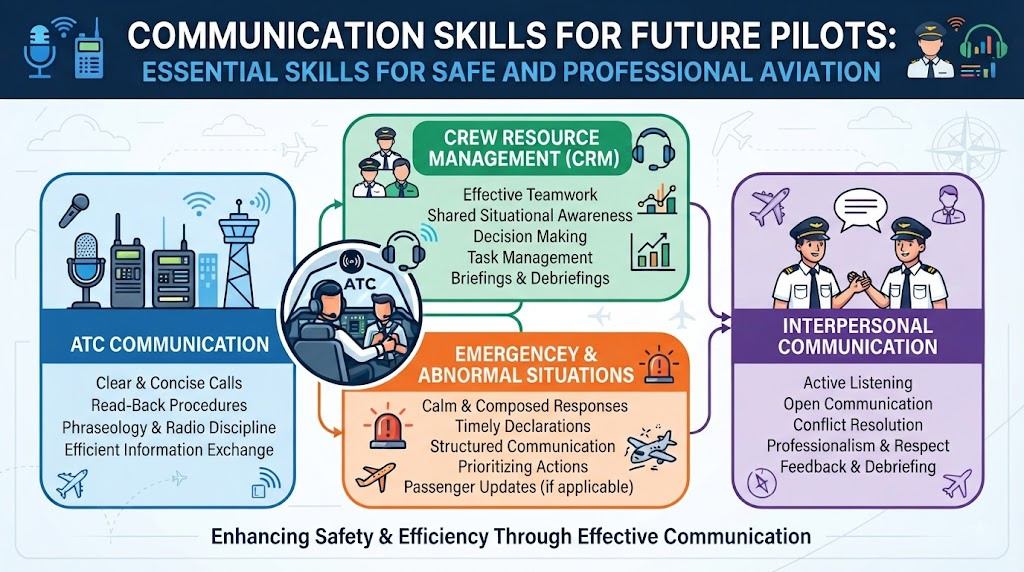
Introduction
Communication is one of the most important skills a future pilot can develop. Flying an aircraft requires much more than technical knowledge, navigation skills, and the ability to operate cockpit systems. Pilots must continuously exchange accurate information with air traffic controllers, fellow pilots, cabin crew, ground personnel, flight instructors, dispatch teams, and other aviation professionals.
Clear communication becomes especially important when pilots are operating in busy airspace, managing changing weather conditions, coordinating with other crew members, or responding to an unexpected situation. A message that is unclear, incomplete, misunderstood, or communicated at the wrong time can affect situational awareness and decision-making.
For student pilots, communication skills should be developed from the beginning of flight training rather than treated as a secondary ability. Good pilot communication involves speaking clearly, listening carefully, using appropriate aviation terminology, confirming important information, asking for clarification when necessary, and communicating concerns professionally.
This guide explains the most important communication skills future pilots should develop, why these skills matter in aviation, common communication mistakes, and practical ways students can become more confident and effective communicators.
Why Communication Skills Matter for Future Pilots
Aviation is a highly coordinated industry. Pilots rarely operate completely independently. Even during a routine flight, they may need to exchange information with multiple people at different stages of an operation.
Effective communication can help pilots:
- Understand instructions accurately
- Communicate intentions clearly
- Maintain situational awareness
- Coordinate effectively with other crew members
- Support sound decision-making
- Reduce misunderstandings
- Share important operational information
- Raise safety concerns appropriately
- Manage workload
- Work effectively as part of a professional aviation team
Communication is particularly important because aviation frequently involves standardized procedures. Pilots need to communicate information in a way that is clear to other aviation professionals, even when they may have different accents, backgrounds, or levels of experience.
For future pilots, communication should therefore be considered a fundamental flight skill alongside navigation, aircraft handling, meteorology, and aviation regulations.
Understanding Pilot Communication
Pilot communication is broader than simply talking over a radio. It includes every situation in which a pilot receives, interprets, or provides information during flight operations.
It can involve:
- Radio communication with Air Traffic Control
- Communication between pilots
- Communication with cabin crew
- Communication with ground staff
- Pre-flight briefings
- Post-flight debriefings
- Communication with flight instructors
- Emergency communication
- Crew Resource Management
- Written operational communication
- Communication during training and simulator sessions
The objective is not to communicate more information. The objective is to communicate the right information clearly, accurately, and at the appropriate time.
What Makes Aviation Communication Different?
Everyday conversation is usually flexible. People can use informal language, repeat themselves, or explain something in several different ways.
Aviation communication is more structured.
Pilots often need to communicate information that affects aircraft movement, operational decisions, coordination, and safety. As a result, aviation communication emphasizes:
- Clarity
- Accuracy
- Brevity
- Standardized terminology
- Active listening
- Correct information exchange
- Appropriate timing
- Professional behavior
Standardized aviation phraseology helps reduce ambiguity and makes communication more predictable.
Future pilots should therefore learn that being a good communicator in aviation does not mean using complicated language. It means communicating information in a manner that other aviation professionals can understand quickly and accurately.
Essential Communication Skills Every Future Pilot Should Develop
1. Clear and Concise Speaking
A future pilot should be able to express information clearly without unnecessary words.
This is especially important during radio communication. Poor pronunciation, excessive speed, hesitation, or unnecessary explanations can make a transmission difficult to understand.
Student pilots should practice:
- Speaking at a controlled pace
- Pronouncing words clearly
- Organizing information before speaking
- Using appropriate terminology
- Avoiding unnecessary words
- Maintaining a professional tone
Speaking too quickly may cause important information to be missed, while overly long transmissions can make communication inefficient.
The goal should always be clarity and precision.
2. Active Listening
Strong communication begins with listening.
Pilots may receive important information from Air Traffic Control, instructors, other crew members, dispatch personnel, or ground staff. They must be able to listen carefully and identify the information that matters.
Active listening includes:
- Paying attention to the complete message
- Identifying important details
- Avoiding assumptions
- Confirming information when necessary
- Remembering relevant instructions
- Asking for clarification when something is unclear
A student pilot who learns to listen carefully during training can build habits that remain valuable throughout a professional aviation career.
3. Aviation English
For many pilots, English is an essential part of aviation communication.
However, aviation English is not simply the ability to have a general conversation in English. Pilots need to understand aviation-specific vocabulary, standardized phraseology, instructions, and operational terminology.
Future pilots can strengthen aviation English by:
- Learning aviation terminology
- Reading aviation-related material
- Listening to appropriate aviation communications
- Practicing spoken English
- Participating in briefings
- Reviewing unfamiliar terminology
- Practicing communication in realistic training scenarios
Strong aviation English can improve confidence while also helping pilots communicate information more precisely.
4. Radio Communication
Radio communication is a major part of pilot communication.
Student pilots may initially feel nervous when communicating through the radio. This is common because they are simultaneously learning flight procedures, aircraft handling, navigation, and communication techniques.
With regular practice, pilots can become more comfortable with radio communication by learning to:
- Listen before transmitting
- Prepare the message mentally
- Speak clearly
- Use appropriate phraseology
- Keep transmissions concise
- Respond accurately
- Request clarification when necessary
Students should learn actual radio procedures from qualified flight instructors and the applicable aviation authority rather than relying solely on informal examples.
5. Accurate Readbacks
Accurate readbacks are an important communication practice in aviation.
When pilots receive information or instructions for which a readback is required, they need to repeat the relevant information accurately according to applicable procedures.
Readbacks can help identify misunderstandings before they become operational problems.
Future pilots should therefore develop the habit of:
- Listening carefully
- Identifying important information
- Repeating required information accurately
- Confirming uncertainty
- Avoiding assumptions
If a student pilot does not understand an instruction, asking for clarification is much safer than pretending to understand it.
6. Professional Assertiveness
Pilots need to be able to communicate concerns appropriately.
Assertiveness does not mean being aggressive or disrespectful. It means expressing information, questions, or concerns clearly and professionally.
A future pilot should be comfortable:
- Asking questions
- Raising concerns
- Clarifying instructions
- Pointing out relevant information
- Communicating uncertainty
- Speaking up when something appears inappropriate or unsafe
Professional assertiveness is especially important in a cockpit environment where effective teamwork depends on crew members being willing to communicate important observations.
7. Situational Awareness Through Communication
Communication and situational awareness are closely connected.
Pilots receive information from multiple sources. Communication can help them understand changes in weather, traffic, aircraft status, operational requirements, and other circumstances.
Effective communication can help pilots:
- Share relevant observations
- Confirm information
- Recognize changing conditions
- Maintain a common understanding
- Coordinate decisions
- Identify potential problems
For future pilots, learning to connect communication with situational awareness is an important part of developing professional judgment.
Pilot Communication With Air Traffic Control
Communication with Air Traffic Control is an essential part of flight operations.
Depending on the flight and applicable procedures, pilots may communicate with ATC during:
- Taxiing
- Departure
- Climb
- Cruise
- Descent
- Approach
- Landing
The pilot needs to listen carefully, understand relevant instructions or information, and respond appropriately.
A professional communication process generally involves:
- Listening carefully to the transmission.
- Identifying information relevant to the flight.
- Understanding the instruction or information.
- Responding using appropriate aviation terminology.
- Completing required readbacks accurately.
- Requesting clarification when necessary.
Future pilots should remember that radio communication is not a performance exercise. The objective is to exchange operational information clearly and efficiently.
Communication Between Pilots and Crew Members
Cockpit communication is equally important.
In a multi-crew environment, pilots need to maintain a shared understanding of what is happening. One pilot may identify a change that another pilot has not noticed, making communication essential for coordinated decision-making.
Effective cockpit communication includes:
- Sharing relevant information
- Confirming important details
- Coordinating tasks
- Discussing concerns
- Listening to another crew member
- Supporting decisions
- Maintaining situational awareness
Good communication should encourage appropriate participation rather than create an environment where one person dominates every discussion.
The Role of Crew Resource Management
Crew Resource Management, commonly referred to as CRM, focuses on the effective use of available resources, including people, information, equipment, and procedures.
Communication is a central part of CRM.
Future pilots should understand how communication contributes to:
- Teamwork
- Leadership
- Decision-making
- Situational awareness
- Workload management
- Conflict management
- Cross-checking
- Safety awareness
CRM teaches pilots that effective flight operations are not based only on individual technical skills. Crew members need to communicate, coordinate, and support one another.
Communication During Emergency Situations
Communication becomes even more important when an abnormal or emergency situation occurs.
Stress and workload can affect how people communicate. Future pilots therefore need to develop habits that help them remain organized and focused.
During challenging situations, pilots should focus on:
- Staying as calm as possible
- Prioritizing important information
- Following established procedures
- Communicating relevant information
- Coordinating responsibilities
- Maintaining situational awareness
- Requesting appropriate assistance
Emergency communication should be practiced through formal flight training and simulator exercises.
Student pilots should not attempt to memorize isolated emergency phrases from unofficial sources. They should learn the procedures, terminology, and communication practices applicable to their aircraft, operation, and jurisdiction from qualified instructors and official training materials.
Communication Skills Required at Different Stages of Flight
| Flight Stage | Important Communication Skills | Typical Communication Focus |
|---|---|---|
| Pre-flight | Listening, briefing, questioning | Flight plan, weather, aircraft status |
| Taxi | Clarity, radio discipline | Ground movement and instructions |
| Departure | Concise speaking, listening | Clearances and traffic coordination |
| Climb | Accuracy, situational awareness | Changes in altitude, routing, and instructions |
| Cruise | Active listening | Operational updates and coordination |
| Descent | Preparation, accuracy | Arrival information and clearances |
| Approach | Concise communication | Approach and traffic information |
| Landing | Clear communication | Landing-related instructions and coordination |
| Post-flight | Reporting, teamwork | Aircraft status and operational information |
The exact communication requirements vary according to the aircraft, airport, airspace, operation, and applicable regulations.
Common Communication Mistakes Student Pilots Should Avoid
Speaking Too Quickly
Nervousness can cause student pilots to speak faster than normal.
Better approach: Practice controlled speech and focus on clear pronunciation.
Failing to Listen Completely
Students may begin preparing their response before the other person has finished speaking.
Better approach: Listen to the complete transmission before responding.
Using Unclear or Informal Language
Everyday expressions may not be appropriate for aviation communication.
Better approach: Learn and use the terminology and phraseology taught during formal training.
Guessing an Instruction
Assuming what someone meant can create unnecessary risk.
Better approach: Request clarification using the appropriate procedure.
Incorrect Readbacks
Students may repeat information incorrectly because they were distracted or nervous.
Better approach: Concentrate on the complete transmission and accurately repeat required information.
Speaking Too Much
Long explanations can make radio communication inefficient.
Better approach: Communicate relevant information clearly and concisely.
Becoming Overly Nervous
New pilots may become anxious when using the radio.
Better approach: Build confidence through repeated supervised practice.
Failing to Speak Up
A student may notice something but hesitate to mention it.
Better approach: Develop professional assertiveness and communicate relevant concerns appropriately.
How Future Pilots Can Improve Their Communication Skills
Communication is a skill that improves through repeated practice and feedback.
Practice Aviation Terminology
Create a personal vocabulary list containing commonly used aviation terms and review it regularly.
Listen to Appropriate Aviation Communication
Exposure to appropriate aviation communication can help students become familiar with terminology, pace, and communication structure.
Practice Radio Scenarios
Students can practice simulated radio exchanges during ground training or with an instructor before handling similar situations during flight.
Participate in Flight Briefings
Briefings provide an opportunity to practice organizing information and explaining plans clearly.
Improve Active Listening
Practice listening without interrupting and identify the most important information in each conversation.
Use Simulator Sessions
Simulators provide an environment where students can practice communication during different operational situations without the pressure of an actual flight.
Review Communication During Debriefings
Students should ask instructors for feedback on:
- Clarity
- Timing
- Accuracy
- Radio technique
- Listening
- Professional behavior
Practice Speaking With Confidence
Public speaking, presentations, and structured conversations can help future pilots become more comfortable expressing information clearly.
Learn From Mistakes
A communication mistake during training should be treated as an opportunity to improve rather than something to hide.
Communication Skills and Pilot Training
Communication training should begin early and continue throughout a pilot’s development.
During ground school, students learn aviation terminology, procedures, and concepts. During flight training, they begin applying these skills in operational situations.
Flight instructors can help students improve:
- Radio communication
- Briefing techniques
- Aviation English
- Cockpit coordination
- Readbacks
- Active listening
- Professional communication
- Decision-making communication
Simulator training can provide additional opportunities to practice communication in realistic scenarios.
Debriefing is also important. After a flight, students can evaluate not only their aircraft handling and navigation but also how effectively they communicated.
This approach helps communication become a consistent professional habit rather than an isolated training requirement.
Communication Skills and Aviation Safety
Effective communication supports aviation safety in several ways.
Clear communication can help aviation professionals:
- Exchange important information
- Maintain situational awareness
- Coordinate responsibilities
- Identify potential problems
- Clarify misunderstandings
- Support decision-making
- Respond appropriately to changing circumstances
However, communication is only one component of aviation safety. Safe operations also depend on training, procedures, aircraft maintenance, weather assessment, regulatory compliance, human factors, operational planning, and many other elements.
The objective is therefore not simply to communicate more frequently. Pilots need to communicate clearly, accurately, professionally, and at the appropriate time.
Questions Future Pilots Should Ask About Communication Training
Before selecting a pilot training program, aspiring pilots can ask:
- How is aviation communication incorporated into flight training?
- Will students receive radio communication practice?
- Is aviation English included in the training curriculum?
- Are CRM concepts covered?
- Do instructors provide communication feedback during debriefings?
- Are simulator sessions available for communication practice?
- How are students prepared for communication in busy airspace?
- Are emergency communication scenarios included in appropriate training?
- What resources are available for improving aviation terminology?
- How are students assessed on communication and teamwork?
These questions can help students understand whether a training program takes professional communication seriously.
Communication Skills Checklist for Future Pilots
Future pilots can use this checklist while developing their communication abilities:
- Speak clearly and at an appropriate pace
- Listen carefully before responding
- Learn aviation terminology
- Understand applicable aviation phraseology
- Practice radio communication
- Make accurate readbacks when required
- Ask for clarification when necessary
- Avoid unnecessary communication
- Communicate relevant information promptly
- Maintain a professional tone
- Develop active listening skills
- Improve aviation English
- Participate actively in briefings
- Learn CRM principles
- Practice professional assertiveness
- Communicate safety concerns appropriately
- Remain focused during stressful situations
- Review communication performance during debriefings
Frequently Asked Questions
1. Why are communication skills important for future pilots?
Communication skills help pilots exchange information with ATC, crew members, instructors, ground personnel, and other aviation professionals. Clear communication supports coordination, situational awareness, teamwork, and decision-making.
2. What communication skills should student pilots develop?
Student pilots should develop clear speaking, active listening, aviation English, radio communication, accurate readbacks, professional assertiveness, teamwork, and the ability to communicate effectively under pressure.
3. Why is aviation English important for pilots?
Aviation English helps pilots understand and communicate aviation-related information using appropriate terminology and standardized communication practices. Strong aviation English can also improve confidence during training and professional operations.
4. How can student pilots improve radio communication?
Students can improve through supervised radio practice, simulator exercises, aviation terminology study, listening exercises, and feedback from qualified flight instructors.
5. What role does communication play in aviation safety?
Communication helps pilots and aviation professionals exchange information, coordinate activities, maintain situational awareness, and support decision-making. It is one of several important components of aviation safety.
6. Why is active listening important for pilots?
Pilots receive important information from ATC, crew members, instructors, and other sources. Active listening helps them identify relevant information and respond accurately.
7. What is Crew Resource Management?
Crew Resource Management is a structured approach to using available resources effectively. It includes communication, teamwork, leadership, decision-making, situational awareness, and workload management.
8. How can future pilots become more confident communicators?
Confidence can develop through repeated practice, instructor feedback, aviation English training, simulator exercises, briefings, radio practice, and active participation during flight training.
9. What should a pilot do if an instruction is unclear?
A pilot should follow the applicable communication procedure to request clarification rather than guessing or assuming what was intended.
10. Can communication skills be improved during pilot training?
Yes. Communication skills can be developed throughout ground school, flight training, simulator sessions, CRM exercises, briefings, and post-flight debriefings.
Key Takeaways
- Communication is a fundamental skill for every future pilot.
- Effective pilot communication involves both speaking and listening.
- Aviation communication emphasizes clarity, accuracy, brevity, and appropriate terminology.
- Aviation English is an important part of professional pilot communication.
- Radio communication should be developed through structured training and practice.
- Accurate communication with ATC supports effective coordination.
- CRM helps pilots communicate and work effectively as a team.
- Future pilots should learn to communicate concerns professionally.
- Simulator training and debriefings can help improve communication skills.
- Communication should be treated as an ongoing professional skill throughout a pilot’s career.
Conclusion
Communication skills are an essential part of becoming a safe, confident, and professional pilot. From the first stages of flight training, aspiring pilots need to learn how to listen carefully, speak clearly, use appropriate aviation terminology, and communicate information accurately.
Strong communication also supports teamwork, situational awareness, decision-making, and Crew Resource Management. Whether a pilot is communicating with Air Traffic Control, coordinating with another crew member, receiving instructions from an instructor, or managing an unexpected situation, the ability to exchange information effectively can make a significant difference.
Future pilots should therefore practice communication alongside their technical flight skills. With consistent training, constructive feedback, simulator practice, and real-world application under qualified supervision, communication can become a natural part of professional pilot performance.
Developing these skills early can help aspiring pilots enter the aviation industry with greater confidence and a stronger understanding of the communication standards expected in professional flight operations.
