
Introduction
A pilot career is one of the most exciting, respected, and rewarding career paths in the aviation industry. For many students and working professionals, becoming a pilot is not just a job goal but a lifelong dream. The idea of flying aircraft, traveling to different destinations, working with advanced technology, and building a professional career in aviation attracts thousands of aspiring pilots every year.
However, starting a pilot career requires proper planning, discipline, training, medical fitness, financial preparation, and the right guidance. Many beginners feel confused about where to start, which pilot license is required, how much pilot training costs, and what qualifications are needed to become a commercial or airline pilot.
This complete guide explains everything you need to know about starting a pilot career. You will learn about pilot eligibility, types of pilot jobs, pilot licenses, flight school selection, training steps, required skills, career growth, salary expectations, common mistakes, and practical tips to succeed in aviation.
Why Choose a Pilot Career?
A pilot career offers a unique combination of adventure, responsibility, technical skill, and professional growth. Unlike many traditional jobs, pilots work in a dynamic environment where every flight requires focus, teamwork, decision-making, and precision.
One of the biggest reasons people choose aviation is the opportunity to travel. Pilots often fly to different cities and countries, experience new cultures, and work in a global industry. The profession also offers strong career progression, especially for those who continue building flight hours, gaining advanced certifications, and maintaining excellent safety records.
Aviation also brings personal pride. Pilots are trusted with aircraft, passengers, cargo, and safety-critical decisions. This responsibility makes the career highly respected. For students who enjoy technology, travel, discipline, and problem-solving, becoming a pilot can be a powerful career choice.
Different Types of Pilot Careers
Pilot careers are not limited to airline flying. There are several aviation career paths depending on your interest, training, license, and experience.
| Pilot Career | Main Role | Best For |
|---|---|---|
| Airline Pilot | Flies passengers on domestic or international routes | Long-term aviation career |
| Commercial Pilot | Flies aircraft for business, charter, cargo, or services | Professional flying jobs |
| Cargo Pilot | Transports goods and packages | Logistics and freight aviation |
| Charter Pilot | Flies private passengers on demand | Flexible flying operations |
| Corporate Pilot | Flies business executives or private aircraft | Business aviation |
| Flight Instructor | Trains student pilots | Teaching and hour-building |
| Military Pilot | Flies aircraft for defense services | Government and defense careers |
| Helicopter Pilot | Operates helicopters for medical, rescue, tourism, or private use | Rotary-wing aviation |
| Agricultural Pilot | Supports farming operations through aerial spraying or monitoring | Specialized rural aviation |
| Test Pilot | Tests aircraft performance and safety | Advanced aviation engineering roles |
Eligibility Requirements to Become a Pilot
Before starting pilot training, you must meet basic eligibility requirements. These may vary by country and aviation authority, but most flight training paths include similar standards.
Educational Qualifications
Most pilot training programs require students to complete high school or equivalent education. Strong knowledge of mathematics, physics, and English is helpful because pilots must understand navigation, weather, aircraft systems, performance calculations, and aviation communication.
Some countries or airlines may prefer candidates with a college degree, especially for airline pilot positions. However, a degree is not always mandatory for all pilot careers.
Age Requirements
The minimum age depends on the type of license. Student pilot training can often begin at a younger age, while commercial pilot licenses and airline transport pilot licenses require higher minimum ages. Aspiring pilots should check the requirements of their local aviation authority before enrolling.
Medical Requirements
Medical fitness is very important in aviation. Pilots must pass aviation medical examinations to prove they are physically and mentally fit to fly. These exams usually check vision, hearing, heart health, neurological fitness, and general medical condition.
English Language Proficiency
English is the international language of aviation. Pilots must communicate clearly with air traffic controllers, crew members, instructors, and passengers. Good spoken and written English skills are essential.
Personal Skills and Qualities
A successful pilot should have discipline, focus, confidence, patience, teamwork ability, decision-making skills, and emotional stability. Flying requires calm thinking, especially during emergencies or changing weather conditions.
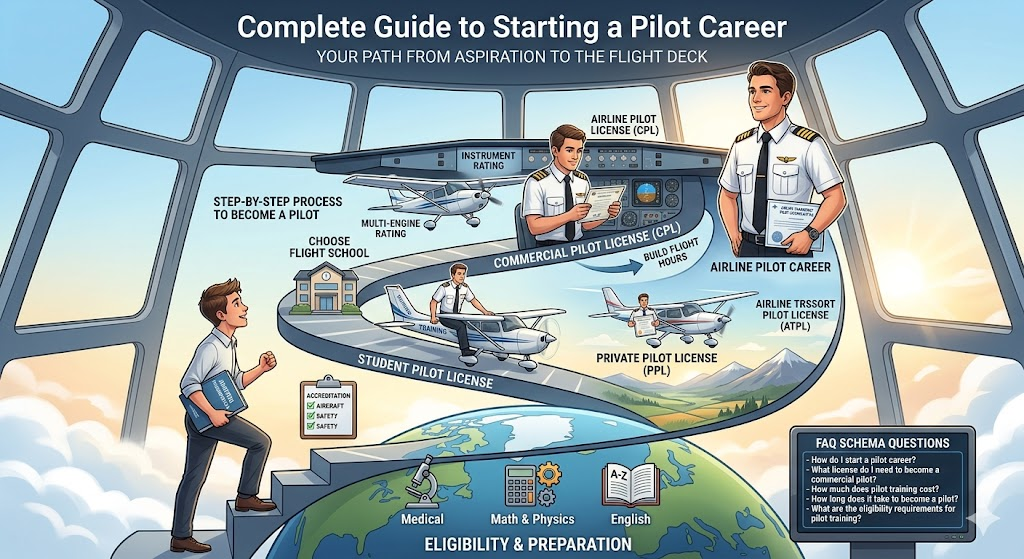
Step-by-Step Process to Become a Pilot
Step 1: Complete Your Education
Start by completing your basic education. Focus on subjects like mathematics, physics, geography, and English. These subjects help build a strong foundation for aviation training.
Step 2: Meet Medical Standards
Before investing in flight training, complete an aviation medical examination. This ensures that you are medically eligible to continue pilot training.
Step 3: Choose the Right Flight School
Selecting the right flight school is one of the most important decisions in your pilot career. Look for safety standards, instructor quality, aircraft availability, training reputation, and placement support.
Step 4: Obtain a Student Pilot License
A student pilot license allows you to begin practical flight training under instructor supervision. This is the first official step toward becoming a licensed pilot.
Step 5: Complete Flight Training
Flight training includes both ground school and practical flying. Ground school teaches aviation theory, navigation, meteorology, air regulations, aircraft systems, and safety procedures.
Step 6: Earn a Private Pilot License
A Private Pilot License allows you to fly for personal or recreational purposes. It is an important milestone but does not usually allow you to fly commercially.
Step 7: Obtain a Commercial Pilot License
A Commercial Pilot License allows you to work as a professional pilot. This license is required for many paid flying jobs, including charter, cargo, and airline pathways.
Step 8: Build Flight Hours
Flight hours are important for career growth. Many pilots build hours by working as flight instructors, charter pilots, or entry-level commercial pilots.
Step 9: Gain Advanced Ratings and Certifications
Advanced ratings such as Instrument Rating and Multi-Engine Rating improve your employability. Airlines and commercial operators often prefer pilots with additional ratings.
Step 10: Apply for Pilot Jobs
Once you meet license, hour, and certification requirements, you can apply for aviation jobs. Keep your resume updated, prepare for interviews, and stay current with aviation knowledge.
Types of Pilot Licenses Explained
| License / Rating | Purpose | Career Use |
| Student Pilot License | Allows basic training under supervision | First step in pilot training |
| Private Pilot License | Allows non-commercial flying | Personal flying and foundation training |
| Commercial Pilot License | Allows paid flying jobs | Required for professional pilot career |
| Airline Transport Pilot License | Highest pilot certification | Required for airline captain roles |
| Instrument Rating | Allows flying using instruments | Important for poor visibility and airline careers |
| Multi-Engine Rating | Allows flying aircraft with multiple engines | Required for many commercial aircraft |
Choosing the Right Flight School
The quality of your flight school can strongly affect your training experience and career readiness. A good flight school should provide safe aircraft, experienced instructors, structured training, transparent fees, and strong student support.
Flight School Checklist
| Factor | What to Check |
| Accreditation | Is the school approved by the aviation authority? |
| Aircraft Fleet | Are aircraft well-maintained and available regularly? |
| Instructors | Are instructors experienced and professional? |
| Safety Record | Does the school follow strict safety procedures? |
| Ground School | Is classroom training detailed and organized? |
| Simulator Training | Are simulators available for practice? |
| Fees | Are costs transparent and clearly explained? |
| Placement Support | Does the school guide students toward jobs? |
| Student Reviews | Are past students satisfied with training quality? |
Cost of Becoming a Pilot
Pilot training can be a significant investment. Costs depend on country, flight school, aircraft type, fuel price, training duration, and license requirements.
| Cost Area | Description |
| Registration Fees | Enrollment and admission charges |
| Ground School | Classroom training and study material |
| Flight Training | Aircraft rental and instructor fees |
| Medical Exams | Aviation medical certification |
| Licensing Fees | Aviation authority exam and license charges |
| Simulator Training | Practice for procedures and emergencies |
| Additional Ratings | Instrument, multi-engine, or advanced training |
| Accommodation | Living costs if training away from home |
Because costs vary widely, students should always ask the flight school for a complete fee breakdown before enrollment.
Skills Required for a Successful Pilot Career
Communication Skills
Pilots must communicate clearly with air traffic control, cabin crew, ground staff, and passengers. Clear communication improves safety and coordination.
Decision Making
Pilots make important decisions during flight planning, weather changes, technical issues, and emergency situations. Good judgment is essential.
Leadership
The pilot is responsible for aircraft safety and crew coordination. Strong leadership helps manage pressure and maintain professionalism.
Situational Awareness
Pilots must always understand aircraft position, weather, fuel status, traffic, altitude, speed, and system performance.
Problem Solving
Unexpected situations can happen in aviation. Pilots must analyze problems quickly and choose safe solutions.
Teamwork
Modern aviation depends on teamwork between pilots, controllers, engineers, dispatchers, and ground staff.
Technical Knowledge
Pilots must understand aircraft systems, navigation, performance, regulations, and emergency procedures.
Discipline and Responsibility
Aviation requires strict discipline. Pilots must follow procedures, maintain training standards, and respect safety rules.
Pilot Salary and Career Growth
Pilot salary depends on license type, experience, aircraft type, airline, country, and job role. Entry-level pilots usually start with lower pay while building experience. Senior airline captains and experienced corporate pilots can earn significantly higher salaries.
| Career Stage | Typical Role | Growth Focus |
| Beginner | Student Pilot / Trainee | Learn fundamentals |
| Early Career | Flight Instructor / Junior Pilot | Build flight hours |
| Mid-Level | Commercial Pilot / First Officer | Gain operational experience |
| Senior Level | Airline Captain / Corporate Captain | Lead flights and manage safety |
| Advanced | Training Captain / Check Pilot | Train and evaluate other pilots |
Challenges Aspiring Pilots Should Know
A pilot career is rewarding, but it also comes with challenges. Training can be expensive, and students must stay committed for a long period. Medical fitness must be maintained throughout the career. Pilots also work irregular schedules, including nights, weekends, and holidays.
The hiring process can also be competitive. Airlines and operators look for strong technical knowledge, professional attitude, good communication, and safety awareness. Aspiring pilots should prepare mentally, physically, and financially before starting this journey.
Tips for Success in the Aviation Industry
- Start with proper research before joining a flight school.
- Complete your aviation medical check early.
- Build strong English communication skills.
- Study aviation basics before training begins.
- Choose a flight school with good safety standards.
- Maintain discipline during ground school and flight training.
- Practice regularly and review every lesson.
- Ask questions from instructors.
- Keep a record of your flight hours and achievements.
- Stay updated with aviation rules and procedures.
- Build professional networking in the aviation industry.
- Improve interview and simulator assessment skills.
- Stay physically and mentally fit.
- Be patient during the training and job search process.
- Focus on safety more than speed.
Common Mistakes to Avoid
- Choosing a flight school only based on low fees.
- Starting training without checking medical eligibility.
- Ignoring English communication skills.
- Not understanding the full training cost.
- Skipping ground school preparation.
- Poor attendance during training.
- Not maintaining flight logs properly.
- Expecting immediate airline jobs after training.
- Ignoring advanced ratings.
- Not preparing for pilot interviews and assessments.
Future of Pilot Careers
The aviation industry continues to evolve with new aircraft technology, improved safety systems, digital cockpit tools, and growing demand for air travel. Pilot careers are expected to remain important because aircraft still require trained professionals who can manage safety, operations, and decision-making.
Technology may change how pilots work, but it will not remove the need for skill, judgment, communication, and responsibility. Future pilots who combine strong flying skills with adaptability, technical knowledge, and continuous learning will have better career opportunities.
Frequently Asked Questions
1- How long does it take to become a pilot?
The time required depends on the type of license, training schedule, weather, aircraft availability, and student performance. Some students complete basic training faster, while others take more time due to exams, finances, or flight hour requirements.
2- What subjects are important for becoming a pilot?
Mathematics, physics, and English are very helpful for pilot training. These subjects support navigation, aircraft performance, weather understanding, communication, and technical learning.
3- Can I become a pilot without a science background?
In many cases, it may be possible depending on the country and training path. However, aviation involves technical subjects, so students without a science background may need extra preparation.
4- What is the minimum age to become a pilot?
The minimum age depends on the license type and aviation authority rules. Student pilot training can usually begin earlier, while commercial and airline licenses require higher age limits.
5- How much does pilot training cost?
Pilot training cost varies by country, school, aircraft type, license path, and additional ratings. Students should request a full cost estimate from the flight school before joining.
6- Is pilot training difficult?
Pilot training is challenging but achievable with discipline, practice, and proper guidance. Students must study theory, develop flying skills, pass exams, and maintain medical fitness.
7- Are pilots in demand?
Pilot demand depends on airline growth, regional aviation needs, retirement trends, and economic conditions. Skilled pilots with proper licenses, ratings, and experience can find strong opportunities.
8- What medical tests are required for pilots?
Pilot medical exams usually check vision, hearing, heart health, general fitness, and mental alertness. Exact requirements depend on aviation authority standards.
9- Can women become pilots?
Yes, women can absolutely become pilots. Aviation offers career opportunities for both men and women, and many women work successfully as airline, commercial, military, and corporate pilots.
10- What is the difference between a private pilot and a commercial pilot?
A private pilot usually flies for personal or recreational purposes, while a commercial pilot is licensed to fly professionally and earn income from flying jobs.
11- Do I need a college degree to become a pilot?
A college degree is not always mandatory, but some airlines may prefer it. The most important requirements are license, flight hours, medical fitness, and pilot skills.
12- What is an Instrument Rating?
An Instrument Rating allows pilots to fly using cockpit instruments, especially when visibility is low. It is very important for professional and airline flying.
13- What is a Multi-Engine Rating?
A Multi-Engine Rating allows pilots to operate aircraft with more than one engine. It is often required for commercial aviation and airline career growth.
14- Can I become an airline pilot after getting a Commercial Pilot License?
A Commercial Pilot License is an important step, but airlines may also require additional flight hours, ratings, exams, and selection assessments.
15- What is the best first step to start a pilot career?
The best first step is to research the career path, check medical eligibility, understand training costs, and choose a reliable flight school.
FAQ Schema Questions
- How do I start a pilot career?
- What license do I need to become a commercial pilot?
- How much does pilot training cost?
- How long does it take to become a pilot?
- What are the eligibility requirements for pilot training?
Conclusion
Starting a pilot career is a powerful decision that requires passion, planning, discipline, and the right training path. From understanding eligibility and medical requirements to choosing a flight school and earning pilot licenses, each step plays an important role in your aviation journey. A successful pilot career is not built overnight; it grows through continuous learning, flight experience, safety awareness, and professional attitude. Aspiring pilots should begin with proper research, prepare financially, focus on strong communication skills, and select training institutions carefully. With dedication and the right guidance, becoming a pilot can lead to a respected, exciting, and long-term career in aviation.
