
Introduction
Engine failure training prepares student pilots to manage one of the most demanding situations they may experience during flight. The purpose is not simply to memorise a checklist. Effective training teaches students to control the aircraft, establish a safe flight path, select a suitable landing area, manage cockpit workload and make timely decisions under pressure. The FAA includes simulated emergency approaches and landings as a specific private-pilot skill involving aircraft control, best-glide performance, landing-area selection, checklist use and risk management.
This guide mainly discusses engine failure training in light, single-engine training aircraft. The correct actions, airspeeds, control settings and limitations vary between aircraft. A student must always follow the approved Pilot’s Operating Handbook or Airplane Flight Manual, the aircraft emergency checklist and the instructions provided by a qualified flight instructor.
Understanding Aircraft Engine Failure
An engine failure occurs when the aircraft’s powerplant can no longer provide the power required for normal flight. The problem may involve a complete loss of power or only a partial reduction.
Students should understand the difference between several possible situations:
- Complete engine failure: The engine stops producing useful power.
- Partial power loss: The engine continues operating but cannot produce normal power.
- Rough-running engine: The engine operates unevenly, vibrates or produces abnormal sounds.
- Intermittent power loss: Power disappears and returns unexpectedly.
- Abnormal instrument indication: A faulty instrument or sensor may suggest an engine problem even when the engine is still operating.
- Propeller or control-system problem: Engine power may be available, but the aircraft cannot use it normally.
These situations do not always require identical responses. A partial-power condition may allow more options than a complete failure, but it can also become worse without warning. Students must avoid spending so much time diagnosing the cause that they forget to maintain airspeed and aircraft control.
Common Causes of Engine Power Loss
An aircraft engine can lose power for many reasons. The possible causes depend on the aircraft’s fuel system, engine type, ignition system and operating environment.
Common training topics include:
- Fuel exhaustion
- Fuel starvation
- Incorrect fuel-tank selection
- Fuel contamination
- Improper mixture setting
- Carburettor icing in applicable aircraft
- Air-intake obstruction
- Ignition-system problems
- Mechanical damage
- Oil-pressure or temperature problems
- Incorrect use of engine controls
- Maintenance-related faults
A student should never assume that one generic restart procedure applies to every aircraft. Some training aircraft use carburetted engines, while others use fuel injection. Fuel selectors, electric fuel pumps, ignition controls and propeller systems also differ.
The aircraft manufacturer’s approved emergency procedure must therefore take priority over general training material. The FAA’s Airplane Flying Handbook similarly directs pilots to use aircraft-specific procedures and performance information contained in the approved handbook or flight manual.
Recognising the Warning Signs
Engine failure may be sudden, but power problems can also develop gradually. Possible indications include:
- A sudden reduction in engine sound
- Falling engine revolutions per minute
- Reduced climb performance
- Strong or unusual vibration
- Rough engine operation
- Abnormal oil pressure
- Abnormal oil or cylinder temperature
- Smoke, fumes or unusual smells
- Irregular fuel-flow indications
- Partial or changing power
- Unexpected yaw or change in aircraft attitude
Students should cross-check the indications rather than focus on one instrument. However, troubleshooting must not replace the first responsibility: flying the aircraft.
The Aviate, Navigate and Communicate Principle
The basic priority during an abnormal or emergency situation is often expressed as aviate, navigate and communicate. FAA safety guidance describes this sequence as flying the aircraft first, managing the flight path second and communicating after the first two tasks are under control.
| Priority | Meaning | Common Student Mistake |
|---|---|---|
| Aviate | Control attitude, airspeed and aircraft configuration | Looking inside the cockpit while airspeed decreases |
| Navigate | Choose and maintain a safe flight path toward a suitable landing area | Changing landing areas repeatedly |
| Communicate | Inform air traffic control or other aircraft when time permits | Making a long radio call before controlling the aircraft |
Aviate
The pilot must maintain positive aircraft control. This normally includes adjusting pitch promptly, establishing the aircraft-specific recommended glide condition and preventing a stall.
Navigate
The pilot must identify where the aircraft can safely go. Altitude, wind, terrain, obstructions and glide capability influence the decision.
Communicate
The pilot should communicate the emergency when workload and time allow. Radio communication is valuable, but it is less important than controlling the aircraft and maintaining a safe flight path.
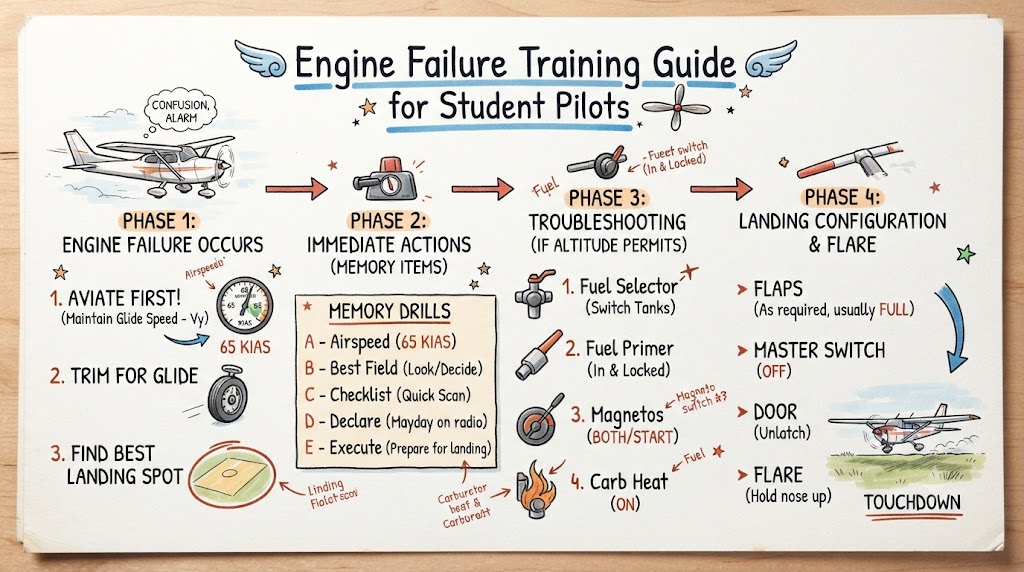
Immediate Priorities Following Power Loss
The exact procedure must come from the aircraft checklist, but a general training framework includes the following priorities:
- Maintain control of the aircraft.
- Establish the manufacturer-recommended glide condition.
- Check altitude and available time.
- Select a suitable landing area.
- Turn or position the aircraft toward that area.
- Complete aircraft-specific immediate actions.
- Use the approved emergency checklist.
- Attempt a restart only when appropriate.
- Communicate when workload permits.
- Prepare the aircraft and occupants for landing.
This is not a universal emergency checklist. The order and wording of aircraft-specific actions may be different.
Students should also learn when troubleshooting must stop. At lower altitude, preparing for landing is generally more important than continuing a restart attempt that distracts the pilot from airspeed, terrain and alignment.
Engine Failure During Different Flight Phases
The pilot’s available options change greatly according to the aircraft’s altitude, speed and position.
Engine Failure Before Takeoff
A power problem identified before the aircraft begins its takeoff roll should normally lead to delaying the departure until the cause has been investigated.
Warning signs may appear during:
- Engine start
- Taxi
- Engine run-up
- Pre-takeoff checks
- Power application
- Instrument verification
Unusual temperatures, pressures, sounds, vibrations or control responses should not be ignored. A student should never allow schedule pressure, embarrassment or concern about delaying other traffic to influence a safety decision.
Engine Failure During the Takeoff Roll
If power is lost or the engine does not perform normally during the takeoff roll, the pilot may need to reject the takeoff.
Training normally focuses on:
- Prompt power reduction
- Directional control
- Effective braking
- Remaining on the available surface
- Avoiding unnecessary configuration changes
- Following the aircraft’s rejected-takeoff procedure
The decision becomes more difficult when a runway is short or the aircraft has already accelerated significantly. A pre-takeoff briefing helps the student decide in advance how an abnormal acceleration, instrument indication or engine failure will be handled.
Engine Failure Immediately After Takeoff
An engine failure shortly after liftoff gives the pilot very little time. The aircraft may be flying at a high pitch attitude and relatively low airspeed, so prompt pitch control is essential.
The main priorities are to:
- Lower the nose as required to maintain a safe airspeed
- Maintain control
- Select the safest reachable landing area
- Avoid excessive bank angles
- Follow the approved emergency procedure
- Prepare for landing
The FAA recommends considering emergency landing options before every takeoff, including departure direction, altitude, wind, terrain and potential landing sites.
The Turn-Back Decision
Trying to return to the departure runway after an engine failure can require a steep turn, a major change in direction and accurate energy management at low altitude. There is no universal altitude at which a turn-back becomes safe.
The result depends on:
- Aircraft glide performance
- Pilot reaction time
- Wind
- Runway length
- Departure path
- Bank angle
- Aircraft weight
- Terrain
- Pilot proficiency
- Height lost while turning
- Additional turns needed to align with the runway
Students should practise decision-making with an instructor rather than selecting a turn-back altitude from an online article. Any demonstration or training exercise must use safe recovery limits established by the instructor.
Engine Failure During Climb
An engine failure later in the climb may provide more time and more reachable landing areas. However, the aircraft may still be relatively close to the airport and operating at a climb attitude.
The pilot should assess:
- Available altitude
- Distance from the airport
- Wind direction
- Nearby runways or fields
- Terrain and obstacles
- Aircraft glide range
- Traffic
- Weather conditions
The nearest runway is not always the safest option. Reaching it may require aggressive manoeuvring, while a suitable area ahead may offer a more stable approach.
Engine Failure During Cruise
Cruise altitude may provide additional time for landing-area selection, checklist use, communication and passenger preparation.
A well-trained student should still act promptly. Available altitude can disappear quickly when the pilot becomes focused on troubleshooting, navigation equipment or radio communication.
During cruise, the pilot may have time to:
- Establish the correct glide
- Identify nearby airports
- Compare landing options
- Use the emergency checklist
- Assess the possibility of an engine restart
- Inform air traffic control
- Brief passengers
- Secure loose objects
- Plan the approach
Engine Failure During Approach or Landing
An engine failure during approach may leave the aircraft close to a runway, but it can still become dangerous if the pilot responds with abrupt turns or allows the airspeed to fall.
Students should learn to:
- Maintain a reachable landing surface
- Avoid extending the approach unnecessarily
- Manage flaps and landing gear carefully
- Use configuration changes only when landing is assured
- Preserve sufficient energy
- Avoid trying to stretch the glide
A pilot cannot stretch a glide by pulling back and flying slower. Excessive pitch can increase drag, reduce airspeed and lead to a stall.
Best Glide and Energy Management
Best-glide speed is the aircraft-specific speed normally used to obtain the greatest distance for the available altitude in still-air conditions. It is not the same as minimum-sink speed, which is associated with remaining airborne for a longer period rather than travelling the greatest horizontal distance.
The FAA Private Pilot Airman Certification Standards require applicants to understand best-glide speed, minimum-sink speed, wind effects, atmospheric conditions and energy management during a simulated emergency approach. Applicants are expected to establish the recommended best-glide airspeed, configure the aircraft correctly and select a suitable landing area.
Why the Correct Speed Matters
Flying too slowly may reduce control margins and increase stall risk. Flying too quickly may increase the descent rate or reduce the distance available for landing-site selection.
Best-glide performance can also be affected by:
- Wind
- Aircraft weight
- Bank angle
- Flap position
- Landing-gear position
- Propeller condition
- Turbulence
- Aircraft damage
- Pilot control accuracy
Students must obtain the correct speed from the aircraft handbook rather than relying on a speed remembered from another aircraft.
Selecting a Suitable Emergency Landing Area
Selecting a landing area is not simply a matter of choosing the nearest open field. The pilot must consider whether the aircraft can reach it and whether a controlled approach is possible.
Important factors include:
- Wind direction and strength
- Surface length
- Surface condition
- Slope
- Surrounding terrain
- Trees
- Buildings
- Power lines
- Fences
- Roads and traffic
- People and animals
- Approach obstacles
- Sun position
- Available glide distance
The FAA’s private-pilot standards specifically include altitude, wind, terrain, obstructions, glide distance and available landing distance in emergency-landing risk management.
Fields
A field may provide a large open area, but crops, irrigation channels, fences, soft soil and hidden obstacles can create risks.
Roads
A road may appear smooth and clearly defined, but vehicles, signs, bridges, wires and roadside structures can make it unsuitable.
Airports
An airport may offer prepared surfaces and emergency assistance, but the pilot must avoid using all available altitude merely trying to reach a runway that is outside the aircraft’s realistic glide range.
Beaches or Shorelines
A beach may look open from altitude, but people, soft sand, water, changing tides and surface irregularities must be considered.
The objective is not to find a perfect area. It is to choose the most suitable reachable option and commit to a controlled approach.
Using the Aircraft Emergency Checklist
Emergency checklists are created for a particular aircraft and system configuration. Students should know where the checklist is kept and how to access it quickly.
Training usually separates emergency actions into two categories:
- Immediate or memory actions: Actions that may need to be completed without first reading the checklist.
- Checklist verification: Using the approved checklist to confirm that the required actions have been completed correctly.
Students must learn only the immediate actions approved for their aircraft and training organisation.
A general checklist-management process is:
- Maintain aircraft control.
- Complete instructor-taught immediate actions.
- Direct the aircraft toward a landing area.
- Open the correct emergency checklist.
- Read and confirm each applicable item.
- Monitor altitude and flight path.
- Stop troubleshooting when landing preparation becomes the priority.
The FAA certification standards require appropriate checklist completion and configuration in accordance with the Pilot’s Operating Handbook or Airplane Flight Manual.
Restart Considerations
An engine restart may be attempted when altitude, time and aircraft procedures permit. However, restart efforts must not interfere with aircraft control or landing preparation.
A restart attempt may be reasonable when:
- The aircraft is high enough to permit troubleshooting
- A landing area has already been selected
- The aircraft remains within reach of that area
- The approved checklist provides a restart procedure
- The pilot can complete the procedure without losing situational awareness
A restart attempt should not become the pilot’s only plan. Even when the engine begins operating again, the pilot should consider the possibility of another power loss and continue evaluating landing options.
Emergency Communication
When workload permits, the pilot should tell air traffic control about the emergency.
A useful emergency transmission may include:
- Distress or urgency call
- Aircraft registration or call sign
- Nature of the problem
- Position
- Altitude
- Intended landing area
- Pilot’s intentions
- Number of people onboard when relevant
- Fuel remaining when requested or useful
In the United States, 121.5 MHz is an emergency frequency monitored by many air traffic facilities and aircraft. The transponder emergency code is 7700 when appropriate. Radio frequencies, transponder use and emergency phraseology must follow the rules applicable to the country and airspace in which the flight is operating.
A student should remember that a short, clear transmission is usually more useful than a long explanation. If communication interferes with aircraft control, communication must wait.
Passenger and Cabin Preparation
Passengers may become frightened when the engine sound changes or the aircraft begins descending. Calm and clear instructions can reduce confusion.
When time permits, the pilot may instruct passengers to:
- Fasten and tighten seat belts
- Adjust shoulder harnesses
- Secure loose objects
- Stop unnecessary conversation
- Review the location of exits
- Adopt an appropriate brace position
- Follow evacuation instructions after landing
The pilot should also ensure that objects cannot move forward and interfere with controls or cause injury.
Simulated Engine Failure Training
A simulated engine failure gives students an opportunity to practise emergency skills without experiencing an actual powerplant failure.
Training may develop:
- Pitch and airspeed control
- Landing-area selection
- Glide planning
- Checklist discipline
- Situational awareness
- Workload management
- Radio communication
- Passenger briefing
- Decision-making
- Approach control
The FAA includes simulated emergency approaches and landings in private-pilot certification standards. The exercise evaluates knowledge, risk management and practical control skills.
Simulated failures must be introduced and supervised by a qualified instructor or authorised evaluator. The exercise must be conducted in an area where a safe recovery is possible.
Students should never independently:
- Shut down an engine for practice
- Move fuel controls without authorisation
- Reduce power unexpectedly
- Practise low-altitude emergency turns
- Attempt a forced-landing exercise over unsuitable terrain
- Continue a simulation below the instructor’s recovery limit
Recommended Training Progression
A structured training programme may follow these stages:
Classroom Discussion
The student learns basic priorities, aircraft performance, possible causes of power loss and emergency decision-making.
Aircraft Handbook Study
The student reviews aircraft-specific airspeeds, immediate actions, restart procedures, limitations and emergency checklists.
Cockpit Familiarisation
With the aircraft safely on the ground, the student locates important controls, instruments and checklists.
Instructor Demonstration
The instructor demonstrates the correct response at a safe altitude while explaining each decision.
Student Practice
The student performs the procedure under close supervision.
Scenario-Based Exercises
The instructor introduces different circumstances, such as changing wind, limited landing areas or partial power.
Flight-Phase Practice
Training covers failures during climb, cruise, approach and other suitable phases.
Debriefing
The instructor and student review control accuracy, decision-making, checklist use and missed information.
Recurrent Training
Emergency procedures should be reviewed after the licence is obtained, not treated as a one-time test exercise.
Scenario-Based Training Examples
Scenario One: Power Loss Shortly After Takeoff
Training objective: Maintain control and make a quick landing-area decision.
Main decisions: Pitch control, airspeed, direction and landing area.
Common error: Trying to return to the runway without sufficient altitude or preparation.
Instructor discussion: Compare the risks of a turn-back with reachable areas ahead.
Safety lesson: A controlled landing in an imperfect area is preferable to losing control while attempting an unrealistic manoeuvre.
Scenario Two: Partial Power During Climb
Training objective: Recognise that partial power does not guarantee continued flight.
Main decisions: Whether the aircraft can maintain altitude, whether to return and which landing areas remain available.
Common error: Continuing to climb or travel away from suitable landing areas.
Instructor discussion: Review engine indications and aircraft performance without allowing troubleshooting to dominate attention.
Safety lesson: Treat uncertain power as a condition that may become a complete failure.
Scenario Three: Rough Engine During Cruise
Training objective: Balance diagnosis, navigation and landing preparation.
Main decisions: Airspeed, nearby airports, suitable terrain and use of the checklist.
Common error: Focusing entirely on engine instruments.
Instructor discussion: Practise assigning time and attention between aircraft control, navigation, checklist use and communication.
Safety lesson: Extra altitude creates options only when it is managed carefully.
Scenario Four: Power Loss Near an Unfamiliar Airport
Training objective: Use available navigation information while preserving visual awareness.
Main decisions: Runway selection, wind, traffic, terrain and approach direction.
Common error: Spending too much time programming cockpit equipment.
Instructor discussion: Compare electronic information with visual landing options.
Safety lesson: Technology can assist the pilot, but it must not replace basic aircraft control and outside observation.
Common Student Pilot Mistakes
Looking Down for Too Long
Searching for a checklist or control can allow the aircraft’s pitch and airspeed to change. Students should develop a quick cockpit scan and return their attention outside frequently.
Delaying Landing-Area Selection
A student may begin troubleshooting before choosing a landing area. A suitable area should be selected early so the aircraft always has a clear destination.
Fixating on Restarting the Engine
The engine may not restart. Students must continue flying a planned approach while any restart attempt is made.
Stretching the Glide
Raising the nose beyond the required attitude does not create additional energy. It can reduce airspeed and increase stall risk.
Turning Too Steeply
Steep turns can increase load factor, stall speed and altitude loss. Bank angle should be managed carefully.
Changing Landing Areas Repeatedly
Constantly switching targets can produce an unstable flight path. The pilot should change the selected area only when a clearly safer option becomes available.
Extending Flaps or Gear Too Early
Additional drag may reduce glide distance. Configuration changes should follow the aircraft procedure and be timed so the landing remains assured.
Communicating Too Early
A student may attempt a detailed radio call before controlling the aircraft. Flying and navigating remain the first priorities.
Ignoring Wind
Wind changes both glide distance and the approach. A strong headwind can reduce the distance the aircraft can travel over the ground.
Continuing Troubleshooting Too Low
At some point, the pilot must stop diagnosing the engine and concentrate fully on the landing.
Human Factors During Engine Failure
Technical knowledge alone is not enough. Students must also understand how stress affects performance.
Startle Effect
An unexpected power loss can temporarily delay action. Repeated, realistic training helps students recognise the situation and begin the correct response sooner.
Tunnel Vision
The pilot may focus on one instrument, switch or landing area while ignoring airspeed, terrain or traffic.
Task Saturation
The combination of flying, selecting a landing site, using a checklist and communicating can exceed the student’s available attention.
Confirmation Bias
A pilot may interpret information in a way that supports the preferred plan, such as believing a distant runway is reachable despite evidence to the contrary.
Decision Paralysis
Too many possible landing areas can delay commitment. Students should learn to identify a satisfactory option rather than wait for a perfect one.
Overconfidence
Successfully completing a simulation does not mean every real engine failure will develop in the same way. Wind, terrain, passengers, weather and aircraft damage can make the real event much more difficult.
A useful mental routine is:
- Control
- Confirm
- Choose
- Checklist
- Communicate
- Commit to the landing
This memory aid is only a workload-management tool. It does not replace the aircraft’s approved emergency procedure.
Engine Failure Study Checklist for Students
Use this checklist for study and preparation, not as an in-flight emergency checklist:
- Read the aircraft’s emergency-procedure section.
- Memorise only instructor-approved immediate actions.
- Know the aircraft’s best-glide speed.
- Understand how wind affects glide distance.
- Know where the emergency checklist is stored.
- Practise identifying landing areas.
- Review emergency radio phraseology.
- Discuss engine failure after takeoff before departure.
- Practise passenger briefings.
- Review each simulation during the post-flight debrief.
- Repeat emergency training regularly.
- Never practise without instructor approval and supervision.
Role of the Flight Instructor
A qualified flight instructor helps the student connect written procedures with safe aircraft handling.
The instructor should help the student:
- Understand aircraft-specific procedures
- Recognise engine-failure indications
- Maintain safe airspeed
- Select realistic landing areas
- Manage cockpit workload
- Use checklists correctly
- Understand turn-back risks
- Improve communication
- Recognise unsafe decisions
- Build confidence without creating complacency
A good debrief should examine not only what the student did, but why each decision was made.
Preflight Actions That Reduce Risk
Not every mechanical failure can be prevented, but careful preparation can identify some problems before takeoff.
Important habits include:
- Confirming the required fuel quantity
- Visually checking fuel when possible
- Inspecting fuel samples for contamination
- Checking the oil level
- Verifying fuel-cap security
- Checking engine controls
- Completing the engine run-up
- Monitoring temperatures and pressures
- Reviewing maintenance status
- Checking aircraft performance
- Reviewing weather and terrain
- Planning emergency landing directions before takeoff
FAA takeoff guidance advises pilots to complete run-up and pre-takeoff checks, verify normal engine indications and consider engine-failure options before departure.
Actions Following an Emergency Landing
After the aircraft stops, the pilot’s priorities change from flight control to occupant safety.
General considerations include:
- Stop and secure the aircraft using the approved checklist.
- Evacuate if fire, fuel, smoke or another immediate hazard exists.
- Help passengers move to a safer location.
- Contact emergency services when possible.
- Avoid returning to an unsafe aircraft.
- Provide first aid within the limits of available training.
- Preserve relevant information about the event.
- Follow the accident or incident reporting requirements applicable to the location.
Reporting rules differ between countries. Pilots should obtain guidance from the appropriate aviation authority, operator, flight school or investigating agency.
Practical Engine Failure Training Plan
| Training Exercise | Skill Developed | Typical Student Error | Instructor Focus | Review Material |
|---|---|---|---|---|
| Ground-based cockpit drill | Control and checklist familiarity | Looking for controls for too long | Accurate identification and flow | POH or AFM |
| Best-glide demonstration | Airspeed and trim control | Chasing the airspeed indicator | Stable attitude and outside reference | Performance section |
| Landing-area selection | Situational awareness | Choosing an unreachable area | Wind, terrain and glide range | Emergency procedure |
| Simulated cruise failure | Workload management | Troubleshooting before selecting a field | Aviate, navigate and communicate | Emergency checklist |
| Simulated approach failure | Energy management | Adding drag too early | Landing assurance and configuration | Landing procedures |
| Passenger-briefing exercise | Communication | Giving unclear instructions | Calm, brief and direct language | Safety briefing |
| Scenario debrief | Decision-making | Defending the first decision | Honest review and alternatives | Instructor notes |
Frequently Asked Questions
1. What is the best-glide speed during an engine failure?
Best-glide speed is aircraft-specific. It must be obtained from the approved Pilot’s Operating Handbook or Airplane Flight Manual. Students should not use a speed taken from another aircraft.
2. What should a student pilot do first after an engine failure?
The first priority is to maintain positive aircraft control. The pilot should establish the appropriate glide condition and prevent a stall before becoming occupied with troubleshooting or communication.
3. Can a student practise a simulated engine failure alone?
No. Simulated engine failures should be conducted only as part of properly supervised training with a qualified instructor or authorised evaluator.
4. Should a pilot always turn back after an engine failure following takeoff?
No. Turning back can require significant altitude and accurate low-altitude manoeuvring. The decision depends on the aircraft, wind, runway, terrain, height, pilot proficiency and prior training.
5. How many times should a pilot attempt to restart the engine?
There is no universal number. Restart attempts must follow the aircraft checklist and should continue only while altitude, time and workload permit.
6. Which frequency should be used for an emergency call?
Pilots should normally use the frequency already in use when contact is available. In the United States, 121.5 MHz is an emergency frequency. Other countries may have different procedures or additional requirements.
7. How should a pilot select an emergency landing area?
The pilot should consider reachability, wind, surface condition, length, slope, terrain, people, obstacles and the possibility of flying a controlled approach.
8. Should the pilot use memory actions or read the checklist first?
This depends on the aircraft procedure. Time-critical actions may be memorised when specifically required, followed by checklist verification. Students must use only instructor-approved aircraft-specific actions.
9. Is a simulated emergency landing included in private-pilot testing?
In FAA private-pilot testing, simulated emergency approach and landing procedures are included within the emergency-operations standards for applicable aircraft categories.
10. Should engine failure training continue after earning a licence?
Yes. Emergency skills can weaken when they are not practised. Recurrent, instructor-led training helps pilots refresh aircraft control, checklist use and decision-making.
Key Takeaways
- Fly the aircraft before completing any other task.
- Use the aircraft-specific best-glide speed.
- Select a reachable landing area early.
- Follow the approved aircraft checklist.
- Do not allow restart attempts to distract from landing preparation.
- Avoid unrealistic low-altitude turn-back attempts.
- Use radio communication only when workload permits.
- Practise simulated failures only with qualified supervision.
- Include engine-failure options in every pre-takeoff briefing.
- Continue emergency training after obtaining a pilot licence.
Conclusion
Engine failure training gives student pilots a structured way to manage an unexpected loss of power without allowing fear, confusion or cockpit workload to take control of the situation. Strong performance depends on maintaining aircraft control, establishing the correct glide, selecting a suitable landing area, following the approved checklist and making decisions early enough to preserve available options. Regular instructor-led practice helps convert these principles into disciplined habits. Astropilot.co can support students with educational aviation guides, but practical emergency training must always take place under qualified supervision and in accordance with the procedures approved for the aircraft.
Aviation Safety Disclaimer: This article is provided for general aviation education only. It does not replace instruction from a qualified flight instructor, an approved flight-training programme, the aircraft’s Pilot’s Operating Handbook or Airplane Flight Manual, official emergency checklists or instructions issued by the relevant aviation authority. Emergency procedures, airspeeds, aircraft limitations, communication practices and legal requirements vary by aircraft and location.
