
Introduction
Every time a mobile phone searches for service, it needs to recognize the networks around it. Network identifiers help the phone understand which operator runs each network.
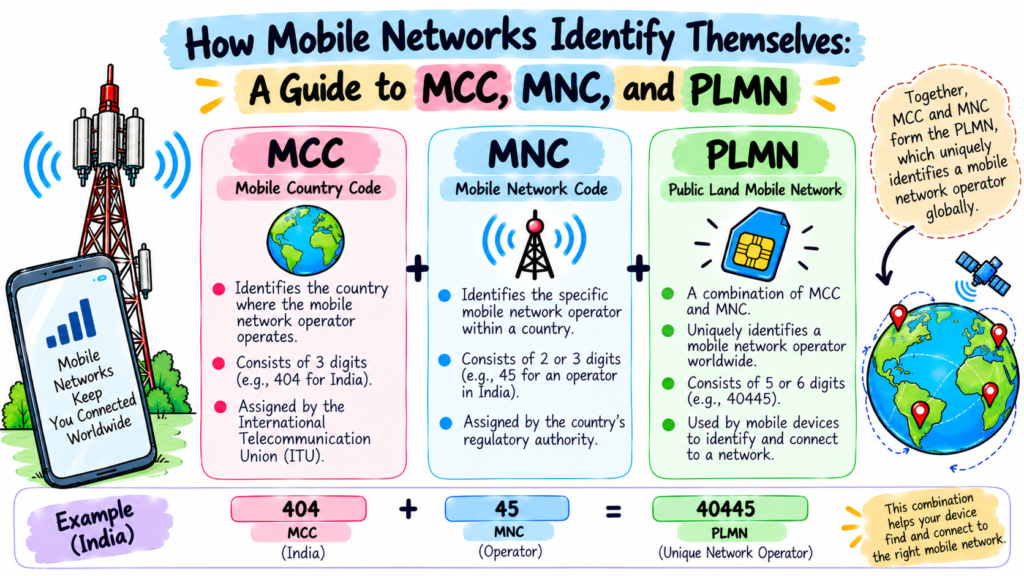
Three key terms explain this process: Mobile Country Code (MCC), Mobile Network Code (MNC), and Public Land Mobile Network (PLMN). These identifiers work together, but each has a different purpose.
MCC represents a country or territory within the mobile numbering system. MNC distinguishes a mobile network within the relevant numbering plan. PLMN combines both codes to identify a public mobile network.
Learning these basics helps readers understand roaming, network selection, and mobile connectivity. It also gives telecom professionals a useful starting point for network testing and troubleshooting.
MCC: The Country-Level Identifier
A Mobile Country Code, or MCC, uses three digits to identify a country or territory within the mobile numbering system.
Mobile networks use this code as part of their identity. When a phone searches for service, it can read network information that includes the MCC.
What Does MCC Help With?
MCC supports several important tasks:
- Country identification: It indicates the country or territory associated with a mobile network.
- Network discovery: It helps a device recognize network information during its search for service.
- Roaming: It helps systems distinguish networks associated with different countries.
- Technical management: Telecom teams use MCC values when reviewing network configurations.
An MCC identifies a network’s country or territory context. It does not identify a particular customer or phone.
MNC: The Mobile Network Identifier
A Mobile Network Code, or MNC, helps distinguish one mobile network from another within the relevant numbering plan.
The code usually contains two or three digits. Its length depends on the country’s numbering arrangements and the assigned code.
Why Does MNC Matter?
Mobile devices and telecom systems use MNC values alongside MCC values to recognize specific networks.
MNC supports tasks such as:
- Identifying a mobile operator’s network.
- Distinguishing networks within the same country.
- Supporting network selection and registration.
- Helping engineers investigate roaming or configuration problems.
An MNC alone may not uniquely identify a network worldwide. The MCC provides important context, so systems use both codes together.
PLMN: The Complete Network Identity
A Public Land Mobile Network, known as a PLMN, provides mobile communication services through a cellular network. Mobile operators use these networks to deliver services such as voice calls, messaging, and mobile data.
A PLMN identity combines the MCC and MNC.
PLMN identity = MCC + MNC
This combination helps mobile devices distinguish one public mobile network from another.
How Does a Phone Use PLMN?
Imagine that you travel to another country and switch on your phone. Your device searches for available cellular networks and reads their broadcast information.
The phone uses network identities as part of its selection process. It also considers your SIM settings, preferred operators, roaming permissions, and other network rules.
After selecting a suitable network, the phone attempts to register. The operator checks whether your subscription and connection meet its requirements.
A PLMN identity helps the phone recognize a network, but it does not guarantee access. Coverage, roaming agreements, subscription settings, and network conditions also affect connectivity.
MCC, MNC, and PLMN: Key Differences
These three terms describe related but distinct parts of mobile network identification.
| Term | What it identifies | Typical format |
|---|---|---|
| MCC | A country or territory | Three digits |
| MNC | A mobile network within the relevant numbering plan | Two or three digits |
| PLMN | A public mobile network | MCC combined with MNC |
Think of MCC as the country-level part of a network identity. MNC adds the network-level distinction. PLMN brings the two values together.
For accurate identification, check the complete code against a reliable telecom reference. Avoid guessing an operator’s identity from only part of a code.
The Role of Network Identifiers in 4G and 5G
Mobile network technology continues to change, but network identification remains important.
Network Identification in 4G
LTE networks use PLMN identities to help devices recognize available networks. Devices consider this information during network selection and registration.
Operators also use network identity information to support roaming and manage their network services.
Network Identification in 5G
5G systems also use PLMN identities to identify mobile networks. Devices rely on network information during discovery and selection.
Some private or specialized deployments use additional identifiers and configuration rules. These arrangements can add complexity, but MCC and MNC still provide an important foundation for identifying public mobile networks.
How Network Identifiers Support Roaming
Roaming allows a subscriber to use a compatible network outside the home operator’s service area, subject to the subscriber’s plan and operator agreements.
When a traveler reaches another country, the phone may detect several local networks. Their PLMN identities help the device distinguish the available networks.
The phone then applies its network-selection rules and attempts registration. The visited operator and the home operator may need an appropriate roaming arrangement before the subscriber can use the service.
If registration fails, the network identity offers one useful clue. Engineers should also examine roaming permissions, SIM settings, subscription status, and registration messages.
Common Connectivity Problems and What to Check
Network identifiers can help explain some connection problems, but they rarely tell the whole story.
The Phone Selects an Unexpected Network
A device may choose a different operator because of preferred-network settings, roaming rules, or local availability.
What to check: Review automatic network selection, preferred operators, and roaming settings.
The Phone Cannot Register While Roaming
A phone may detect a network but fail to obtain service.
What to check: Confirm that the plan supports roaming and that the operator permits access to the visited network. Review any registration error messages.
Network Information Looks Incorrect
An unexpected MCC or MNC value may point to a configuration issue or a misunderstanding of the code format.
What to check: Compare the complete network identity with an authoritative telecom source. Confirm whether the MNC uses two or three digits.
The Phone Shows No Service
A valid PLMN identity cannot create coverage where no usable signal exists.
What to check: Examine signal strength, local coverage, device compatibility, SIM status, and possible network outages.
A Device Cannot Use a Particular Operator
Some devices, SIM plans, or subscriptions limit access to certain networks.
What to check: Verify device compatibility, subscription permissions, SIM settings, and the operator’s access rules.
Practical Tips for Telecom Teams
Telecom engineers, network testers, and support teams can use these practices to work with network identifiers more accurately.
- Use trusted references: Check official telecom records or reliable operator documentation.
- Preserve leading zeros: Treat codes as identifiers rather than ordinary numbers. A leading zero can matter.
- Check the complete identity: Review both MCC and MNC instead of relying on one code alone.
- Understand the numbering plan: Confirm the correct MNC length for the country or network.
- Review other connection factors: Check signal quality, device settings, SIM status, and registration results.
- Use appropriate diagnostic tools: Gather network information through device settings or authorized testing systems.
- Protect subscriber data: Keep network identifiers separate from personal subscriber information.
For more information about eSIM technology and related mobile connectivity topics, visit esimglobo.com.
MCC, MNC, and PLMN: Frequently Asked Questions
What does MCC stand for?
MCC stands for Mobile Country Code. It contains three digits and identifies a country or territory within the mobile numbering system.
What does MNC stand for?
MNC stands for Mobile Network Code. It helps distinguish a mobile network within the relevant numbering plan.
What does PLMN mean?
PLMN means Public Land Mobile Network. Its identity combines the MCC and MNC to identify a public mobile network.
How many digits does an MCC contain?
An MCC contains exactly three digits.
Does every MNC have the same length?
No. An MNC typically contains two or three digits, depending on the applicable numbering plan.
Can MCC identify a specific mobile operator?
No. MCC identifies the country or territory context. The MNC adds the network-level distinction.
Do 4G and 5G phones use PLMN identities?
Yes. Both LTE and 5G systems use PLMN identities to support mobile network identification and selection.
Does a PLMN identity guarantee a connection?
No. A device also needs suitable coverage and permission to access the network. SIM settings, subscriptions, and operator rules can affect registration.
Can MCC and MNC help solve roaming problems?
Yes. These codes help engineers identify the network involved. However, they must also check roaming agreements, account permissions, and registration errors.
Do MCC and MNC identify individual subscribers?
No. They identify networks, not individual users. Mobile systems use separate subscriber identifiers for that purpose.
Final Thoughts
MCC, MNC, and PLMN form the foundation of mobile network identification. Each plays a separate role in helping devices recognize cellular networks and choose where to connect.
Understanding their differences makes network selection and roaming easier to follow. It also helps telecom teams investigate connection problems with a clearer starting point.
As 4G and 5G services continue to develop, these identifiers remain useful tools for understanding how mobile networks recognize one another and support connectivity.
