
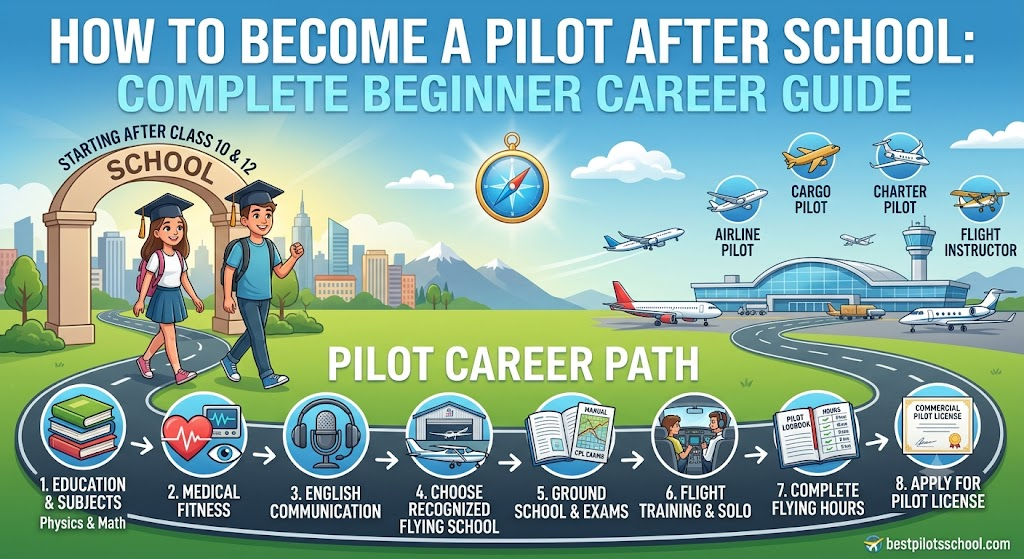
Becoming a pilot after school is one of the most exciting career dreams for many students. The idea of flying an aircraft, wearing a pilot uniform, travelling to different places, and working in the aviation industry feels inspiring. However, becoming a pilot is not only about passion. It also requires the right education, medical fitness, discipline, flight training, exams, flying hours, communication skills, and proper career planning.
Many students ask one common question: How to Become a Pilot After School? The answer depends on your education level, country, aviation authority rules, budget, medical fitness, and the type of pilot career you want to choose. Some students want to become commercial airline pilots, while others may want to become private pilots, cargo pilots, charter pilots, corporate pilots, or flight instructors.
This guide by bestpilotsschool.com explains the complete pilot career path after school in simple language. It is written especially for students, parents, and beginners who want to understand pilot training step by step.
What Does a Pilot Do?
A pilot is a trained aviation professional who operates an aircraft safely from one place to another. A pilot’s work is not limited to flying the aircraft. Pilots are responsible for passenger safety, aircraft checks, weather understanding, navigation, communication, emergency handling, and coordination with air traffic control.
A pilot’s duties may include:
- Checking the aircraft before flight
- Understanding weather conditions
- Planning the flight route
- Communicating with air traffic control
- Operating the aircraft safely
- Monitoring fuel, speed, altitude, and navigation systems
- Handling emergency situations calmly
- Ensuring passenger and crew safety
- Completing flight reports after landing
A pilot must be focused, disciplined, responsible, and mentally alert. Aviation is a safety-focused profession, so every decision matters.
Why Choose a Pilot Career After School?
A pilot career attracts students because it offers a combination of adventure, technical learning, responsibility, and professional growth. It is not a normal desk job. It requires confidence, continuous learning, and strong decision-making.
Here are some reasons why students choose a pilot career after school:
1. Passion for Flying
Many students dream of flying from a young age. If you love aircraft, airports, aviation, and travel, pilot training can be a meaningful career path.
2. Professional Career Path
Pilot training follows a structured path. Students move from basic aviation learning to advanced flying skills and license-based qualifications.
3. Global Career Opportunities
Aviation is a global industry. Trained pilots may find opportunities in airlines, charter companies, cargo services, corporate aviation, flight schools, and private aviation depending on their license, experience, and regulatory approval.
4. Technical Learning
Pilot training teaches subjects like navigation, meteorology, aircraft systems, aviation rules, air law, flight planning, and radio communication.
5. Responsible and Respected Profession
Pilots carry great responsibility. They are trusted with aircraft safety, passenger safety, and professional decision-making.
Basic Eligibility to Become a Pilot After School
Eligibility requirements may vary depending on the country and aviation authority. However, most pilot training paths include some common requirements.
Students usually need to focus on the following:
- School education completion
- Required subjects, often Physics and Mathematics for commercial pilot training in many countries
- Minimum age requirement
- Medical fitness
- Good eyesight and overall health
- English communication skills
- Ability to understand technical subjects
- Financial planning for training costs
Before joining any flying school, students should check the official rules of the aviation authority in their country.
Which Stream Is Best After 10th to Become a Pilot?
Students who want to become pilots should start planning after Class 10. In many countries, especially for commercial pilot training, students are expected to study Physics and Mathematics at the higher secondary level.
The best stream after 10th for aspiring pilots is usually:
- Science stream
- Physics
- Mathematics
- English
- Computer or technical subjects, if available
Physics helps students understand motion, force, aircraft movement, pressure, weather, and flight principles. Mathematics helps with navigation, fuel calculations, distance, speed, time, and flight planning.
Students who are in commerce or arts should not lose hope. In some regions, alternative academic pathways or bridge courses may be available. However, students must verify the current rules of the aviation authority and flying school before making a decision.
Can You Become a Pilot After 12th?
Yes, students can start their pilot career journey after completing 12th. For many students, 12th is the main starting point for commercial pilot training.
A common route after 12th includes:
- Complete 12th with required subjects
- Check medical fitness
- Choose a recognized flying school
- Apply for student pilot training
- Complete ground school
- Complete flying training
- Pass required exams
- Build flying hours
- Apply for the required pilot license
Students should remember that completing 12th alone does not make someone a pilot. It only makes the student eligible to begin the training process, depending on the rules of the country and flying school.
Step-by-Step Process to Become a Pilot After School
Here is a simple step-by-step guide for students who want to understand How to Become a Pilot After School.
Step 1: Complete School Education With the Right Subjects
The first step is completing school education. Students should choose subjects carefully after 10th. Physics and Mathematics are important for many commercial pilot training routes.
Students should also focus on English because aviation communication is usually done in English.
Step 2: Build Strong English Communication Skills
Pilots must communicate clearly with air traffic control, crew members, instructors, and aviation teams. Strong English speaking and listening skills are important.
Students can improve English by:
- Reading aviation-related articles
- Practicing spoken English
- Listening to aviation communication examples
- Building confidence in speaking
- Improving grammar and vocabulary
Good communication helps during training, interviews, cockpit work, and real flight operations.
Step 3: Maintain Physical and Mental Fitness
Medical fitness is one of the most important parts of becoming a pilot. A student may be academically strong, but if they do not meet medical standards, they may face difficulty in pilot training.
Students should take care of:
- Eyesight
- Hearing
- General health
- Mental alertness
- Physical fitness
- Sleep routine
- Stress management
Before spending money on flying school, students should complete the required aviation medical examination from an approved medical examiner.
Step 4: Research Pilot Career Options
Not every pilot career is the same. Students should understand different aviation paths before starting.
Common pilot career options include:
- Private pilot
- Commercial pilot
- Airline pilot
- Cargo pilot
- Charter pilot
- Corporate pilot
- Flight instructor
- Helicopter pilot
Each path may require different licenses, training hours, exams, and experience.
Step 5: Understand Pilot License Types
Pilot licenses are official permissions that allow a trained person to fly specific aircraft under specific rules. Students should understand the basic license structure before joining training.
| License Type | Purpose | Suitable For | Basic Requirement |
|---|---|---|---|
| Student Pilot License | Basic entry-level training permission | Beginners starting flight training | Medical fitness and flying school admission |
| Private Pilot License | Flying for personal or non-commercial purpose | Aviation hobbyists and private flying | Flight training and exams |
| Commercial Pilot License | Flying professionally for payment | Students aiming for pilot careers | Required flying hours, exams, and medical fitness |
| Airline Transport Pilot License | Advanced airline command level | Experienced airline pilots | High flying experience and advanced qualification |
The exact name, process, and rules may differ from country to country.
Step 6: Clear the Required Medical Examination
Aviation medical fitness is compulsory for pilot training. Commercial pilot candidates usually need a higher medical fitness standard than private pilot candidates.
Medical checks may include:
- Vision test
- Hearing test
- Blood pressure check
- Heart health check
- General body fitness
- Medical history review
- Mental health and alertness assessment
Students should complete medical checks early. This helps avoid future disappointment and financial loss.
Step 7: Choose a Recognized Flying School
Choosing the right flying school is one of the most important decisions in a pilot career. A flying school should not be selected only because of low fees or attractive advertisements.
Students should check:
- Approval or recognition by the aviation authority
- Aircraft availability
- Instructor experience
- Training quality
- Safety standards
- Maintenance system
- Ground school facilities
- Flying hour completion record
- Fee transparency
- Refund policy
- Student reviews
- Accommodation support
- Weather conditions in the training location
Parents and students should visit the flying school if possible and ask detailed questions before admission.
Step 8: Join Ground School Training
Before flying an aircraft, students study important aviation subjects in ground school. Ground school helps students understand the theory behind flying.
Common ground school subjects include:
- Air regulations
- Navigation
- Meteorology
- Aircraft technical knowledge
- Flight planning
- Radio communication
- Human performance
- Aviation safety
- Principles of flight
Ground school is important because pilots must understand both practical flying and theoretical knowledge.
Step 9: Start Flight Training
After ground preparation and required approvals, students begin actual flying training with certified flight instructors.
Flight training usually includes:
- Basic aircraft handling
- Takeoff and landing practice
- Turns and climbs
- Navigation flights
- Emergency procedures
- Solo flying
- Cross-country flying
- Instrument flying basics
- Night flying, where required
Flight training builds confidence slowly. Students first fly with instructors and later progress to solo flying when they are ready and approved.
Step 10: Complete Required Flying Hours
Every pilot license has required flying hours. The required number depends on the aviation authority, license type, aircraft category, and training program.
Students should understand that flying hours are not just numbers. They represent real aircraft experience, decision-making, safety practice, and skill development.
Flying hours may include:
- Dual flying with instructor
- Solo flying
- Cross-country flying
- Instrument flying
- Night flying
- Pilot-in-command time
Students should track their flying hours carefully in their logbook.
Step 11: Pass Written Exams and Skill Tests
Pilot training includes written exams and practical flying tests. Students must clear aviation subjects and demonstrate safe flying skills.
Exams may test:
- Aviation laws
- Weather knowledge
- Aircraft systems
- Navigation
- Flight planning
- Safety procedures
- Radio communication
- Human factors
The skill test usually checks whether the student can operate the aircraft safely according to required standards.
Step 12: Apply for the Pilot License
After completing training, exams, medical requirements, and flying hours, students can apply for the relevant pilot license.
The aviation authority reviews:
- Education documents
- Medical certificate
- Flying logbook
- Exam results
- Skill test records
- Flying school certification
- Identity documents
After approval, the student receives the pilot license based on the completed training category.
Step 13: Build Experience and Apply for Pilot Opportunities
Getting a license is an important milestone, but career growth continues after that. New pilots often need to build more experience before joining larger airline roles.
They may work toward:
- Flight instructor roles
- Charter flying
- Cargo flying
- Type rating
- Airline selection process
- Multi-engine training
- Instrument rating
- Additional aviation qualifications
A pilot career requires continuous learning and regular skill improvement.
Medical Fitness Requirements for Pilots
Medical fitness is a serious part of aviation because pilots must be alert, healthy, and capable of handling pressure.
Important medical areas include:
Vision
Pilots need good vision according to aviation medical standards. Corrective glasses or lenses may be allowed in some cases, depending on the rules.
Hearing
Pilots must hear radio communication clearly. Good hearing is important for cockpit safety and air traffic control communication.
General Health
Heart health, blood pressure, neurological health, and overall physical fitness are checked during aviation medical examinations.
Mental Alertness
Pilots must make quick and correct decisions. Mental focus, emotional stability, and stress management are important.
Regular Medical Renewal
Pilot medical certificates may need renewal from time to time. Pilots must continue to meet medical standards throughout their career.
Skills Required to Become a Successful Pilot
A successful pilot needs more than technical training. The profession requires a balanced mix of knowledge, attitude, discipline, and confidence.
Important pilot skills include:
1. Communication Skills
Pilots must speak clearly and listen carefully. Miscommunication can create safety risks.
2. Decision-Making
Pilots must make quick and correct decisions during weather changes, technical issues, or emergency situations.
3. Discipline
Aviation follows strict rules and procedures. A disciplined mindset is necessary.
4. Focus and Patience
Pilot training takes time. Students must stay focused even when progress feels slow.
5. Technical Understanding
Pilots should understand aircraft systems, instruments, navigation, and flight planning.
6. Leadership
A pilot often leads the cockpit team and makes responsible decisions.
7. Problem-Solving
Unexpected situations can happen in aviation. Pilots must remain calm and solve problems logically.
8. Confidence Under Pressure
A pilot must stay calm during challenging weather, technical alerts, or operational pressure.
How to Choose the Right Flying School
Selecting the right flying school can make a big difference in your training quality, cost planning, and career confidence.
Before choosing a flying school, students should check the following points:
Recognition and Approval
The school should be approved by the relevant aviation authority. Never join an unapproved training center.
Aircraft Availability
A good flying school should have enough aircraft for training. Limited aircraft can delay flying hours.
Instructor Quality
Experienced instructors help students learn safely and confidently.
Safety Standards
Check the school’s safety culture, aircraft maintenance, and operational discipline.
Training Facilities
Good classrooms, simulators, briefing rooms, and study material can improve learning.
Fee Structure
Ask for a clear fee breakup. Understand what is included and what may cost extra.
Student Feedback
Talk to current and former students if possible. Their experience can reveal practical details.
Training Timeline
Ask how long students usually take to complete required flying hours.
Location and Weather
Weather affects flying training. Some locations allow more flying days, while others may face delays.
Estimated Cost of Pilot Training
Pilot training can be expensive. The cost depends on the country, flying school, aircraft type, fuel cost, instructor charges, exam fees, accommodation, medical tests, and license type.
Students should plan for:
- Admission fees
- Ground school fees
- Flying charges
- Instructor charges
- Exam fees
- Medical examination fees
- Study material
- Uniform and equipment
- Accommodation and food
- Travel cost
- License application fees
- Extra flying hours, if required
Students should avoid choosing a flying school only because it looks cheap. Low fees without proper aircraft, instructors, or approval can create bigger problems later.
A smart student should compare quality, safety, training completion record, and total cost transparency.
Common Mistakes Students Should Avoid
Many students enter pilot training with excitement but without proper planning. Here are common mistakes to avoid:
1. Not Checking Eligibility Early
Students should check subject, age, and medical requirements before making career decisions.
2. Ignoring Medical Fitness
Medical fitness should be checked before paying large training fees.
3. Choosing a Flying School Without Research
Never select a flying school only through advertisements. Verify approval, safety, aircraft, instructors, and student reviews.
4. Not Planning Finances
Pilot training requires serious financial planning. Students should understand the complete cost before joining.
5. Weak English Communication
English is important in aviation. Students should improve communication skills early.
6. Poor Discipline
Pilot training demands punctuality, focus, and professional behavior.
7. Depending Only on Passion
Passion is important, but it must be supported by study, fitness, training, and patience.
8. Not Understanding the License Path
Students should clearly understand which license they need for their career goal.
Pilot Career Options After Training
After completing pilot training and licensing requirements, students can explore different aviation career paths.
Commercial Airline Pilot
Commercial airline pilots fly passenger aircraft for airlines after meeting license, experience, type rating, and airline selection requirements.
Cargo Pilot
Cargo pilots transport goods, packages, and freight. This is an important part of aviation logistics.
Charter Pilot
Charter pilots fly private or small commercial aircraft for specific clients or routes.
Corporate Pilot
Corporate pilots operate aircraft for companies, business leaders, or private organizations.
Flight Instructor
Some pilots become instructors and train new student pilots. This can also help build flying experience.
Private Aircraft Pilot
Private pilots may fly personal or private aircraft depending on license privileges.
Aviation Training Roles
Some trained pilots may work in aviation education, ground instruction, simulator training, or operational support.
Sample Student Journey
Let us understand the journey through a simple example.
Rohan is a Class 10 student who dreams of becoming a pilot. After researching aviation careers, he chooses Physics and Mathematics in higher secondary school. During Class 11 and 12, he improves his English communication and studies science seriously.
After completing 12th, he checks pilot eligibility rules and completes an aviation medical examination. Once he confirms that he is medically fit, he compares different flying schools. He checks approval status, aircraft availability, instructor quality, student reviews, and total training cost.
After choosing a recognized flying school, he joins ground school and starts learning aviation subjects. Later, he begins flight training with an instructor. Slowly, he completes flying lessons, solo flying, exams, and required flying hours. After clearing the required tests, he applies for his pilot license.
Rohan’s journey shows that becoming a pilot after school is possible, but it requires planning, patience, discipline, and proper guidance.
How bestpilotsschool.com Can Help Students
bestpilotsschool.com can be a helpful learning resource for students who want to understand aviation careers in a simple and beginner-friendly way. Students and parents can use the platform to explore pilot career information, flying school selection tips, aviation training awareness, and step-by-step guidance related to becoming a pilot after school.
For beginners, the pilot journey may feel confusing at first. There are many questions about subjects, eligibility, medical fitness, licenses, costs, flying schools, and career options. A student-friendly aviation platform can make this process easier by explaining each step clearly.
bestpilotsschool.com can help students learn:
- How pilot training works
- What to study after school
- How to choose a flying school
- What skills pilots need
- What license options are available
- What mistakes to avoid
- How to plan a pilot career practically
The goal should always be to help students make informed and responsible decisions.
Quick Checklist for Students
Before starting pilot training, students should check:
- Have I completed the required school education?
- Did I study the required subjects?
- Have I checked official aviation authority rules?
- Have I completed the required medical test?
- Is my English communication strong enough?
- Have I researched different flying schools?
- Is the flying school approved?
- Do I understand the full training cost?
- Do I know which pilot license I need?
- Am I ready for discipline, study, and continuous training?
This checklist can help students avoid confusion and start their journey with clarity.
FAQs About How to Become a Pilot After School
1. Can I become a pilot after 12th?
Yes, students can start pilot training after completing 12th, depending on the eligibility rules of their country and aviation authority. Many commercial pilot training paths require specific subjects, medical fitness, and approved flight training.
2. Which subject is best for becoming a pilot?
Physics and Mathematics are highly important for students who want to become pilots. English is also important because aviation communication is usually done in English.
3. Is Physics and Mathematics compulsory for pilots?
In many countries and training systems, Physics and Mathematics are required for commercial pilot training. However, rules may vary, so students should verify current requirements with the relevant aviation authority.
4. What is the minimum age to start pilot training?
The minimum age depends on the country, license type, and aviation authority. Student pilot and private pilot training may start earlier than commercial pilot licensing, but official rules must always be checked.
5. Is medical fitness important for pilots?
Yes, medical fitness is very important. Pilots must meet required medical standards for vision, hearing, general health, and mental alertness.
6. How long does it take to become a pilot?
The duration depends on the flying school, weather, aircraft availability, student performance, exams, and required flying hours. Some students complete training faster, while others may take more time.
7. Is pilot training expensive?
Yes, pilot training can be costly. The total cost depends on the country, flying school, aircraft type, flying hours, exam fees, medical tests, and living expenses.
8. Can girls become pilots after school?
Yes, girls can become pilots after school if they meet the required education, medical, training, and licensing standards. Aviation careers are open to both boys and girls.
9. Which license is required to become a commercial pilot?
A Commercial Pilot License is commonly required to fly professionally for payment. Additional ratings, experience, and airline-specific requirements may also be needed.
10. How should students start preparing for a pilot career?
Students should choose the right subjects, improve English, stay physically fit, research aviation careers, understand license types, check medical fitness, and compare recognized flying schools.
Conclusion
Becoming a pilot after school is a dream that can become a real career with the right preparation. Students must understand that flying is a professional responsibility, not just an exciting lifestyle. The journey includes proper education, medical fitness, ground school, flight training, exams, flying hours, and continuous learning.
If you are wondering How to Become a Pilot After School, the best approach is to start early, choose the right subjects, stay healthy, improve communication skills, research flying schools carefully, and follow official aviation authority rules.
A pilot career requires dedication, patience, discipline, and financial planning. With the right guidance and responsible preparation, students can move step by step toward their aviation dream. bestpilotsschool.com can help beginners and parents understand the pilot journey in a simple, practical, and student-friendly way.
