
Introduction
Choosing the right pilot school is one of the most important decisions for anyone who dreams of becoming a pilot. A pilot school is not just a place where students learn how to fly an aircraft. It is where they build their aviation foundation, develop safety habits, understand aircraft operations, prepare for exams, and gain the confidence needed for a professional flying career.
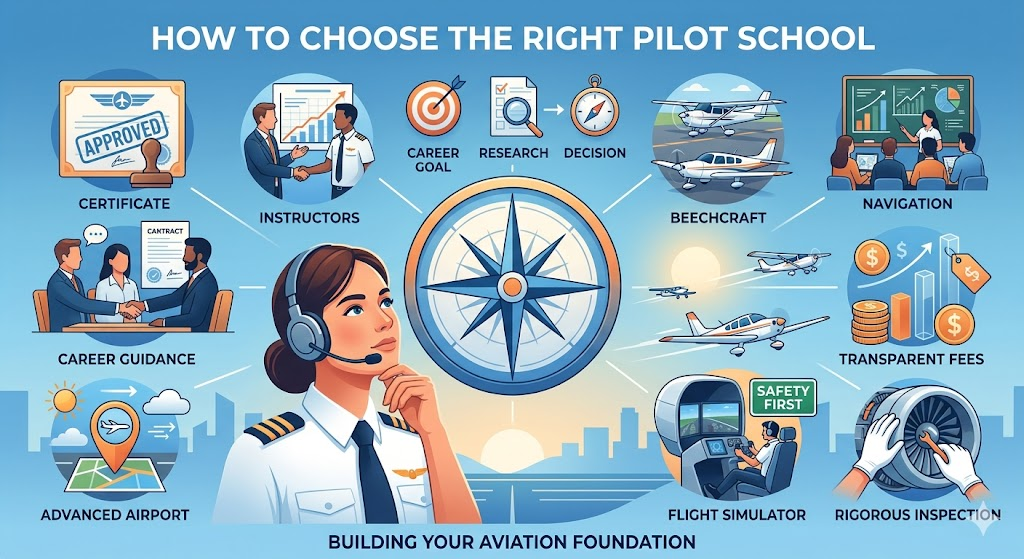
Many students and parents focus only on the training fee when selecting a flying school. While cost is important, it should not be the only deciding factor. A good pilot school should offer proper approvals, experienced instructors, well-maintained aircraft, strong ground school training, transparent fees, safe operations, and practical career guidance.
For aspiring pilots, the right school can make the training journey smoother, safer, and more career-focused. The wrong choice can lead to delays, extra expenses, poor learning experience, and confusion about the next career steps. This guide will help aviation students, parents, and beginners understand what to check before joining a pilot school and how to make a smart decision.
Why Choosing the Right Pilot School Matters
Pilot training is a serious investment of time, money, and effort. Students spend months or even years building the knowledge, flying hours, discipline, and confidence needed to become professional pilots. That is why choosing the right training school matters so much.
A good pilot school helps students learn in a structured way. It provides clear training plans, regular flying opportunities, strong ground classes, experienced instructors, and proper safety procedures. These factors directly affect how quickly and confidently a student progresses.
The right school also helps students understand the complete pilot career path. It guides them about licenses, medical requirements, exams, flying hours, simulator training, interview preparation, and future aviation opportunities. This type of support is especially useful for beginners who are entering the aviation field for the first time.
On the other hand, a poorly managed school can cause unnecessary delays. Students may face aircraft shortage, irregular flying schedules, unclear fees, weak ground school support, or lack of instructor availability. These issues can increase the total training cost and affect the student’s motivation.
Choosing the right pilot school is not only about getting admission. It is about building a strong aviation career from the beginning.
Understand Your Pilot Career Goal First
Before selecting a pilot school, students should understand what type of pilot career they want to pursue. Different aviation careers may require different training paths, licenses, ratings, and experience levels.
Some students want to become commercial airline pilots. Some may be interested in private flying, cargo aviation, charter flying, corporate aviation, helicopter flying, or flight instruction. Knowing your goal helps you choose a school that offers the right training program.
For example, if your goal is to become a commercial airline pilot, you should look for a school that offers strong Commercial Pilot License training, good ground school support, instrument training, multi-engine exposure, and career guidance. If you are interested in private flying, you may first focus on a Private Pilot License program.
Common pilot career goals include:
- Commercial airline pilot
- Private pilot
- Charter pilot
- Cargo pilot
- Flight instructor
- Corporate pilot
- Helicopter pilot
- Military aviation path
- Air ambulance pilot
- Aviation training professional
Students do not need to have every detail planned from day one, but having a basic direction helps them make better choices.
Check School Approval and Accreditation
One of the first things students should check is whether the pilot school is approved by the relevant aviation authority. Approval is important because pilot training must follow proper aviation rules, safety standards, and licensing requirements.
An approved pilot school is expected to meet certain standards related to aircraft maintenance, instructor qualifications, training procedures, documentation, and safety operations. Students should never join a flying school without verifying its approval status.
When checking approval, look for:
- Valid aviation authority approval
- Permission to conduct pilot training programs
- Approved aircraft for training
- Qualified instructors
- Proper training documentation
- Recognized license programs
- Updated operational compliance
Students should ask the school for official approval details and verify them carefully. Parents should also review these documents before making payments or confirming admission.
A school with proper approval gives students more confidence that their training will be valid, recognized, and aligned with aviation regulations.
Review the Pilot Training Programs Offered
Not every pilot school offers the same training programs. Some schools may focus only on basic flight training, while others may provide complete training pathways from beginner level to advanced pilot preparation.
Students should check whether the school offers the course they need for their career goal. A good pilot school should clearly explain its programs, training duration, flying hour requirements, ground school structure, and license pathway.
Common pilot training programs include:
- Student Pilot License preparation
- Private Pilot License training
- Commercial Pilot License training
- Instrument Rating
- Multi-Engine Rating
- Ground school classes
- Simulator training
- Flight instructor training
- Type rating guidance
- Radio telephony preparation
- Aviation exam preparation
Students should ask what is included in the training package and what is charged separately. They should also understand whether the school provides both theoretical and practical training.
A school that offers clear program details helps students plan their aviation journey better.
Evaluate the Aircraft Fleet
Aircraft availability is one of the most important factors in pilot training. Students need regular flying practice to build confidence, improve skills, and complete required flying hours on time. If a school has very few aircraft or poor aircraft availability, training can be delayed.
A good pilot school should have a reliable fleet of training aircraft. The aircraft should be well-maintained, suitable for student training, and available according to a structured schedule.
Students should check:
- Number of training aircraft
- Type of aircraft used for training
- Aircraft maintenance quality
- Availability of backup aircraft
- Single-engine aircraft options
- Multi-engine aircraft options
- Simulator availability
- Flying schedule flexibility
- Average flying hours per student per month
It is also important to ask whether aircraft are regularly grounded due to maintenance issues. Maintenance is necessary for safety, but frequent aircraft unavailability may delay training progress.
A strong aircraft fleet improves training consistency and helps students complete flying hours more efficiently.
Check Instructor Experience and Training Quality
Instructors play a major role in pilot training. A good instructor does more than teach students how to control an aircraft. They help students understand aviation discipline, safety thinking, communication, decision-making, and emergency handling.
Students should check the qualifications and experience of instructors before joining a pilot school. Experienced instructors can identify student weaknesses, explain concepts clearly, and build confidence step by step.
Important points to check include:
- Instructor qualifications
- Flying experience
- Teaching experience
- Student-to-instructor ratio
- Communication style
- Availability for doubt clearing
- Safety approach
- Ground school support
- Flight briefing and debriefing quality
Students should also try to speak with current students to understand how instructors behave during training. A supportive instructor can make the learning process much easier, especially for beginners.
Training quality is not only about flying hours. It is also about how well students understand what they are doing and why they are doing it.
Compare Training Cost and Fee Transparency
Pilot training can be expensive, so students and parents should understand the complete cost before taking admission. Many students make the mistake of comparing only the basic course fee. In reality, the total cost may include many additional expenses.
A good pilot school should provide a clear fee structure. Students should know exactly what is included and what is not included.
Common cost components include:
- Admission fee
- Ground school fee
- Flying hour charges
- Simulator charges
- Exam fees
- Study material cost
- Uniform cost
- Medical examination cost
- Documentation charges
- Accommodation cost
- Food expenses
- Local transport cost
- Extra flying hour charges
- License processing charges
Students should ask whether the fee is fixed or based on actual flying hours. They should also ask what happens if extra training is needed.
Fee transparency is very important. A school with unclear pricing or hidden charges can create financial stress later. Choosing the cheapest school is not always the best decision. Students should compare cost along with safety, aircraft availability, instructor quality, and training value.
Check Safety Standards and Maintenance Practices
Safety should always be the top priority when choosing a pilot school. Aviation training involves real aircraft, real weather, real procedures, and real decision-making. A strong safety culture helps students become responsible pilots.
Students should check how seriously the school handles safety. This includes aircraft maintenance, pre-flight checks, weather decisions, emergency training, instructor supervision, and operational discipline.
Important safety factors include:
- Regular aircraft maintenance
- Proper technical inspections
- Safety briefings before flights
- Emergency procedure training
- Weather monitoring
- Instructor supervision
- Clear flight operating procedures
- Student safety rules
- Incident reporting process
- Discipline during flight operations
A good school should never compromise safety for faster training. Students should observe how the school manages aircraft, instructors, and flight schedules. If a school ignores safety questions or gives unclear answers, that is a warning sign.
Strong safety training builds strong pilots.
Review Ground School Quality
Ground school is an important part of pilot training. Many beginners think pilot training is only about flying aircraft, but theoretical knowledge is equally important. Pilots must understand aviation rules, weather, navigation, aircraft systems, communication, and flight planning.
A good pilot school should provide structured ground classes with experienced faculty. These classes help students prepare for exams and understand real flying situations.
Important ground school subjects include:
- Air regulations
- Navigation
- Meteorology
- Aircraft technical knowledge
- Flight planning
- Radio telephony
- Human performance
- Aviation safety
- Aircraft performance
- Operational procedures
Weak ground school training can make it harder for students to clear exams and understand flight operations. Students should ask about class schedules, study materials, mock tests, doubt sessions, and exam preparation support.
Strong ground school training creates confident and knowledgeable pilots.
Look at Simulator Training Facilities
Simulator training is useful because it allows students to practice flight procedures in a controlled environment. Simulators help students learn cockpit discipline, emergency handling, instrument flying, navigation, and communication procedures before practicing in actual aircraft.
Not every pilot school has advanced simulator facilities, but basic simulator support can still be valuable. Students should check what type of simulator training is available and how it is included in the course.
Simulator training can help students:
- Practice standard procedures
- Improve instrument understanding
- Learn emergency handling
- Build cockpit confidence
- Reduce fear before actual flying
- Improve decision-making
- Understand navigation better
- Prepare for advanced ratings
Simulator training should not replace actual flying, but it can improve the quality of flight training when used properly.
Consider Location and Weather Conditions
The location of a pilot school can affect training speed, cost, and overall student experience. Weather conditions, airport traffic, accommodation, food, transport, and cost of living all matter.
A school located in an area with good flying weather may help students complete flying hours more consistently. However, students should also gain experience in different weather and air traffic conditions as they progress.
Factors to consider include:
- Weather conditions
- Number of flying days per month
- Airport facilities
- Airspace restrictions
- Air traffic level
- Distance from home
- Accommodation availability
- Food options
- Local transport
- Cost of living
- Student safety in the area
A school far from home may offer better flying opportunities, but students should calculate living expenses carefully. Parents should also check whether the location is safe and suitable for long-term training.
The best location is one that supports regular flying, affordable living, and a comfortable learning environment.
Check Student Reviews and Alumni Feedback
Student reviews and alumni feedback can give practical insights that brochures and websites may not show. Current students can explain the real training experience, while alumni can share how the school supported their career journey.
Before joining, students should try to speak with current students or past trainees. They should ask direct and practical questions.
Questions to ask include:
- Is flying scheduled regularly?
- Are aircraft available most of the time?
- Are instructors supportive?
- Is ground school useful?
- Are fees transparent?
- Are students able to complete training on time?
- Does the school provide career guidance?
- Is the management responsive?
- Are safety practices followed properly?
- Are students satisfied with the training quality?
Reviews should be judged carefully. One negative review does not always mean the school is bad, and one positive review does not always mean the school is perfect. Students should look for repeated patterns in feedback.
Real student experience can help you avoid costly mistakes.
Placement Support and Career Guidance
A good pilot school should guide students beyond flying hours. Pilot training does not end with completing a license. Students also need help understanding airline preparation, interviews, license conversion, type rating, resume building, and career planning.
Career guidance is especially important for beginners who may not understand the aviation job market. A school with strong guidance can help students prepare for the next step after training.
Useful career support may include:
- Airline interview preparation
- Resume guidance
- License documentation support
- Type rating guidance
- Aviation career counseling
- Simulator assessment preparation
- Communication skill development
- Networking support
- Guidance for further ratings
- Support for flight instructor pathway
Students should be careful of schools that promise guaranteed jobs without clear details. A school can support placement preparation, but job selection depends on student performance, market conditions, license status, and employer requirements.
Good guidance can improve career readiness, but unrealistic promises should be avoided.
Red Flags to Avoid While Choosing a Pilot School
Students should watch for warning signs before taking admission. If a school avoids answering important questions or pressures students to pay quickly, it may not be the right choice.
Common red flags include:
- No clear approval documents
- Unclear fee structure
- Hidden charges
- Very poor aircraft availability
- Limited instructors
- No proper ground school support
- Poor communication from management
- Unrealistic job guarantees
- No student reviews
- Weak safety culture
- No maintenance transparency
- Irregular flying schedules
- No written training plan
- Poor campus facilities
- Lack of career guidance
Students should not rush the decision. If something feels unclear, ask more questions. A professional pilot school will be transparent and willing to explain its training process.
Step-by-Step Checklist to Choose the Right Pilot School
Choosing a pilot school becomes easier when students follow a checklist. This helps compare multiple schools fairly instead of making an emotional or rushed decision.
1- Define your pilot career goal
Start by deciding whether you want to become an airline pilot, private pilot, cargo pilot, charter pilot, flight instructor, or another type of aviation professional.
2- Check aviation authority approval
Verify whether the school is properly approved by the relevant aviation authority and allowed to conduct pilot training.
3- Compare training programs
Check whether the school offers the license, rating, and ground school training you need.
4- Review aircraft fleet
Ask how many aircraft are available, what types are used, and how often students get flying slots.
5- Check instructor experience
Understand instructor qualifications, student-to-instructor ratio, and teaching quality.
6- Visit the campus if possible
A campus visit helps you see aircraft, classrooms, facilities, and student life directly.
7- Understand the full fee structure
Ask for written details of all costs, including flying hours, exams, accommodation, and extra charges.
8- Ask about flying hour availability
Find out how many flying hours students usually complete per month.
9- Speak with students or alumni
Real feedback helps you understand the actual training experience.
10- Compare safety standards
Ask about maintenance, emergency training, weather rules, and safety procedures.
11- Review accommodation and location
Check whether the location is safe, affordable, and suitable for long-term training.
12- Check career guidance support
Ask whether the school provides interview preparation, license support, and career counseling.
13- Take the final decision carefully
Compare all factors before selecting the school. Do not decide only based on low fees or advertisements.
Common Mistakes Students Make While Selecting a Pilot School
Many students make mistakes because they are excited to start training quickly. While enthusiasm is good, pilot training requires careful planning.
Common mistakes include:
- Choosing a school only because it has low fees
- Not checking official approval
- Ignoring aircraft availability
- Not understanding the total training cost
- Believing guaranteed job claims
- Not visiting the school
- Ignoring instructor quality
- Not checking ground school support
- Not asking about accommodation cost
- Ignoring safety standards
- Not speaking with current students
- Choosing based only on advertisements
- Not comparing multiple schools
These mistakes can lead to delays, extra expenses, and disappointment. Students should take time to research properly before investing in pilot training.
Final Tips for Parents and Students
Pilot training is a big decision for both students and parents. Parents should not look only at the fee, and students should not choose only based on excitement or popularity. Both should work together to evaluate the school carefully.
Parents should ask about safety, approval, fee transparency, accommodation, student support, and career guidance. Students should ask about flying schedule, instructors, ground school quality, aircraft availability, and exam preparation.
A good pilot school should make both students and parents feel informed and confident. It should explain the complete process honestly and help students understand what to expect during training.
Before taking admission, compare at least a few schools. Make notes, ask questions, and avoid making quick decisions under pressure. The right school will support your learning, safety, confidence, and long-term aviation career.
FAQs
1- How do I choose the best pilot school?
To choose the best pilot school, check approval, training quality, aircraft availability, instructor experience, safety standards, fee transparency, and career guidance. Do not decide only based on low fees. Compare multiple schools and speak with current students or alumni before taking admission.
2- What should I check before joining a pilot school?
Before joining a pilot school, check whether it is approved by the relevant aviation authority. Also review its aircraft fleet, instructor qualifications, ground school quality, simulator facilities, total training cost, accommodation options, safety practices, and student feedback.
3- Is approval important for a pilot training school?
Yes, approval is very important. Pilot training must follow aviation rules and licensing standards. An approved school is expected to follow proper training, safety, documentation, maintenance, and instructor requirements. Students should always verify approval before admission.
4- How much does pilot school usually cost?
Pilot school cost varies depending on the country, training program, flying hours, aircraft type, accommodation, exams, and additional ratings. Students should ask for a complete written fee structure before joining. They should also budget for extra expenses such as medical checks, study materials, travel, and living costs.
5- Should I choose a pilot school near my home?
A pilot school near home may reduce living expenses and make travel easier, but location should not be the only factor. Students should also consider weather, aircraft availability, instructor quality, safety standards, and training consistency. Sometimes a school farther away may offer better training value.
6- Why is aircraft availability important in pilot training?
Aircraft availability affects how regularly students can fly. If a school has limited aircraft or frequent maintenance delays, students may take longer to complete flying hours. Regular flying practice helps students build confidence, improve skills, and complete training more efficiently.
7- How important are instructors in pilot training?
Instructors are extremely important because they guide students during both ground training and flight training. A good instructor teaches safety, decision-making, aircraft handling, communication, and emergency procedures. Experienced and supportive instructors can make the learning process much better.
8- What is the role of ground school in pilot training?
Ground school helps students understand aviation theory before and during flight training. It covers subjects such as air regulations, meteorology, navigation, aircraft technical knowledge, radio communication, and flight planning. Strong ground school support also helps students prepare for exams.
9- Can a pilot school guarantee a job?
Students should be careful with schools that promise guaranteed jobs. A school can provide career guidance, interview preparation, and training support, but final job selection depends on student performance, licenses, market demand, airline requirements, and other factors. Unrealistic job promises are a red flag.
10- What are the red flags of a poor pilot school?
Red flags include unclear fees, no approval documents, poor aircraft availability, weak ground school support, limited instructors, hidden charges, unrealistic job guarantees, poor communication, and weak safety culture. Students should avoid schools that cannot answer basic training and safety questions clearly.
11- Should parents visit the pilot school before admission?
Yes, parents should visit the pilot school if possible. A visit helps them check the campus, aircraft, classrooms, accommodation, safety standards, and overall environment. It also gives them a chance to speak with staff, instructors, and students before making a financial decision.
12- How can students compare two pilot schools?
Students can compare two pilot schools by creating a checklist. Compare approval, course structure, aircraft fleet, instructor quality, fee transparency, safety practices, flying schedule, ground school support, student reviews, location, accommodation, and career guidance. The school with better overall value is usually the smarter choice.
Conclusion
Choosing the right pilot school is not only about selecting a training center. It is about choosing the foundation for your aviation career. A good pilot school should offer proper approval, experienced instructors, well-maintained aircraft, strong ground school training, transparent fees, safe operations, and useful career guidance. Students should avoid making decisions based only on low fees, advertisements, or unrealistic job promises. Instead, they should compare schools carefully, speak with current students, check facilities, understand total costs, and review safety standards. With the right research and planning, aspiring pilots can choose a school that supports their goals and helps them move confidently toward a successful flying career.
