
Introduction
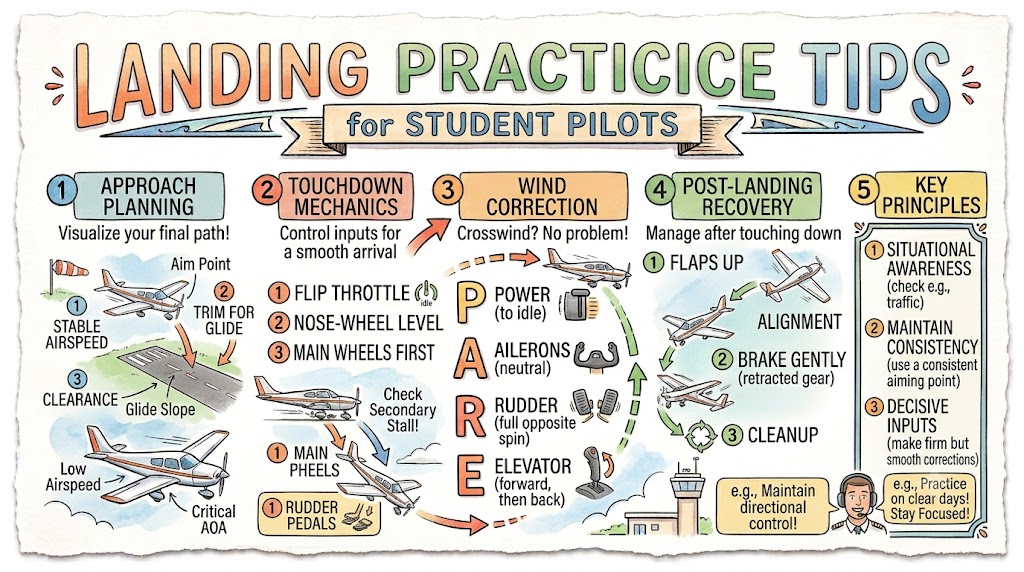
Landing is often one of the most challenging skills for a student pilot to master. During a landing, the pilot must control airspeed, descent rate, runway alignment, wind drift, aircraft configuration, flare timing, touchdown position, and directional control within a short period.
Students sometimes believe that a good landing depends mainly on producing a smooth touchdown. In reality, a safe landing begins much earlier. Accurate circuit planning, proper configuration, a stable final approach, and a willingness to go around are more important than making every touchdown feel perfect.
The Federal Aviation Administration describes a stabilized approach as one that maintains a constant-angle glide path toward a selected point on the runway while using a consistent final-approach airspeed and configuration. A stable approach gives the pilot a much better chance of completing a safe, controlled landing.
This guide explains practical landing tips for student pilots. It is intended for general education and should always be used together with instruction from a qualified flight instructor and the procedures published in the aircraft’s Pilot’s Operating Handbook or approved flight manual.
Why Landing Practice Feels Difficult
Landing requires several flying skills to work together. The student must judge height and movement visually while coordinating pitch, power, rudder, aileron, trim, and flap settings.
Unlike cruise flight, the aircraft is close to the ground, leaving less time to identify and correct an error. Wind, turbulence, runway width, slope, visibility, aircraft loading, and traffic can also change the appearance and feel of an approach.
Student pilots commonly struggle with:
- Maintaining a consistent approach speed
- Judging whether the aircraft is high or low
- Correcting runway drift
- Keeping the aircraft on the centreline
- Knowing when to begin the flare
- Looking too close to the aircraft
- Holding the correct landing attitude
- Managing crosswinds
- Deciding when to go around
These challenges normally improve through structured practice, instructor feedback, and repetition in different—but suitable—conditions.
Build Every Landing Around a Stabilized Approach
A stable approach is the foundation of a safe landing. The aircraft should be correctly configured, aligned with the runway, descending along an appropriate flight path, and maintaining the recommended airspeed before reaching the lower part of final approach.
The FAA notes that excessive speed, excessive altitude, or excessive manoeuvring can contribute to a destabilized approach. Trying to rescue an unstable approach close to the ground increases workload and can lead to loss of control.
A student should check:
- Is the aircraft aligned with the runway?
- Is the approach speed correct and stable?
- Is the descent rate controlled?
- Is the aircraft in the correct landing configuration?
- Is the selected touchdown area reachable without aggressive corrections?
- Is the crosswind within personal, school, and aircraft limits?
- Is the runway clear?
- Can the landing be completed safely?
When the answer to any important question is no, the safer decision is normally to go around.
Use the Aircraft’s Recommended Approach Speed
Approach speed affects almost every part of the landing.
Flying too fast can result in:
- Excessive floating
- Longer landing distance
- Difficulty touching down in the planned area
- Increased risk of runway overrun
- Ballooning during the flare
- Greater workload during crosswind correction
Flying too slowly can result in:
- Poor control response
- Excessive angle of attack
- Stall warning activation
- A hard touchdown
- Loss of control near the ground
Students should use the approach speed recommended in the aircraft’s approved documentation and apply any wind adjustment specified by the manufacturer, instructor, or training organisation. Published speeds should not be replaced with a value taken from another aircraft or an informal online source.
Understand the Relationship Between Pitch and Power
During a normal light-aircraft approach, pitch and power must be coordinated rather than treated as completely independent controls.
As a useful training principle:
- Pitch is often used primarily to correct airspeed.
- Power is often used primarily to adjust the descent path.
- Both controls are then coordinated to restore a stable approach.
For example, when the aircraft is below the desired glide path but the airspeed is correct, a small power increase may reduce the descent rate. When the aircraft is too fast, the student may need an appropriate pitch and power correction while maintaining the desired path.
Large or repeated corrections usually indicate that the approach was not properly planned or has become unstable.
Look at the Correct Part of the Runway
Where the student looks has a major effect on flare timing and directional control.
During final approach, the pilot should use an aim point to judge whether the aircraft is maintaining the desired flight path. An aim point that appears stationary in the windscreen generally indicates that the aircraft is travelling toward it.
As the aircraft enters the roundout and flare, the student should gradually shift visual attention farther along the runway. Looking too close to the nose can make it difficult to judge height, sink rate, and aircraft attitude.
Looking farther ahead helps the pilot:
- Recognise whether the aircraft is drifting
- Judge the rate at which the ground is approaching
- Maintain the correct landing attitude
- Keep the aircraft parallel to the runway
- Detect unwanted yaw during touchdown
The FAA’s landing guidance emphasises visual judgment of height, movement, and aircraft attitude throughout the roundout and touchdown.
Maintain Runway Centreline Discipline
Centreline control should begin on final approach and continue throughout touchdown and rollout.
Student pilots should not accept a landing merely because the aircraft is somewhere over the runway. A safe landing requires correct lateral position, alignment, and directional control.
Use coordinated control inputs to:
- Correct wind drift
- Keep the aircraft aligned with the runway
- Prevent side loading
- Maintain directional control after touchdown
Rudder controls the aircraft’s longitudinal alignment, while aileron helps manage bank and wind drift. The exact control technique depends on the aircraft, wind, and phase of landing.
A student who is unable to regain centreline alignment before touchdown should go around rather than force the aircraft onto the runway.
Practise Consistent Circuit and Traffic-Pattern Flying
A good landing is easier when every part of the traffic pattern is planned consistently.
Student pilots should practise:
- Flying the correct circuit altitude
- Maintaining suitable spacing from the runway
- Completing checks at the appropriate time
- Selecting configuration without rushing
- Correcting for wind on each leg
- Turning onto final at a safe distance
- Avoiding steep or uncoordinated turns
- Maintaining an effective lookout
An inconsistent downwind or base leg often produces a rushed final approach. Entering final too high, too low, too close, or poorly aligned may require large corrections close to the ground.
The objective is not to make every circuit identical regardless of conditions. The objective is to create a predictable structure that can be safely adjusted for wind, traffic, runway length, and instructor direction.
Learn to Judge the Flare
The flare is a gradual transition from the approach attitude to the landing attitude. Its purpose is to reduce the descent rate and allow the aircraft to touch down at an appropriate speed and attitude.
The flare should not be treated as one sudden control movement.
A basic sequence is:
- Maintain the stabilized approach.
- Transition your vision farther down the runway.
- Begin the roundout at the height demonstrated by the instructor.
- Gradually increase back pressure as airspeed decreases.
- Maintain runway alignment and crosswind correction.
- Allow the aircraft to settle onto the runway.
- Continue controlling the aircraft throughout the rollout.
The correct flare height and control movement vary between aircraft. Seating position, runway width, slope, wind, loading, and visibility can also affect height perception.
Avoid Forcing the Aircraft Onto the Runway
Students sometimes push the nose down when the aircraft floats beyond the intended touchdown point. This is unsafe because it can produce a nose-wheel-first touchdown, porpoising, or loss of directional control.
If the aircraft has excessive speed, it may not be ready to land. The pilot should maintain the correct attitude and allow the airspeed to decrease rather than forcing the wheels onto the surface.
A go-around should be initiated when:
- The remaining runway is becoming insufficient
- The touchdown zone has been missed
- The aircraft is floating excessively
- Directional control is uncertain
- The landing attitude is incorrect
- The approach or landing no longer feels controlled
The decision to go around should be made early whenever possible.
Hold the Landing Attitude
After beginning the flare, students often stop increasing back pressure. As the aircraft slows, more elevator input may be needed to maintain the landing attitude.
The student should gradually adjust control pressure as the aircraft decelerates. In a typical tricycle-gear training aircraft, the objective during a normal landing is usually to touch down on the main wheels before gently lowering the nose wheel, subject to the aircraft’s approved technique.
After touchdown:
- Maintain directional control with the rudder
- Keep the aircraft on the centreline
- Use appropriate aileron for the wind
- Lower the nose wheel gently
- Apply braking as required
- Do not relax until the aircraft is clear of the runway
The flight is not over when the main wheels touch the ground.
Manage Crosswind Correction Continuously
Crosswind correction is not something that is applied once and forgotten. Wind effects must be monitored and corrected throughout final approach, flare, touchdown, and rollout.
Depending on the aircraft and instructor-approved method, the pilot may use:
- A crab on final, followed by alignment before touchdown
- A wing-low sideslip
- A combination of both techniques
At touchdown, the aircraft should be aligned with the runway while drift is controlled. Touching down while moving sideways can place unnecessary loads on the landing gear and make directional control more difficult.
As the aircraft slows during rollout, control effectiveness decreases. Additional aileron input into the wind may therefore be needed. The exact technique must follow the aircraft handbook and instructor guidance.
Recognise Common Landing Errors
Landing Too Fast
What happens: The aircraft floats, uses more runway, or balloons during the flare.
Improvement: Establish the correct speed earlier and avoid carrying unnecessary power or excessive nose-down trim into the flare.
Landing Too Slow
What happens: Controls feel less responsive, sink rate increases, or the aircraft touches down firmly.
Improvement: Maintain the approved approach speed and respond immediately to unexpected stall warnings or excessive sink.
Flaring Too Early
What happens: The aircraft balloons or loses airspeed while still too high above the runway.
Improvement: Maintain the landing attitude, avoid pushing the nose down, and add power or go around when necessary.
Flaring Too Late
What happens: The aircraft may touch down hard or nose-wheel first.
Improvement: Improve visual scanning, shift the view farther down the runway, and practise recognising the correct roundout height with an instructor.
Looking Over the Nose
What happens: The student may struggle to judge height and drift.
Improvement: Move visual attention progressively toward the far end of the runway during the flare.
Fixating on the Airspeed Indicator
What happens: Runway alignment, drift, sink rate, or other traffic may be missed.
Improvement: Use a balanced outside scan supported by short instrument checks.
Relaxing After Touchdown
What happens: The aircraft moves away from the centreline or becomes vulnerable to crosswind.
Improvement: Continue active rudder and aileron control throughout the rollout.
Respond Correctly to a Ballooned Landing
A balloon occurs when the aircraft gains height during the flare, often because back pressure was applied too quickly or the aircraft carried excessive speed.
The appropriate response depends on the height and severity of the balloon.
For a small balloon, the instructor may teach the student to:
- Maintain an appropriate landing attitude
- Avoid pushing the nose down
- Add a small amount of power when necessary
- Allow the aircraft to settle under control
For a significant balloon, repeated balloon, or uncertain condition, the safer response is normally a go-around.
Trying to save a badly ballooned landing can produce a hard touchdown, porpoising, or damage to the nose landing gear.
Understand Bounces and Porpoising
A bounced landing occurs when the aircraft returns to the air after touching down.
A small bounce may be recoverable under instructor-approved procedures when:
- The aircraft remains aligned
- Sufficient runway remains
- The landing attitude is maintained
- The pilot retains positive control
A large or increasing bounce should normally lead to a go-around.
Porpoising is a series of increasing nose-wheel and main-wheel contacts. It can develop when an aircraft touches down nose-wheel first or when the pilot responds to a bounce with incorrect control movement.
The pilot should not attempt to push the aircraft back onto the runway. When porpoising begins or control is uncertain, a go-around is generally the safer action, provided it is initiated using the approved aircraft procedure.
Make the Go-Around a Normal Decision
A go-around is not a failed landing. It is a normal safety manoeuvre used when a safe landing is no longer assured.
The FAA and EASA both emphasise the importance of abandoning an unstable approach rather than continuing toward an unsafe landing.
Common reasons to go around include:
- Unstable airspeed or descent rate
- Poor runway alignment
- Excessive drift
- Runway obstruction
- Traffic conflict
- Excessive floating
- Severe balloon or bounce
- Wind conditions beyond limits
- Incorrect configuration
- Loss of visual reference
- Instructor direction
- Any doubt about completing the landing safely
Students should practise go-arounds regularly so that the procedure becomes familiar rather than stressful.
The aircraft-specific sequence may involve applying go-around power, controlling pitch, managing yaw, adjusting flap configuration in stages, establishing a positive climb, and communicating with air traffic services. The approved procedure must always be followed.
Practise Landing Skills in Small Sections
Students often improve faster when landing practice is divided into separate skills.
Practise Stable Approaches
Fly approaches followed by planned go-arounds. Focus only on airspeed, glide path, alignment, and configuration.
Practise Flare Sight Picture
With an instructor, observe the visual transition from final approach to the landing attitude. Compare correct, early, and late roundout cues.
Practise Centreline Control
Concentrate on runway alignment and directional control, including after touchdown.
Practise Crosswind Inputs
Begin in light crosswinds and increase difficulty gradually as skill and instructor confidence improve.
Practise Go-Around Decisions
Ask the instructor to create realistic situations requiring an early or late go-around.
Review Each Landing
After every circuit, identify one point that worked and one point to improve. Trying to correct five errors during the next approach can overload a beginner.
Use a Simple Landing Debrief
After each landing, ask:
- Was the traffic pattern well planned?
- Was the aircraft stabilized on final?
- Was the approach speed correct?
- Did I maintain the centreline?
- Was the touchdown area suitable?
- Did I begin the flare at the correct height?
- Where was I looking?
- Were my control movements smooth?
- Did I maintain crosswind correction?
- Should I have gone around?
- Did I control the aircraft throughout rollout?
An honest debrief is more valuable than judging the landing only by how smoothly the wheels touched.
Instructor’s Perspective
Flight instructors generally look for consistency and sound decision-making rather than one exceptionally smooth landing.
An instructor wants the student to demonstrate:
- Proper planning
- Accurate airspeed control
- Stable flight-path management
- Good lookout
- Coordinated control
- Runway alignment
- Safe flare technique
- Correct wind correction
- Positive go-around decisions
- Control throughout the landing roll
A firm touchdown within the correct area and under control may be safer than an extremely smooth touchdown after a long float.
Example Landing Practice Scenario
A student turns onto final approach slightly high and fast. The student reduces power aggressively and lowers the nose to reach the normal glide path.
The airspeed remains above the recommended value. During the flare, the aircraft floats beyond the planned touchdown area. The student feels pressure to complete the landing because the wheels are close to the runway.
The safest response is to recognise that the approach and landing are no longer developing as planned and initiate a go-around while adequate runway and control remain.
During the next circuit, the student corrects the pattern spacing earlier, establishes the landing configuration on time, maintains the recommended speed, and reaches final approach in a more stable condition.
The second landing becomes easier because the student corrected the cause rather than trying to rescue the final few seconds.
Quick Landing Practice Checklist
Before Entering the Circuit
- Review runway and wind information
- Confirm landing performance
- Complete required checks
- Review approach speed
- Establish go-around criteria
- Check traffic and radio requirements
On Final Approach
- Correct configuration
- Recommended airspeed
- Stable descent path
- Runway alignment
- Controlled wind correction
- Suitable touchdown area
- No excessive manoeuvring
During the Flare
- Shift vision farther down the runway
- Reduce descent smoothly
- Maintain alignment
- Prevent sideways drift
- Avoid forcing the aircraft down
- Hold the correct landing attitude
After Touchdown
- Maintain centreline
- Continue rudder control
- Increase aileron into the wind as appropriate
- Lower the nose wheel gently
- Brake according to conditions
- Remain alert until clear of the runway
This checklist is for educational revision only. It does not replace the aircraft’s approved checklist or instructor guidance.
Frequently Asked Questions
Why do student pilots struggle with landings?
Landings combine airspeed control, visual judgment, wind correction, flare timing, alignment, and decision-making close to the ground. These skills require repeated supervised practice.
What makes a good landing?
A good landing begins with a stabilized approach and ends with a controlled touchdown in a suitable runway area, correct alignment, and positive directional control.
Should a student aim for the smoothest possible touchdown?
Safety and control are more important than smoothness. A slightly firm touchdown in the correct attitude and area may be safer than a long floating landing.
Why does an aircraft float during landing?
Floating commonly results from excessive approach speed, excess power, an early flare, or a combination of these factors.
How can a student improve flare timing?
Practise maintaining a stable approach, use the correct visual references, shift the view farther down the runway, and compare each attempt with instructor demonstrations.
What should a pilot do after a hard bounce?
The response depends on bounce severity, aircraft position, runway remaining, and manufacturer guidance. A substantial or increasing bounce normally requires a go-around.
Is going around after touching down possible?
In some situations, a go-around may be initiated after an initial touchdown or bounce. The pilot must follow the approved aircraft procedure and maintain positive control.
How can crosswind landings be improved?
Begin with light crosswinds, practise drift and alignment control separately, use the method approved for the aircraft, and increase difficulty gradually with an instructor.
Why should pilots look farther down the runway during the flare?
Looking farther ahead helps judge height, descent rate, alignment, drift, and landing attitude more accurately.
When should a student pilot go around?
A go-around should be initiated whenever the approach is unstable, runway alignment is poor, the touchdown cannot be completed safely, an obstruction exists, or the pilot is uncertain about the landing.
Conclusion
Landing practice becomes more effective when student pilots focus on preparation, stable approaches, correct airspeed, visual judgment, centreline control, and early go-around decisions. Smooth touchdowns develop naturally as these basic skills become consistent. Every landing should be treated as a complete manoeuvre that begins in the traffic pattern and continues until the aircraft is safely clear of the runway.
Aviation Safety Disclaimer
This article is intended for general aviation education only. It does not replace instruction from a qualified flight instructor, an approved training syllabus, the Pilot’s Operating Handbook, aircraft flight manual, official checklists, school procedures, or applicable aviation regulations.
