
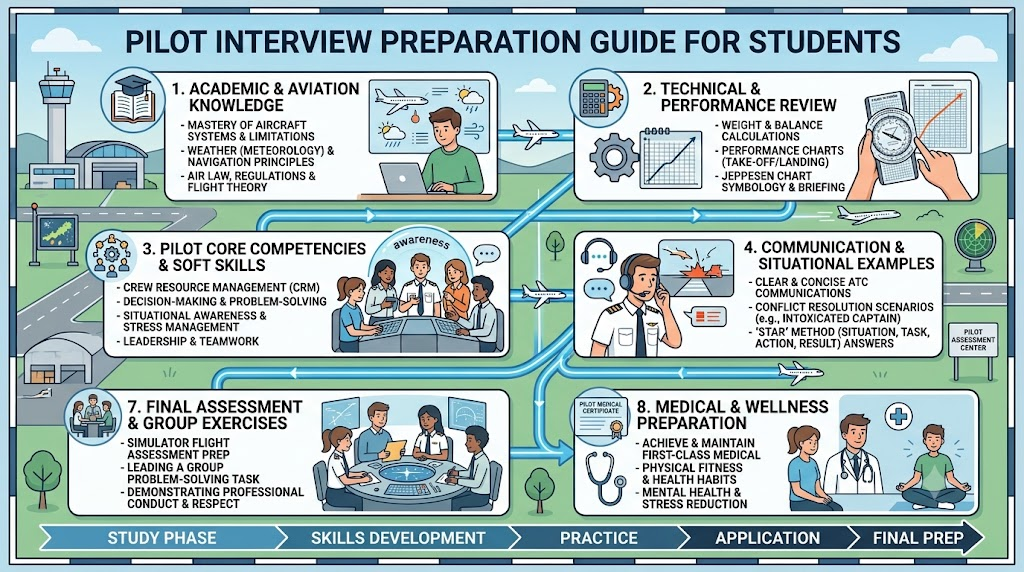
Introduction
Preparing for a pilot interview can be an exciting but challenging experience for students who are beginning their aviation journey.
An interview gives students an opportunity to demonstrate their knowledge, communication skills, motivation, and professional attitude.
Knowing what to expect can make the process less stressful and help candidates prepare more effectively.
This guide explains the key areas students should focus on before, during, and after a pilot interview.
Main Content
Understanding the Pilot Interview
A pilot interview is designed to help an airline, flight school, or aviation organization understand more about a candidate. The exact format can vary depending on the organization and the stage of the candidate’s training.
For students, the interview may cover their educational background, interest in aviation, personal qualities, basic aviation knowledge, and future goals. Some selection processes may also include aptitude assessments, technical evaluations, group activities, or other stages.
The purpose is not simply to determine whether a student can answer technical questions. Interviewers may also want to understand how a candidate communicates, approaches problems, works with others, and responds to unfamiliar situations.
Students should therefore prepare for the interview as a complete professional assessment rather than treating it as a simple question-and-answer session.
Why Preparation Is Important
Proper preparation helps students approach an interview with greater confidence. It also gives them an opportunity to identify areas where they need additional study or practice.
Good preparation can help students:
- Refresh important aviation concepts.
- Understand their own academic background.
- Prepare a clear self-introduction.
- Practice explaining ideas in simple language.
- Become familiar with common interview questions.
- Improve communication skills.
- Reduce unnecessary nervousness.
- Prepare documents and practical arrangements.
- Develop a better understanding of the aviation profession.
Preparation does not mean memorizing answers to every possible question. Interviewers may ask unexpected questions, so students need to develop the ability to think and respond naturally.
Research the Organization
Students should spend time learning about the organization before attending an interview. This is particularly important when applying to a specific airline, flight school, or aviation training program.
Research should focus on information that is relevant to the interview, such as the organization’s background, training activities, professional environment, and the role or program for which the student is applying.
Students should also understand that different organizations can have different selection procedures. Information found online about one airline or flight school should not automatically be treated as a requirement for another.
Being familiar with the organization also makes it easier to answer questions about why the student is interested in that particular opportunity.
Prepare a Clear Self-Introduction
A self-introduction is often one of the first questions asked during an interview. Students should be able to introduce themselves clearly without giving an unnecessarily long personal history.
A useful introduction can include:
- Name and educational background.
- Relevant academic interests or achievements.
- Interest in aviation.
- Reason for considering a pilot career.
- Relevant experience or activities.
- Future career goals.
The introduction should sound natural. Students can practice it several times, but they should avoid memorizing every sentence word-for-word.
A conversational introduction usually sounds more genuine than a speech that has been memorized.
Prepare for Personal Questions
Personal questions allow interviewers to understand a student’s motivation, personality, and self-awareness.
Questions may include:
- Why do you want to become a pilot?
- Why are you interested in aviation?
- What are your strengths?
- What is one area you would like to improve?
- How do you handle pressure?
- How do you work in a team?
- What are your career goals?
- What motivates you to pursue this profession?
Students should answer honestly and support their responses with real examples whenever possible.
For example, instead of simply saying that they are good at teamwork, a student can describe a school project, sports activity, or other experience where they worked with others to achieve a common objective.
Prepare for Aviation and Technical Questions
The technical portion of an interview depends on the candidate’s level of knowledge and the organization conducting the interview. Students who are beginning their aviation education may face questions about basic concepts, while candidates with more training may encounter more detailed questions.
Relevant areas can include:
Basic Aerodynamics
Students should understand fundamental concepts such as lift, weight, thrust, and drag. They should also have a basic understanding of how these forces affect aircraft performance.
Weather
Weather is an important part of aviation. Students may benefit from reviewing basic concepts related to wind, visibility, clouds, precipitation, and changing weather conditions.
Aircraft Systems
Depending on the interview, candidates may be asked about basic aircraft systems. Students should focus on understanding the purpose of major systems rather than trying to memorize complicated technical descriptions without understanding them.
Navigation
Basic navigation concepts may be relevant, especially for students who have already started formal pilot training.
Aviation Safety
Safety is a fundamental part of aviation. Students should understand the importance of procedures, communication, situational awareness, risk management, and responsible decision-making.
The exact technical subjects and difficulty level can vary, so candidates should prepare according to the requirements of the organization and their current level of training.
Answer Questions Clearly
Students sometimes believe that the best interview answer is a long answer. In reality, a clear and relevant answer is usually more effective.
Before answering, listen carefully to the complete question. Take a moment to organize your thoughts if necessary, then respond directly.
A good answer should:
- Address the question directly.
- Use simple and understandable language.
- Include an example when it adds value.
- Avoid unnecessary information.
- Demonstrate honesty.
- Remain professional.
Students should also avoid using technical terms simply to sound knowledgeable. If a concept can be explained clearly in simple language, that is often the better approach.
Handling Questions You Do Not Know
No student can know everything. An interviewer may ask something unfamiliar to see how the candidate responds when they do not immediately know an answer.
Students should never feel pressured to invent an answer.
If they do not know something, they can acknowledge it honestly and explain that they would like to learn more about the subject. If they know part of the answer, they can explain that part without pretending to have complete knowledge.
This demonstrates self-awareness and a willingness to learn.
Practical Interview Preparation
Preparation should begin well before the interview day. Trying to study everything the night before can increase stress and make it harder to remember important information.
Review Your Aviation Fundamentals
Spend time reviewing the aviation subjects that are relevant to your current level. Focus on understanding concepts rather than memorizing definitions without context.
Practice Your Introduction
Practice introducing yourself in a natural way. Try answering your introduction without reading from notes so that you become comfortable speaking about yourself.
Conduct Mock Interviews
Ask a teacher, mentor, friend, or family member to conduct a practice interview. A mock interview can help identify areas where answers are unclear or too long.
You can also record yourself answering questions and review the recording. Pay attention to your speaking speed, clarity, posture, and whether you repeat certain words unnecessarily.
Prepare Your Documents
Check the interview instructions carefully and prepare any documents that may be required. Keep them organized so that you do not have to search for them at the last minute.
Plan Your Journey
Know where the interview will take place and how long the journey is likely to take. Allow extra time for unexpected delays.
Arriving early gives you time to settle down and prepare mentally instead of entering the interview feeling rushed.
Get Enough Rest
A good night’s sleep can help you remain alert and focused. Avoid spending the entire night trying to memorize information.
A focused review followed by proper rest is generally more useful than last-minute studying.
Interview Preparation Overview
| Preparation Area | What Students Should Focus On |
|---|---|
| Aviation knowledge | Review fundamental concepts relevant to your training level |
| Organization research | Understand the organization and the opportunity |
| Self-introduction | Prepare a short, natural introduction |
| Common questions | Practice answering without memorizing scripts |
| Communication | Practice speaking clearly and listening carefully |
| Mock interviews | Conduct realistic practice sessions |
| Documents | Organize all required documents beforehand |
| Interview logistics | Plan the route and arrival time |
| Rest | Get adequate sleep before the interview |
Common Mistakes Students Should Avoid
Memorizing Answers
Memorizing complete answers can make responses sound unnatural. Students should understand the topic and practice expressing their thoughts instead.
Giving Very Long Answers
An answer that continues far beyond the question can lose the interviewer’s attention. Students should stay focused and provide additional information only when it is relevant.
Guessing Technical Information
Students should not provide a technical answer simply because they feel uncomfortable saying they do not know something. Incorrect information can be more damaging than an honest acknowledgment of limited knowledge.
Failing to Research
A student who knows very little about the organization or program may appear unprepared. Basic research demonstrates genuine interest.
Arriving Late
Late arrival can create unnecessary pressure and may affect the first impression. Students should plan their journey carefully.
Being Overconfident
Confidence is valuable, but it should be balanced with humility and professionalism. Students should remain open to questions, corrections, and learning.
Speaking Negatively About Others
Avoid criticizing teachers, classmates, previous institutions, or other candidates. Even when discussing a difficult experience, students should communicate respectfully.
Ignoring Communication Skills
A student may have good academic knowledge but struggle to explain it clearly. Regular practice can improve the ability to communicate ideas under interview conditions.
Interview-Day Preparation Checklist
| Area | Recommended Preparation |
|---|---|
| Appearance | Wear clean, neat, and professional clothing |
| Documents | Carry the documents requested by the organization |
| Arrival | Reach the location early enough to avoid rushing |
| Communication | Speak clearly and listen carefully |
| Body language | Maintain natural eye contact and professional posture |
| Technical review | Review key concepts without attempting last-minute cramming |
| Mindset | Remain calm, respectful, and willing to learn |
| Questions | Be prepared to ask appropriate questions if given the opportunity |
Important Considerations
Students should understand that there is no universal pilot interview format. Airlines, flight schools, aviation academies, and other organizations may use different interview processes and assessment methods.
Some interviews may focus primarily on personal qualities and motivation, while others may include technical questions, aptitude assessments, group exercises, or additional selection stages.
Requirements can also change over time. Students should therefore rely on current information provided by the specific organization they are applying to instead of assuming that advice from another organization applies everywhere.
Another important consideration is that an interview is only one part of becoming a pilot. A successful aviation career requires continued education, practical training, discipline, communication, safety awareness, and responsible decision-making.
Students should also avoid comparing themselves too closely with other candidates. Everyone enters an interview with different educational experiences and levels of preparation. The focus should be on presenting one’s own knowledge and abilities honestly.
Most importantly, students should treat the interview as an opportunity to learn. Even if an interview does not result in selection, the experience can help identify areas that need improvement for future opportunities.
Frequently Asked Questions
1. What questions are commonly asked in a pilot interview?
Questions may cover personal background, motivation for becoming a pilot, academic experience, aviation knowledge, teamwork, communication, strengths and weaknesses, career goals, and situational judgment.
2. How should students prepare for a pilot interview?
Students should research the organization, review relevant aviation fundamentals, practice common questions, prepare a self-introduction, conduct mock interviews, and organize required documents.
3. Are technical questions asked in pilot interviews?
Technical questions may be included depending on the organization, the position, and the candidate’s level of aviation training. The subjects and difficulty can vary.
4. How should I answer “Why do you want to become a pilot?”
Give an honest explanation based on your genuine interest in aviation. Discuss what attracts you to the profession while showing that you understand the responsibility, discipline, and continuous learning involved.
5. What should I do if I do not know an answer?
Remain calm and be honest. Avoid guessing or inventing information. If you know part of the subject, explain what you understand and acknowledge the limits of your knowledge.
6. Should students practice mock interviews?
Yes. Mock interviews can help students become more comfortable answering questions, improve communication, identify weak areas, and reduce unnecessary nervousness.
7. What should I wear to a pilot interview?
Students should generally choose clean, neat, and professional clothing appropriate for the interview setting. Grooming should also be simple and well maintained.
8. How can I become more confident before a pilot interview?
Preparation is one of the best ways to build confidence. Review relevant subjects, practice answering questions, conduct mock interviews, plan your journey, and get enough rest before the interview.
9. What mistakes should students avoid during a pilot interview?
Students should avoid arriving late, giving memorized answers, guessing technical information, providing unnecessarily long responses, failing to research the organization, and showing poor communication or professionalism.
10. How important are communication skills in a pilot interview?
Communication skills are important because aviation requires clear information sharing, teamwork, coordination, and responsible decision-making. An interview gives students an opportunity to demonstrate these abilities.
Conclusion
Preparing for a pilot interview involves more than studying possible questions. Students need to develop a combination of aviation knowledge, communication skills, self-awareness, professionalism, and confidence.
Researching the organization, reviewing relevant aviation fundamentals, practicing through mock interviews, preparing documents, and planning the interview day can make the experience more manageable. Students should also remember that they do not need to know everything. Honest and thoughtful answers are better than guesses or memorized responses.
A calm, prepared, and professional approach allows students to communicate their abilities and motivation more effectively. Whether the interview is for pilot training, a flight school, or another aviation opportunity, preparation can help students approach the experience with greater clarity and confidence.
