
Introduction
Becoming a pilot is a dream career for many students, but not everyone clearly understands the eligibility requirements needed to start pilot training. Before joining a flying school or applying for aviation licenses, it is important to know whether you meet the basic criteria set by aviation authorities. These rules ensure safety, discipline, and proper skill development in aviation. Many students make the mistake of starting preparation without checking eligibility, which leads to confusion and delays later. This guide explains pilot training eligibility criteria in simple language so beginners can clearly understand what is required before starting their aviation journey.
What Are Pilot Training Eligibility Criteria?
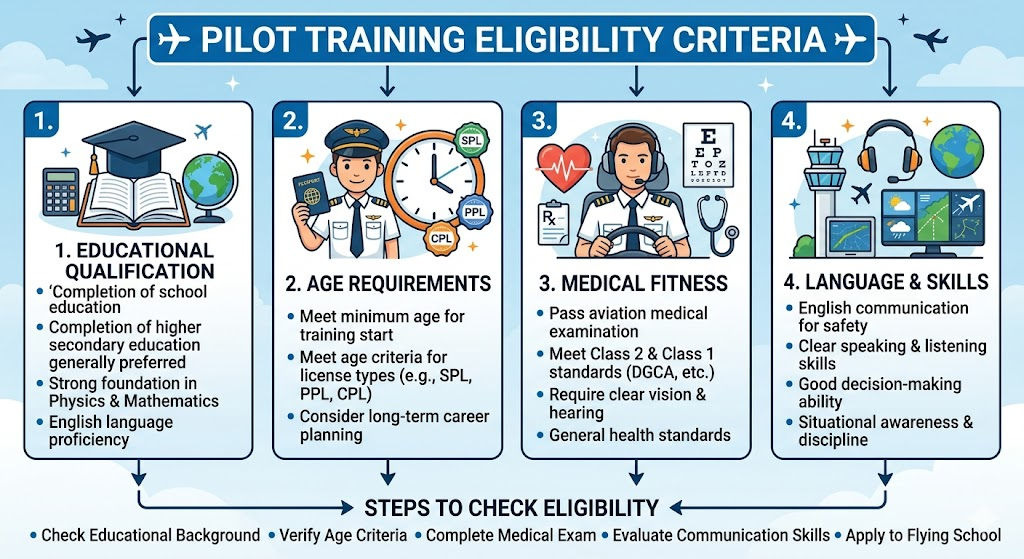
Pilot training eligibility criteria are the basic requirements a student must meet before starting aviation training. These include education, age, medical fitness, language ability, and basic skills.
These criteria are set by aviation authorities to ensure that every pilot:
- Is physically fit to fly
- Has basic academic understanding
- Can communicate clearly in aviation environments
- Can handle training pressure and responsibility
- Meets safety standards required in aviation
In simple terms, eligibility rules ensure that only qualified and capable candidates enter pilot training.
Educational Qualification Requirements
Education plays an important role in pilot training because aviation involves technical subjects, calculations, navigation, and weather understanding.
Basic Schooling Requirement
Most flying schools require students to complete school education up to a certain level before starting training. Completion of higher secondary education is generally preferred.
Importance of Physics and Mathematics
Physics and Mathematics are important because pilots need to understand:
- Aircraft motion
- Navigation calculations
- Weather systems
- Fuel and distance calculations
- Flight performance principles
For Non-Science Students
Students from non-science backgrounds may still enter aviation, but they may need additional preparation or bridge courses depending on aviation authority rules and flying school requirements.
English Communication
Good English understanding is important because aviation communication, manuals, and air traffic control instructions are conducted in English.
Age Requirements for Pilot Training
Age is an important factor in pilot training because aviation careers require long-term commitment and physical fitness.
Starting Age for Training
Students can begin pilot training at a young adult stage, depending on aviation authority rules. Early preparation is beneficial for a long aviation career.
Age for Different Licenses
Pilot training includes different stages, and each stage may have different age requirements:
- Student Pilot License (SPL): Entry-level training stage
- Private Pilot License (PPL): Intermediate stage for private flying
- Commercial Pilot License (CPL): Professional pilot stage
Each stage has its own eligibility rules, but overall students should be within the required age range defined by aviation authorities.
Why Age Matters
Age is important because:
- Training takes several years
- Physical fitness must be maintained
- Career progression requires long-term planning
- Airlines prefer trained and experienced candidates
Medical Fitness Requirements
Medical fitness is one of the most important eligibility criteria in aviation. A pilot must be medically fit to handle flying responsibilities safely.
Why Medical Fitness Is Important
Pilots must remain alert, healthy, and capable of making quick decisions during flight operations. Even small health issues can affect safety.
Vision Requirements
- Clear vision is required
- Corrective lenses may be allowed depending on regulations
- Eye health is regularly checked
Hearing Requirements
Pilots must be able to clearly hear communication from air traffic control and cockpit systems.
General Health Standards
Medical examinations check:
- Heart health
- Blood pressure
- Neurological health
- Physical fitness
DGCA Medical Standards
In many countries, aviation authorities like DGCA define medical classes such as:
- Class 2 Medical (initial stage)
- Class 1 Medical (commercial pilot stage)
Each level has stricter requirements as training progresses.
Language Requirements
English is the global language of aviation, and communication plays a major role in flight safety.
Why English Is Required
Pilots must communicate with:
- Air traffic controllers
- Cabin crew
- International airports
- Flight operation teams
Communication Skills Needed
Students should be able to:
- Speak clearly
- Understand instructions
- Read aviation manuals
- Respond quickly during communication
Good communication reduces misunderstandings and improves flight safety.
Skill-Based Requirements
Apart from education and medical fitness, certain personal skills are also important for pilot training.
Decision-Making Ability
Pilots must make quick and correct decisions during flight situations.
Situational Awareness
Understanding surroundings, weather conditions, and aircraft position is critical.
Discipline and Focus
Aviation requires strict discipline and attention to detail.
Stress Management
Pilots must remain calm under pressure and handle emergencies efficiently.
Technical Understanding
Basic understanding of aircraft systems and aviation concepts is helpful for training success.
Documents Required for Pilot Training
Before starting training, students must prepare important documents.
Common requirements include:
- Identity proof
- Educational certificates
- Passport-size photographs
- Medical certificate
- Application forms
- Address proof
- Additional aviation authority documents
Proper documentation ensures smooth admission into flying schools.
Step-by-Step Eligibility Check Process
Students can follow a simple process to confirm eligibility before joining pilot training.
Step 1: Check Educational Background
Ensure you meet minimum education requirements.
Step 2: Verify Age Criteria
Check whether you fall within the required age range.
Step 3: Complete Medical Examination
Get aviation medical clearance before training.
Step 4: Evaluate Communication Skills
Improve English speaking and understanding skills.
Step 5: Apply to Flying School
Once all criteria are met, apply to an approved aviation training institute.
Eligibility for Different Pilot Licenses
Pilot training is divided into different license levels, each with its own eligibility requirements.
Student Pilot License (SPL) Eligibility
- Basic education required
- Minimum age requirement as per rules
- Medical fitness required
- English communication ability
SPL is the starting point for all aviation students.
Private Pilot License (PPL) Eligibility
- Completion of SPL or equivalent training
- Better flight understanding
- Medical fitness certification
- Ability to handle solo flying tasks
PPL is mainly for private flying and recreational aviation.
Commercial Pilot License (CPL) Eligibility
- Higher level of education or training completion
- Strong medical fitness (Class 1 standards)
- Completion of required flight hours
- Advanced aviation knowledge
CPL is required for professional pilot careers.
Common Mistakes Students Make
Many students make avoidable mistakes when starting pilot training:
- Ignoring medical requirements
- Not checking eligibility before applying
- Misunderstanding license levels
- Choosing flying schools without research
- Weak English communication preparation
- Not planning long-term career path
Avoiding these mistakes helps students save time and effort.
Why Eligibility Matters in Aviation Careers
Eligibility criteria are not just formal requirements. They ensure long-term safety and career success.
They help in:
- Maintaining aviation safety standards
- Ensuring proper training readiness
- Reducing training failure rates
- Improving airline recruitment chances
- Building disciplined aviation professionals
How BestPilotSchool.com Helps Students
BestPilotSchool.com supports aviation aspirants by providing:
- Clear pilot training eligibility guidance
- Beginner-friendly aviation explanations
- Flying school selection advice
- Pilot career roadmap information
- License understanding support
This helps students make informed decisions before starting their aviation journey.
Frequently Asked Questions
1- What is pilot training eligibility?
Pilot training eligibility refers to the basic requirements such as education, age, medical fitness, and skills needed to start aviation training.
2- What qualifications are required to become a pilot?
Students generally need completed schooling, medical fitness, English communication ability, and training eligibility approval.
3- Is Mathematics required for pilot training?
Mathematics is highly recommended because it helps in navigation, calculations, and understanding aviation concepts.
4- What is the age limit for pilot training?
Age requirements vary by license type, but students must meet aviation authority rules for each stage.
5- What medical tests are required?
Medical tests include vision, hearing, heart health, physical fitness, and general medical evaluation.
6- Can non-science students become pilots?
Yes, but they may need additional preparation depending on flying school or aviation authority requirements.
7- Is English mandatory for pilots?
Yes, English is essential for aviation communication and safety procedures.
8- What is DGCA medical requirement?
DGCA medical requirements include Class 2 and Class 1 medical standards depending on training stage.
9- Can I become a pilot after 12th?
Yes, students can start pilot training after completing school education if they meet eligibility criteria.
10- What happens if I don’t meet eligibility criteria?
Students must first meet missing requirements such as education, medical fitness, or skill improvement before starting training.
Conclusion
Pilot training eligibility criteria are the foundation of every aviation career. These requirements ensure that students entering aviation are physically fit, academically prepared, and mentally ready for the challenges of flying. Understanding education, age limits, medical fitness, communication skills, and documentation is essential before starting training. By checking eligibility early, students can avoid confusion and build a clear path toward becoming a pilot. BestPilotSchool.com helps aspiring pilots understand these requirements in a simple way so they can confidently begin their aviation journey.
