
Introduction
An aircraft spin is one of the most misunderstood conditions encountered during pilot training. The rapid rotation, nose-low attitude, altitude loss, and unusual visual sensations can make the situation feel overwhelming, especially to a new pilot.
Spin-awareness training is designed to prevent that confusion. Its primary purpose is not to encourage pilot students to perform intentional spins. Instead, it teaches them how spins develop, how to avoid the conditions that lead to them, how to recognise an incipient spin, and how to respond using the aircraft manufacturer’s approved procedure.
A spin is an aggravated stall involving autorotation. At least one wing remains stalled, while differences in lift and drag between the wings cause the aircraft to rotate and descend. Aircraft design, loading, control inputs, centre of gravity, and density altitude can all affect spin behaviour.
All intentional spin demonstrations must be conducted by a properly qualified instructor in an aircraft specifically approved for spins, at a safe altitude, and within applicable operating limitations.
What Is an Aircraft Spin?
An aircraft spin is a stalled condition combined with yaw and sustained rotation.
During an ordinary coordinated stall, both wings may reach approximately the same stalled condition. During a spin entry, one wing is generally more deeply stalled than the other.
The more deeply stalled wing produces:
- Less lift
- More drag
- A stronger tendency to descend
The other wing produces relatively more lift and less drag. This imbalance causes the aircraft to autorotate while following a steep descending path.
A spin requires two main conditions:
- A stall or excessive angle of attack
- Yaw or uncoordinated flight
Removing either condition early can help prevent a developed spin.
Stall Versus Spin
A stall and a spin are related, but they are not identical.
Aircraft Stall
A stall occurs when a wing exceeds its critical angle of attack. The wing can no longer maintain normal airflow and lift decreases.
Aircraft Spin
A spin occurs when the aircraft is stalled and yaw causes one wing to remain more deeply stalled than the other. The resulting imbalance produces autorotation.
A pilot cannot normally enter a true aerodynamic spin without first stalling at least part of the wing. Therefore, early stall recognition and coordinated flight are central parts of spin prevention.
Why Spin Awareness Matters for Pilot Students
Spin-awareness training develops more than knowledge of a recovery sequence. It helps students recognise dangerous combinations of low airspeed, excessive angle of attack, yaw, poor coordination, distraction, and inappropriate control inputs.
This training improves:
- Stall recognition
- Rudder coordination
- Angle-of-attack awareness
- Aircraft energy management
- Decision-making near the ground
- Recognition of unsafe flight attitudes
- Confidence during slow-flight exercises
- Prevention of loss of control in flight
Loss-of-control accidents frequently involve a failure to prevent or recover from a stall or upset. Takeoff, approach, and landing are particularly critical because there may be very little altitude available for recovery.
Common Situations That Can Lead to a Spin
A spin is often the result of several errors occurring together rather than one isolated mistake.
Skidding Base-to-Final Turn
A pilot who overshoots the runway centreline may use excessive inside rudder to tighten the turn while applying opposite aileron to control the bank.
This creates a skidding, uncoordinated condition. If the pilot also pulls back and increases the angle of attack, the aircraft may stall asymmetrically and enter a spin.
The safer decision is to maintain coordination, discontinue an unstable approach, and perform a go-around.
Excessive Nose-Up Attitude After Takeoff
During takeoff or an initial climb, a student may raise the nose too high while trying to climb rapidly.
As airspeed decreases, strong engine and propeller effects may create yaw. If the aircraft stalls while yawing, spin entry may become possible.
Poorly Coordinated Stall Practice
A stall exercise performed with inadequate rudder control may allow one wing to drop. Holding excessive back pressure while the aircraft yaws can turn a stall into an incipient spin.
Attempting to Stretch a Glide
After an engine failure, a pilot may pull back to extend the glide. This increases the angle of attack and reduces airspeed.
If the pilot then turns aggressively or uses uncoordinated controls, the aircraft may stall and spin close to the ground.
Distraction During Slow Flight
A student concentrating on navigation, radio communication, instruments, or checklists may allow airspeed to decrease and coordination to deteriorate.
Spin-awareness training should therefore include effective scanning, workload management, and early correction of unsafe trends.
Aggressive Manoeuvring
Abrupt back-pressure or a steep turn increases the aerodynamic load on the aircraft. The wing can then reach its critical angle of attack at an airspeed higher than the published one-G stall speed.
Warning Signs of a Developing Spin
The best recovery is prevention. Student pilots should recognise the conditions that normally appear before a spin develops.
Warning signs may include:
- Decreasing airspeed
- Excessive nose-up attitude
- Stall warning activation
- Aerodynamic buffet
- Reduced control effectiveness
- Uncoordinated flight
- Slip-skid indicator displacement
- Increasing rudder pressure
- Uncommanded yaw
- Wing drop
- Continued back pressure after the stall
- Rapid change in the outside visual picture
The presence of a wing drop does not always mean the aircraft has entered a developed spin. However, a stall combined with yaw should be treated immediately as a serious loss-of-control warning.
The Four Phases of a Spin
The FAA Airplane Flying Handbook describes four phases: entry, incipient, developed, and recovery.
Entry Phase
The entry phase begins when the aircraft stalls while yaw is present.
The pilot’s control inputs, aircraft configuration, power setting, and loading influence how the spin begins.
Incipient Phase
During the incipient phase, the aircraft has started autorotating, but the spin has not yet stabilised.
This phase may last only a few seconds. Prompt recognition and immediate recovery action are important because altitude is being lost rapidly.
Initial spin-awareness training often concentrates on recognising and stopping an incipient spin before it becomes fully developed.
Developed Phase
A developed spin exists when the rotation rate, vertical speed, and aircraft attitude become relatively stable or repetitive.
Not every training aircraft enters a stable developed spin. Some may transition into a spiral dive, especially when control inputs or aircraft characteristics change.
Recovery Phase
Recovery begins when the pilot’s control inputs stop the rotation and reduce the wings’ angle of attack below the critical value.
The time and altitude required for recovery vary according to aircraft type, loading, configuration, spin direction, and pilot response.
Spin Versus Spiral Dive
A spin and a spiral dive may look similar because both involve turning and altitude loss. However, their aerodynamics and recovery actions are different.
| Feature | Spin | Spiral Dive |
|---|---|---|
| Wing condition | At least one wing is stalled | Wings are normally not stalled |
| Airspeed | Usually low or relatively stable | Increases rapidly |
| Rotation | Autorotation caused by stall and yaw | Steep descending turn |
| Load factor | May initially remain moderate | Can rise rapidly |
| Main danger | Continued rotation and altitude loss | Excessive airspeed and structural load |
| Recovery basis | Stop rotation and unstall the wings | Reduce bank and recover from the dive |
A rapidly increasing airspeed is an important indication that the aircraft may be in a spiral dive rather than a true spin. Immediate recognition matters because structural and airspeed limits can be exceeded quickly.
General Spin Recovery Principles
The aircraft’s approved Flight Manual or Pilot’s Operating Handbook must always take priority. Different aircraft can have different spin characteristics and recovery requirements.
When no aircraft-specific procedure is available, the FAA handbook presents the following generic recovery framework.
Reduce Power to Idle
Power can aggravate spin characteristics in many aircraft by increasing rotational effects or flattening the spin attitude.
Position the Ailerons to Neutral
Aileron input can delay recovery or worsen the spin in some aircraft. Neutral ailerons prevent the pilot from unintentionally increasing the aerodynamic imbalance.
Apply Full Opposite Rudder
Apply full rudder opposite the direction of rotation and hold it as required by the approved procedure.
The direction of rotation should be identified from the outside visual picture and confirmed with suitable instruments when necessary.
Move the Elevator Forward
Apply positive forward elevator to reduce the angle of attack and break the stall.
The required control movement varies by aircraft. In some types, substantial forward movement may be necessary.
Neutralise the Rudder When Rotation Stops
Once rotation has stopped, neutralise the rudder to avoid entering a sideslip or yaw in the opposite direction.
Recover Smoothly From the Descent
Return to level flight using smooth elevator pressure and adjust power appropriately.
Avoid an abrupt pullout. Excessive back pressure can create high structural loads, exceed airspeed limits, or produce a secondary stall and another spin.
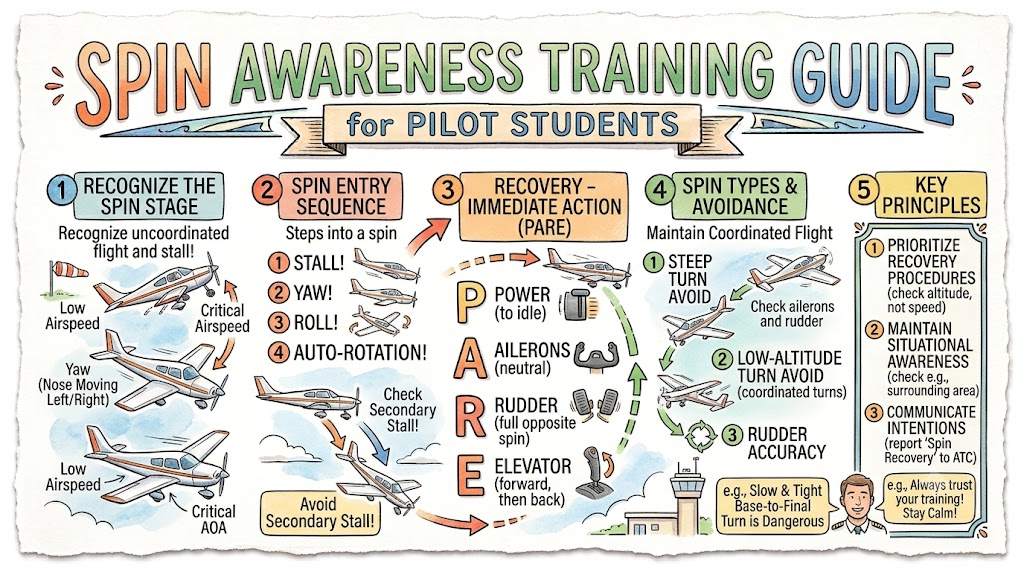
A commonly taught memory aid is PARE:
- P – Power idle
- A – Ailerons neutral
- R – Rudder opposite rotation
- E – Elevator forward
This memory aid is not a replacement for the manufacturer’s approved recovery procedure.
Why Aircraft-Specific Procedures Matter
Pilots should never assume that every aircraft responds to the same recovery inputs.
Spin behaviour can be affected by:
- Aircraft design
- Wing shape
- Propeller effects
- Engine power
- Flap position
- Landing-gear position
- Centre-of-gravity location
- Aircraft weight
- Fuel distribution
- Baggage loading
- Control rigging
- Density altitude
An aft centre of gravity can reduce longitudinal stability and may make spin recovery more difficult. Even an aircraft that is approved for spins must remain within the specific weight, balance, configuration, and operating limits stated in its approved documents.
Intentional Spin Training Safety
Intentional spins must never be attempted simply because a student has read a procedure or watched a demonstration.
Before any intentional spin training, the instructor must verify:
- The aircraft is approved for intentional spins
- The limitations section permits the manoeuvre
- Weight and balance are within the approved spin envelope
- Required placards and operating restrictions are understood
- The aircraft has been inspected properly
- Loose objects are secured
- Weather and visibility are suitable
- The training area is clear
- Adequate recovery altitude is available
- The instructor is qualified and proficient
- Occupant and parachute rules are satisfied where applicable
- The aircraft-specific entry and recovery procedures are reviewed
The FAA handbook states that an aircraft placarded against intentional spins should not be intentionally spun. Such aircraft may not have demonstrated reliable recovery from a fully developed spin.
Training requirements differ between countries and pilot licences. Students must follow their aviation authority, approved training organisation, instructor, and aircraft manual.
Spin Prevention Techniques
Spin prevention begins long before the aircraft starts rotating.
Maintain Coordinated Flight
Use the rudder to keep the aircraft properly coordinated, especially during:
- Slow flight
- Climbs
- Stall practice
- Steep turns
- Approach
- Base-to-final turns
- Go-arounds
Monitor the Angle of Attack
Do not rely only on a published stall speed. A stall can occur at different airspeeds depending on bank angle, load factor, weight, configuration, and control inputs.
Respond to Stall Warnings Immediately
When a stall warning, buffet, or control softness appears unexpectedly:
- Reduce the angle of attack
- Correct yaw
- Level excessive bank as appropriate
- Add power according to the situation
- Restore safe airspeed
- Return to controlled flight
Avoid Forcing an Unstable Approach
A go-around is safer than using aggressive bank, rudder, or pitch inputs to rescue a poor approach.
Manage Workload
Complete important checks early. Avoid becoming so focused on instruments, radio communication, or navigation that airspeed and coordination are ignored.
Use Smooth Control Inputs
Abrupt control movement can rapidly increase angle of attack, load factor, or yaw.
Common Student Pilot Mistakes
Using Aileron Against a Dropped Wing While Stalled
A student may instinctively use strong aileron input to raise the low wing.
Better response: Reduce the angle of attack and correct yaw according to the aircraft’s approved stall or spin recovery procedure.
Pulling Back When the Nose Drops
The natural desire to stop altitude loss can keep the wings stalled.
Better response: Allow the angle of attack to reduce before beginning a smooth pullout.
Applying Opposite Rudder Too Slowly
Weak or hesitant rudder application may delay the stopping of rotation.
Better response: Use the positive control movement specified by the aircraft manufacturer and instructor.
Misidentifying the Direction of Rotation
Stress and unusual visual sensations may make the direction difficult to recognise.
Better response: Practise recognition with an instructor and understand the aircraft’s available indications.
Recovering From the Dive Too Aggressively
A rapid pullout may cause excessive G-loading or a secondary stall.
Better response: Recover smoothly while respecting aircraft limitations.
Practising in an Unapproved Aircraft
A normal-category aircraft or an aircraft with a no-spins placard may not be approved for intentional spinning.
Better response: Confirm approval through the aircraft manual, placards, certification documents, and instructor.
Practical Training Plan for Pilot Students
Ground-School Preparation
Study:
- Stall aerodynamics
- Critical angle of attack
- Causes of yaw
- Spin phases
- Spin versus spiral dive
- Aircraft limitations
- Weight and balance
- Manufacturer recovery procedures
Cockpit Rehearsal
With the instructor, practise:
- Transfer of control
- Recognition callouts
- Recovery control sequence
- Visual identification of rotation
- Emergency decision-making
- Post-recovery checks
Slow-Flight Training
Develop accurate control near the lower end of the speed range. Practise maintaining:
- Heading
- Altitude
- Coordination
- Airspeed
- Configuration awareness
Stall Recognition
Practise power-on and power-off stalls with emphasis on preventing yaw and recovering at the correct point.
Incipient Spin Awareness
Where permitted and appropriate, a qualified instructor may demonstrate how an uncoordinated stall can begin developing into a spin.
The student’s objective is to recognise the condition and respond immediately—not to allow unnecessary rotation.
Post-Flight Debriefing
Discuss:
- What caused the yaw
- Which warning appeared first
- Whether the controls were coordinated
- How quickly the condition was recognised
- Whether recovery inputs were correct
- How much altitude was lost
- How the event could have been prevented
Example Training Scenario
A student pilot is flying the base leg slightly above the intended approach speed. The aircraft turns toward final but overshoots the runway centreline.
The student applies excessive inside rudder to turn the nose toward the runway while using opposite aileron to prevent the bank from increasing. At the same time, back pressure is added to stop the nose from dropping.
The aircraft becomes uncoordinated, the angle of attack increases, and the stall warning activates.
The correct action is not to tighten the turn. The student should reduce the angle of attack, correct the uncoordinated condition, discontinue the unstable approach, and perform a go-around.
The lesson is simple: runway alignment must never be forced with unsafe rudder, bank, or pitch inputs.
Quick Spin-Awareness Checklist
Before flight:
- Review the aircraft manual
- Confirm spin limitations
- Check weight and balance
- Secure loose items
- Review recovery procedures
- Confirm minimum training altitude
- Discuss transfer of control
During flight:
- Maintain coordination
- Monitor airspeed and attitude
- Recognise stall warnings
- Correct yaw early
- Avoid abrupt back pressure
- Do not force unstable approaches
- Follow instructor directions
During recovery:
- Use the aircraft-specific procedure
- Stop rotation
- Reduce angle of attack
- Respect airspeed and G limits
- Avoid a secondary stall
- Restore a safe flight path
This checklist is for educational revision only. It does not replace an approved aircraft checklist, flight manual, training syllabus, or instructor briefing.
Frequently Asked Questions
Can an aircraft spin without stalling?
A true aerodynamic spin requires a stalled condition together with yaw or autorotation. A steep descending turn with increasing airspeed may instead be a spiral dive.
What causes a spin?
A spin normally develops when an aircraft stalls while yaw is present. Poor coordination, excessive rudder, continued back pressure, and a wing drop may contribute.
Is a wing drop automatically a spin?
No. A wing can drop during a stall without entering a developed spin. However, a stalled aircraft with increasing yaw or rotation requires immediate corrective action.
What is an incipient spin?
An incipient spin is the early phase after spin entry but before the rotation and descent become fully stabilised.
Why should ailerons normally be neutral during recovery?
Aileron input can worsen or delay spin recovery in some aircraft. The manufacturer’s procedure determines the correct control position.
How much altitude does a spin require?
Altitude loss varies greatly with aircraft type, loading, spin development, density altitude, and recovery technique. Intentional training must begin with a large safety margin established by the instructor and applicable regulations.
Can all training aircraft perform intentional spins?
No. Many aircraft prohibit intentional spins. Approval must be confirmed through the aircraft manual, limitations, placards, certification information, and operating rules.
Is spin training required for every student pilot?
Requirements vary by country, licence, and aviation authority. Many pilot programmes emphasise spin awareness and prevention, while intentional spin demonstrations may be limited to specific courses or instructor qualifications.
Why is an aft centre of gravity dangerous during a spin?
An aft centre of gravity can reduce stability and may make it more difficult for the elevator to lower the angle of attack sufficiently for recovery.
What is the most important spin-prevention habit?
Maintain coordinated flight and respond immediately to an approaching stall. Preventing the combination of stall and yaw is the most effective strategy.
Conclusion
Spin-awareness training helps pilot students understand how a stall combined with yaw can develop into autorotation and rapid altitude loss. The most important skills are prevention, coordination, early recognition, correct use of aircraft-specific procedures, and disciplined decision-making. Intentional spin exercises must only be performed with a qualified instructor, in an approved aircraft, and within all operating and regulatory limitations.
Aviation Safety Disclaimer
This article is intended only for general aviation education. It does not replace instruction from a qualified flight instructor, an approved training syllabus, the aircraft Flight Manual or Pilot’s Operating Handbook, official checklists, or applicable aviation regulations.
