
Introduction
Takeoff and landing are two of the most important phases of flight because the aircraft is close to the ground, speed is changing, and the pilot has less time to correct mistakes. For student pilots, understanding takeoff and landing performance is not only a theory subject. It is a real safety skill used before every flight.
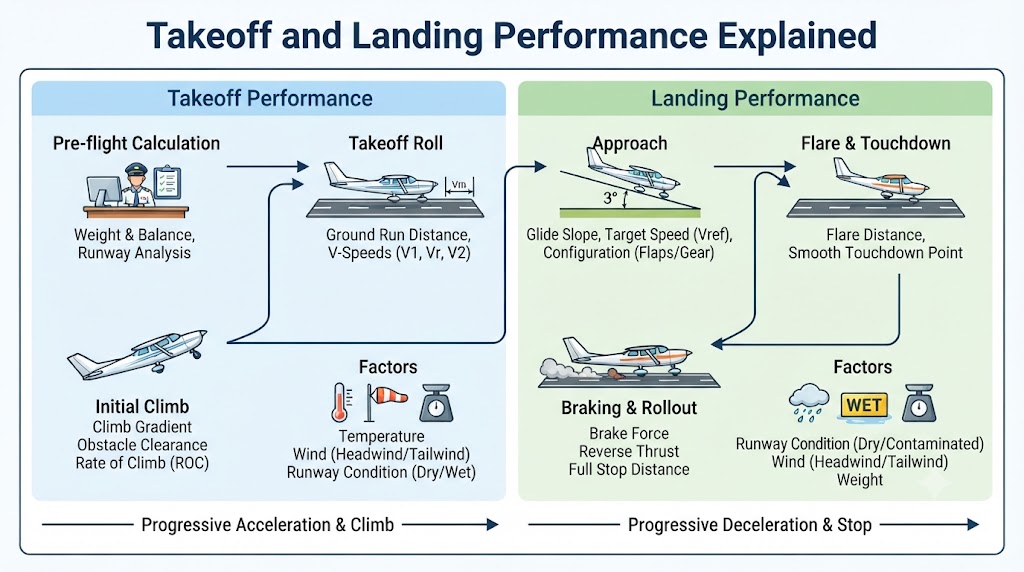
Takeoff and Landing Performance Explained means understanding how much runway an aircraft needs to take off safely, climb over obstacles, land properly, and stop within the available runway distance.
A student pilot must understand that aircraft performance changes from flight to flight. The same aircraft may perform differently depending on weight, temperature, wind, runway surface, pressure altitude, aircraft condition, and pilot technique.
A safe pilot never assumes. A safe pilot checks, calculates, compares, and decides.
What Is Takeoff Performance?
Takeoff performance means the aircraft’s ability to accelerate on the runway, lift off, and climb safely after leaving the ground.
It includes three main parts:
1. Ground Roll
Ground roll is the distance the aircraft travels on the runway before becoming airborne. During this phase, the aircraft accelerates from a stopped position to flying speed.
Ground roll can increase when:
- The aircraft is heavy
- The runway is wet, grass, soft, or rough
- There is a tailwind
- The temperature is high
- The airport elevation is high
- The engine is not producing full expected power
2. Liftoff Distance
Liftoff distance is the distance needed for the aircraft to actually leave the runway. The pilot must reach the correct rotation speed and apply the correct takeoff technique.
If the pilot rotates too early, the aircraft may become airborne before it is ready to climb properly. If the pilot rotates too late, extra runway may be wasted.
3. Obstacle Clearance Distance
After liftoff, the aircraft must climb safely. Many performance charts include distance required to clear an obstacle, often used for planning when trees, buildings, terrain, or power lines are near the runway end.
Obstacle clearance is very important at short runways and high-temperature airports.
What Is Landing Performance?
Landing performance means how much distance the aircraft needs to approach, touch down, slow down, and stop safely.
Landing performance includes:
- Final approach speed
- Touchdown point
- Landing roll
- Braking distance
- Runway condition
- Wind effect
- Aircraft weight
- Pilot technique
A landing is not safe only because the aircraft touches the runway. It is safe when the aircraft lands in the correct area, remains under control, and stops with enough runway remaining.
Why Student Pilots Must Learn Takeoff and Landing Performance
Student pilots must learn takeoff and landing performance because many flight safety decisions begin before the aircraft moves.
This knowledge helps students:
- Decide whether the runway is long enough
- Understand how weather affects flight
- Avoid poor takeoff decisions
- Avoid unstable approaches
- Respect aircraft limitations
- Plan for obstacles after takeoff
- Reduce the risk of runway overrun
- Improve flight confidence
- Build professional pilot judgment
A student pilot should remember that takeoff and landing are not only flying skills. They are planning skills too.
Basic Terms Every Student Pilot Should Know
| Term | Meaning |
|---|---|
| Ground Roll | Runway distance used while aircraft is on the ground |
| Takeoff Distance | Total distance needed to take off safely |
| Landing Distance | Total distance needed to land and stop safely |
| Rotation Speed | Speed where the pilot gently raises the aircraft nose |
| Liftoff | Moment when the aircraft leaves the runway |
| Climb Gradient | Aircraft’s climb performance over distance |
| Obstacle Clearance | Ability to climb over obstacles safely |
| Approach Speed | Speed maintained during final approach |
| Flare | Final phase where descent is reduced before touchdown |
| Touchdown Zone | Runway area where aircraft should land |
| Landing Roll | Distance traveled after touchdown before stopping |
| Braking Distance | Distance needed to slow and stop the aircraft |
| Density Altitude | Air density effect based on altitude, pressure, and temperature |
| Headwind | Wind blowing against aircraft direction |
| Tailwind | Wind blowing from behind the aircraft |
Factors That Affect Takeoff Performance
Aircraft Weight
Weight is one of the biggest performance factors. A heavier aircraft needs more lift, more speed, and more runway.
When aircraft weight increases:
- Acceleration becomes slower
- Takeoff distance increases
- Climb performance decreases
- Stall speed may increase
- Obstacle clearance becomes harder
This is why pilots must check weight and balance before flight.
Temperature
Hot weather reduces air density. Thin air affects the aircraft in three ways:
- The engine produces less power
- The propeller becomes less efficient
- The wings produce less lift
Because of this, takeoff distance may increase on hot days.
Pressure Altitude
Pressure altitude is related to air pressure. At higher elevation airports or during low-pressure weather, the aircraft may perform as if it is at a higher altitude.
This can reduce climb performance and increase runway requirement.
Density Altitude
Density altitude is very important for student pilots. It combines altitude, temperature, and pressure effects.
High density altitude means the aircraft performs worse than expected. The runway may look long enough, but the aircraft may need more distance to take off and climb.
Wind
Wind direction can help or hurt performance.
A headwind helps takeoff because it increases airflow over the wings earlier. A tailwind can be dangerous because it increases ground roll and total takeoff distance.
Runway Surface
Runway surface affects acceleration.
A dry paved runway usually gives better performance. Grass, wet, soft, gravel, or rough runways can increase takeoff distance.
Runway Slope
An uphill runway makes the aircraft work harder during takeoff. A downhill runway may help acceleration but can create other control and stopping concerns.
Aircraft Configuration
Correct flap setting, trim, power setting, and checklist use are important. Wrong configuration can seriously affect performance.
Pilot Technique
Pilot technique matters. Smooth control use, correct rotation speed, proper directional control, and correct climb speed all affect safety.
Factors That Affect Landing Performance
Approach Speed
Approach speed is one of the biggest landing performance factors. If the aircraft approaches too fast, it may float above the runway and land farther than planned.
Extra speed can increase landing distance significantly.
Touchdown Point
A good landing should happen in the correct touchdown area. If the aircraft lands too far down the runway, less distance remains for stopping.
Aircraft Weight
A heavier aircraft may need a higher approach speed and longer stopping distance.
Wind
A headwind usually helps reduce landing distance. A tailwind increases landing distance and can reduce safety margin.
Runway Surface
Wet, soft, icy, or contaminated runways reduce braking effectiveness. Even a normally safe runway can become risky when surface conditions are poor.
Braking Effectiveness
Braking depends on tires, brakes, runway condition, and pilot technique. Hard braking is not a replacement for good planning.
Landing Configuration
Flaps, power setting, and aircraft attitude affect landing distance. Student pilots must follow the aircraft manual and instructor guidance.
Pilot Technique
A stable approach, correct speed, proper flare, and accurate touchdown point help reduce landing distance and improve safety.
Runway Conditions and Their Effect
Dry Paved Runway
This usually provides the best normal performance. Aircraft accelerates and brakes more effectively.
Wet Runway
Wet runways can reduce braking and increase stopping distance. Pilots must be more cautious.
Grass Runway
Grass can increase takeoff roll and landing roll. Wet or long grass can create even more drag.
Soft Field
A soft field can slow acceleration and make takeoff more difficult. It requires correct soft-field technique under instructor guidance.
Gravel Runway
Gravel can affect acceleration, braking, and aircraft handling. It may also create risk of damage from loose stones.
Snow or Ice
Snow and ice can greatly reduce braking and control. Student pilots should avoid such conditions unless training is properly approved and supervised.
Weather Effects on Takeoff and Landing
Headwind
Headwind usually improves performance by reducing ground distance needed for takeoff and landing.
Tailwind
Tailwind increases takeoff and landing distance. Even a small tailwind can reduce safety margin.
Crosswind
Crosswind affects directional control. Student pilots must understand aircraft crosswind limits and personal skill limits.
High Temperature
High temperature increases density altitude and reduces aircraft performance.
Low Pressure
Low pressure can also increase density altitude and reduce performance.
Rain
Rain affects visibility, runway surface, braking, and pilot workload.
Fog
Fog reduces visibility and can make landing planning more difficult.
Turbulence
Turbulence can make speed control and approach stability more difficult.
Aircraft Weight and Performance
Aircraft weight affects both takeoff and landing.
A heavier aircraft:
- Accelerates slowly
- Needs longer runway
- Climbs more slowly
- Uses more fuel
- Needs more landing distance
- May have higher stall speed
Student pilots should not think only about maximum takeoff weight. They should also check balance, runway length, weather, and performance margin.
Importance of Stabilized Approach
A stabilized approach means the aircraft is properly configured, on correct speed, on correct path, and under control before landing.
A stabilized approach helps with:
- Better touchdown point
- Correct landing distance
- Better runway alignment
- Lower workload
- Safer go-around decision
If the approach becomes unstable, the safest decision may be to go around.
Understanding POH Performance Charts
The POH, or Pilot’s Operating Handbook, contains aircraft-specific performance information.
Student pilots should use the POH to check:
- Takeoff distance
- Landing distance
- Climb performance
- Fuel burn
- Weight limits
- Flap settings
- Runway condition corrections
- Temperature and altitude effects
Every aircraft is different. A student should never guess performance from memory or use another aircraft’s numbers.
Common Mistakes Student Pilots Make
Common mistakes include:
- Not checking takeoff distance
- Not checking landing distance
- Forgetting aircraft weight
- Ignoring density altitude
- Ignoring runway slope
- Underestimating tailwind
- Approaching too fast
- Touching down too far down the runway
- Not considering runway surface
- Not using the POH
- Assuming performance is always the same
- Rushing pre-flight planning
These mistakes can be avoided with careful preparation.
Best Practices for Student Pilots
Student pilots should follow these habits:
- Use the POH before every flight
- Check runway length carefully
- Check wind direction and speed
- Understand density altitude
- Review aircraft weight and balance
- Check runway surface condition
- Calculate takeoff and landing distance
- Add safety margin
- Follow instructor guidance
- Make conservative decisions
- Go around if the landing is not stable
Good pilots plan early and stay disciplined.
Real-World Student Pilot Example
A student pilot is preparing for a training flight from a small airport. The weather is hot, and the aircraft has full fuel. The runway is shorter than the student usually uses.
At first, the student thinks the takeoff will be normal. The instructor asks the student to check the POH performance chart.
After checking the chart, the student realizes that the aircraft needs more runway than expected because of heat, weight, and runway conditions.
The instructor and student decide to reduce unnecessary load, wait until cooler weather, or use a longer runway.
This example shows an important lesson: performance planning can change the decision before the flight begins.
Safety Note
This article is for educational understanding only. It does not replace aircraft manuals, approved performance charts, instructor guidance, aviation authority regulations, or flight school SOPs.
Real takeoff and landing performance planning must always use official aircraft data and proper instructor supervision.
FAQs
1. What is takeoff performance?
Takeoff performance means the aircraft’s ability to accelerate, lift off, and climb safely within available runway and conditions.
2. What is landing performance?
Landing performance means the distance required for the aircraft to approach, touch down, slow down, and stop safely.
3. Why is takeoff performance important?
It helps pilots confirm whether the aircraft can safely depart from the runway and clear obstacles.
4. Why is landing performance important?
It helps pilots ensure the aircraft can land and stop within the available runway distance.
5. What affects takeoff distance?
Aircraft weight, temperature, wind, runway surface, runway slope, altitude, and pilot technique affect takeoff distance.
6. What affects landing distance?
Approach speed, touchdown point, aircraft weight, wind, runway condition, braking, and pilot technique affect landing distance.
7. What is density altitude?
Density altitude shows how air density affects aircraft performance. High density altitude reduces aircraft capability.
8. Why does hot weather affect takeoff?
Hot air is thinner, which reduces engine power, propeller efficiency, and wing lift.
9. Why should pilots use the POH?
The POH provides official performance data for the specific aircraft.
10. How can student pilots improve performance planning?
They can improve by practicing POH use, checking weather, calculating runway needs, understanding limits, and learning with instructors.
Conclusion
Takeoff and Landing Performance Explained is a foundation topic for every student pilot. Takeoff and landing safety depends on planning, correct calculations, aircraft limitations, runway condition, weather, and pilot technique.
Student pilots should practice reading performance charts, checking runway distance, understanding density altitude, and reviewing weight and balance before flight.
