
Introduction
Weight and balance is one of the most important safety topics every pilot student learns. Before an aircraft flies, the pilot must know whether it is loaded within safe limits.
This Weight and Balance Guide for Pilot Students explains the basic ideas in simple English. It helps beginners understand aircraft weight, center of gravity, useful load, fuel weight, baggage, and safe loading decisions.
A small aircraft may look ready to fly, but if it is too heavy or poorly balanced, it can become difficult to control. That is why weight and balance is not just paperwork. It is a major part of safe flight planning.
What Is Weight and Balance in Aviation?
Weight and balance means checking two things before flight.
Weight means the total load of the aircraft, including the aircraft itself, pilots, passengers, fuel, baggage, cargo, and equipment.
Balance means how that weight is distributed inside the aircraft.
An aircraft must not be too heavy, and its center of gravity must stay within approved limits. If either condition is wrong, the aircraft may not perform safely during takeoff, climb, cruise, landing, or emergency handling.
Why Weight and Balance Matters for Student Pilots
Student pilots must learn weight and balance because aircraft performance changes with loading.
Proper weight and balance affects:
- Takeoff distance
- Climb performance
- Landing distance
- Stall speed
- Aircraft stability
- Elevator control
- Fuel consumption
- Emergency handling
- Overall safety
A correctly loaded aircraft is easier to control and performs closer to expected values. An overloaded or poorly balanced aircraft can become unsafe very quickly.
Basic Terms Every Student Pilot Should Know
| Term | Simple Meaning |
|---|---|
| Empty Weight | Weight of the aircraft without passengers, baggage, and usable fuel |
| Maximum Takeoff Weight | Maximum approved weight for takeoff |
| Useful Load | Weight available for fuel, people, baggage, and cargo |
| Payload | Weight of passengers, baggage, and cargo |
| Fuel Weight | Weight added by usable fuel |
| Baggage Weight | Weight placed in baggage areas |
| Center of Gravity | Balance point of the aircraft |
| Arm | Distance from a reference point to the item |
| Moment | Weight multiplied by arm |
| Datum | Reference point used for calculations |
These terms may look technical at first, but they become easier with practice and instructor guidance.
Understanding Center of Gravity
Center of gravity, or CG, is the point where the aircraft balances.
If the CG is too far forward, the aircraft may feel nose-heavy. This can make takeoff rotation, landing flare, and control response more difficult.
If the CG is too far aft, the aircraft may become less stable. Stall recovery can also become harder.
That is why pilots must keep the CG within the approved envelope shown in the aircraft documents.
Components That Affect Aircraft Weight
Several items affect aircraft weight and balance:
- Pilot weight
- Passenger weight
- Fuel quantity
- Baggage
- Cargo
- Optional equipment
- Training equipment
- Oil and other operating items
Even small changes matter. Adding a heavy bag in the rear compartment or carrying extra fuel can change the aircraft’s balance.
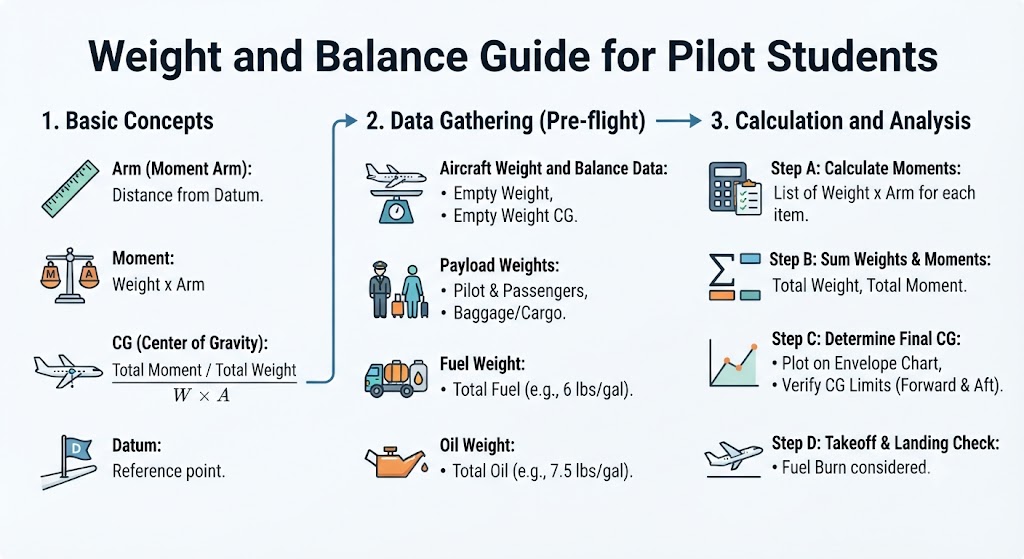
How Student Pilots Calculate Weight and Balance
The basic process is simple:
- Start with the aircraft empty weight.
- Add pilot and passenger weight.
- Add baggage and cargo.
- Add usable fuel weight.
- Calculate total weight.
- Check that total weight is within the approved limit.
- Check that CG is within the approved range.
Student pilots should not guess. They should use the aircraft POH, loading charts, approved data, and instructor guidance.
Aircraft Performance and Weight
A heavier aircraft needs more runway for takeoff. It may climb slower and need more distance to land.
Excessive weight can affect:
- Longer takeoff roll
- Reduced climb rate
- Higher stall speed
- Longer landing distance
- More fuel burn
- Slower acceleration
- Reduced safety margin
This is why pilots must not exceed weight limits, even for short flights.
Aircraft Balance and Flight Characteristics
Balance affects how the aircraft feels and responds.
Poor balance can affect:
- Stability
- Control pressure
- Takeoff rotation
- Climb attitude
- Stall recovery
- Landing flare
- Elevator effectiveness
A student pilot may not immediately understand these effects in the classroom, but they become very important during real flying.
Common Weight and Balance Mistakes Student Pilots Make
Common mistakes include:
- Guessing passenger weight
- Forgetting baggage weight
- Ignoring fuel weight
- Using old aircraft data
- Skipping calculations
- Exceeding maximum takeoff weight
- Ignoring CG limits
- Assuming small differences do not matter
- Not checking the POH
- Rushing pre-flight planning
Good pilots do not rush weight and balance. They check carefully every time.
Best Practices for Safe Weight and Balance
Follow these safe habits:
- Use the aircraft POH.
- Use current aircraft data.
- Check actual fuel quantity.
- Weigh baggage when possible.
- Stay within approved limits.
- Recalculate if loading changes.
- Follow flight school SOPs.
- Ask the instructor when unsure.
- Never fly outside approved limits.
Safety should always come before convenience.
Weight and Balance During Cross-Country Flights
Cross-country flights need extra care. The aircraft may carry more fuel, bags, maps, devices, and passengers.
Fuel burn also changes aircraft weight during flight. In some aircraft, CG can shift as fuel is used.
Student pilots should plan:
- Departure weight
- Landing weight
- Fuel burn
- Baggage location
- Passenger seating
- Alternate planning
- Weather impact
- Aircraft performance
Cross-country planning is a good time to build strong weight and balance habits.
Role of Aircraft POH in Weight and Balance
The POH, or Pilot’s Operating Handbook, is the main source for aircraft-specific information.
It includes:
- Weight limits
- Loading instructions
- CG limits
- Fuel data
- Performance charts
- Approved operating limits
Every aircraft is different. Student pilots should never copy numbers from another aircraft without checking the correct POH.
Real-World Student Pilot Example
A student pilot is preparing for a cross-country lesson. The plan includes one instructor, fuel, bags, and navigation equipment.
At first, the student assumes the aircraft is fine. But after checking the POH and adding all weights, the total load is close to the limit. The CG is also near the edge of the approved range.
The instructor explains the situation. The student removes unnecessary baggage and adjusts the loading plan. After recalculation, the aircraft is within limits.
This simple example shows why weight and balance is important. It helps pilots make safer decisions before the aircraft leaves the ground.
Safety Tips Every Student Pilot Should Remember
- Never exceed aircraft weight limits.
- Never ignore CG limits.
- Do not guess when actual numbers are available.
- Check loading before every flight.
- Recalculate after changes.
- Use the correct POH.
- Ask your instructor for help.
- Treat weight and balance as a safety task, not paperwork.
FAQs
1. What is weight and balance in aviation?
Weight and balance means checking whether an aircraft is within safe weight limits and properly balanced before flight.
2. Why is center of gravity important?
Center of gravity affects aircraft stability, control, takeoff, landing, and stall recovery.
3. What happens if an aircraft is overweight?
An overweight aircraft may need more runway, climb poorly, burn more fuel, and become unsafe.
4. What is useful load?
Useful load is the weight available for people, fuel, baggage, cargo, and other items.
5. How does fuel affect weight and balance?
Fuel adds weight to the aircraft. As fuel burns during flight, aircraft weight reduces and balance may change.
6. Can baggage change aircraft balance?
Yes. Heavy baggage, especially in rear compartments, can shift the center of gravity.
7. What is MTOW?
MTOW means Maximum Takeoff Weight. It is the maximum approved weight for takeoff.
8. Why should pilots calculate weight before every flight?
Because every flight has different fuel, passenger, baggage, and loading conditions.
9. Does weight affect takeoff distance?
Yes. A heavier aircraft usually needs more distance to take off and may climb slower.
10. How can student pilots learn weight and balance?
They can learn by using the POH, practicing examples, asking instructors, and doing calculations before every flight.
Conclusion
This Weight and Balance Guide for Pilot Students shows why proper aircraft loading is a foundation of aviation safety. A safe flight begins before takeoff, and weight and balance is a key part of that preparation.
Student pilots should practice these calculations regularly. With time, they become easier and more natural.
BestPilotsNow.com can be a helpful learning resource for beginner pilots who want simple, clear, and practical aviation knowledge.
