
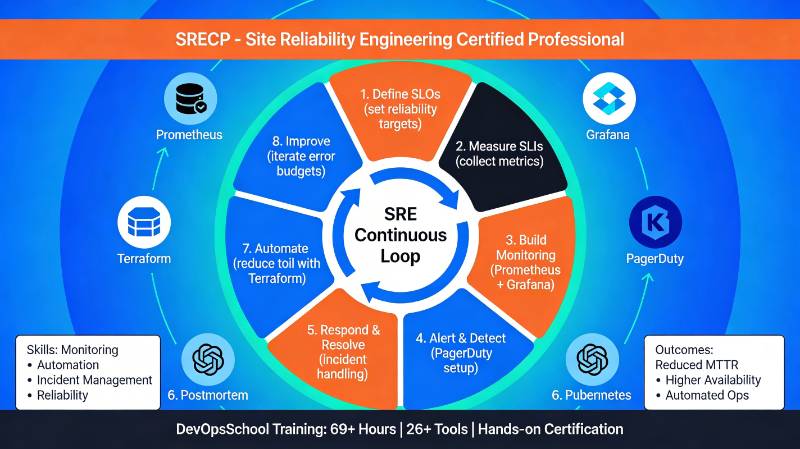
Introduction
Site Reliability Engineering (SRE) is a rapidly growing field that integrates software engineering with IT operations to ensure that systems are scalable, reliable, and efficient. As organizations move towards large-scale, cloud-based systems, the role of SRE has become critical to ensuring uptime, performance, and scalability. The Site Reliability Engineering Certified Professional (SRECP) certification is designed to validate the knowledge and skills needed to maintain and optimize large-scale systems.
This guide provides a comprehensive overview of the SRECP certification, covering what it is, who should take it, the skills you’ll gain, and how to prepare effectively. Whether you’re a DevOps Engineer, Cloud Engineer, or System Administrator, this guide will help you understand how the SRECP can elevate your career and how to succeed in earning this certification.
What is the Site Reliability Engineering Certified Professional (SRECP)?
The SRECP certification validates your ability to apply Site Reliability Engineering principles to ensure the reliability, availability, and scalability of systems. It combines software engineering with IT operations practices to build resilient systems. This certification is perfect for professionals who wish to specialize in system reliability, focusing on automation, performance optimization, and system health.
Who Should Take It?
The SRECP certification is ideal for individuals in the following roles:
- Site Reliability Engineers (SRE)
- DevOps Engineers
- Cloud Engineers
- Platform Engineers
- Infrastructure Engineers
- System Administrators
If you’re involved in managing complex systems, ensuring uptime, or improving system performance, this certification will help enhance your skills and career prospects in the SRE field.
Skills You’ll Gain
By earning the SRECP, you’ll gain the following key skills:
- Incident Management: Managing high-impact incidents, ensuring fast resolution, and minimizing downtime.
- System Design: Designing reliable, scalable, and fault-tolerant systems.
- Automation: Automating tasks to reduce manual intervention, increase reliability, and improve operational efficiency.
- Monitoring & Alerting: Implementing tools for proactive monitoring, detecting system issues before they impact users.
- Performance Tuning: Optimizing system performance to ensure efficient resource use, especially under heavy traffic.
- Capacity Planning: Preparing systems to scale efficiently and meet increasing demand without degradation.
- Disaster Recovery: Developing recovery strategies to ensure systems can be restored quickly in case of failure.
Real-World Projects You Should Be Able to Do After It
Upon completing the SRECP, you should be able to handle the following real-world projects:
- Designing Fault-Tolerant Systems: Architect systems that can continue functioning even in case of partial failure.
- Automating Infrastructure Management: Implement automation for deployment, scaling, and system monitoring.
- Setting Up Monitoring & Alerting Systems: Create dashboards using Prometheus, Grafana, and other tools to ensure system health.
- Optimizing System Performance: Implement changes to improve performance, reduce latency, and handle more traffic.
- Developing Disaster Recovery Plans: Design and test backup systems, failover mechanisms, and recovery procedures to minimize downtime.
Preparation Plan
To successfully prepare for the Site Reliability Engineering Certified Professional (SRECP) certification, it’s important to follow a structured plan that matches your current level of experience. Below is a preparation plan tailored for different levels of expertise: 7-Day Plan, 30-Day Plan, and 60-Day Plan.
7-Day Plan (For Those with a Solid Foundation)
If you already have experience in DevOps or cloud computing, this 7-day plan will quickly help you get up to speed for the SRECP exam.
Day 1-2: Incident Management & Monitoring
- Study incident management frameworks and best practices.
- Focus on monitoring tools like Prometheus, Grafana, and ELK stack.
Day 3-4: Automation & System Design
- Learn automation tools (e.g., Ansible, Terraform) and system design principles for creating scalable, reliable systems.
Day 5-6: Performance Tuning & Capacity Planning
- Focus on performance tuning techniques to optimize systems under load.
- Study capacity planning strategies to prepare systems for scaling.
Day 7: Review & Practice
- Take mock exams, review your weak areas, and ensure you can apply your learning in hands-on labs.
30-Day Plan (For Intermediate Professionals)
For those with a basic understanding of DevOps or cloud computing, this plan allows more time to dive deeper into the concepts.
Week 1: Incident Management & Monitoring
- Dive into incident management practices and monitoring tools.
Week 2: Automation & Performance Optimization
- Focus on automation tools and performance tuning techniques.
Week 3: System Design & Disaster Recovery
- Study system design principles and learn disaster recovery strategies.
Week 4: Hands-On Labs & Mock Exams
- Implement real-world scenarios and take mock exams to assess your readiness.
60-Day Plan (For Beginners)
If you’re new to SRE, this 60-day plan will help you build a solid foundation and gain deep insights into SRE practices.
Week 1-2: Incident Management & Monitoring Basics
- Study the basics of incident management and monitoring.
Week 3-4: Automation & Performance Tuning
- Focus on automation for system management and performance tuning.
Week 5-6: System Design & Disaster Recovery
- Learn about system design and capacity planning for high-availability systems.
Week 7-8: Hands-On Practice & Mock Exams
- Take hands-on labs to apply your knowledge and mock exams to assess readiness.
Common Mistakes
Here are some common mistakes candidates make when preparing for the SRECP:
- Not Practicing Enough: SRE requires practical experience, so ensure you’re working on real-world labs.
- Skipping Incident Management: Incident management is core to SRE. Ignoring it will leave a gap in your preparation.
- Overlooking Automation: Automation is a critical skill for SRE. Don’t skip studying tools like Ansible, Terraform, or Chef.
- Ignoring Performance Tuning: Performance tuning ensures your systems can scale under load. Make sure to study these techniques.
Best Next Certification After This
After completing SRECP, consider pursuing:
- Advanced SRE Certifications for deeper expertise in site reliability engineering.
- DevOps Certified Professional (DCP) for broader DevOps knowledge, including CI/CD and automation.
- Cloud Architect Certifications like AWS Certified Solutions Architect to focus on cloud infrastructure, which is essential for SRE roles.
Choose Your Path
As an SRE, you can further specialize in one of these career tracks:
After completing the SRECP certification, you can specialize in one of the following career paths based on your interests and goals:
- DevOps
Focus on CI/CD pipelines, automation, and continuous integration/delivery to streamline software development and deployment processes. As a DevOps professional, you’ll work on automating repetitive tasks, optimizing workflows, and improving collaboration between development and operations teams. - DevSecOps
Integrate security into the DevOps pipeline to create more secure systems from the start. In DevSecOps, security is not an afterthought; it’s embedded into the development process, from coding to deployment, ensuring secure and compliant systems across the software lifecycle. - SRE (Site Reliability Engineering)
Specialize in reliability, scalability, and performance optimization of large systems. As an SRE, you’ll work on ensuring systems remain available, efficient, and capable of handling increased loads without failure, applying engineering best practices to improve overall system health. - AIOps/MLOps
Leverage AI and machine learning to automate monitoring, incident management, and predictive analytics at scale. AIOps enhances operational efficiency by using machine learning to detect and resolve issues automatically, while MLOps focuses on managing the lifecycle of machine learning models in production environments. - DataOps
Focus on managing data infrastructure, automating data processes, and optimizing data pipelines. As a DataOps professional, you’ll work on improving data quality, integration, and accessibility, ensuring that data flows smoothly and is readily available for analytics, business intelligence, and decision-making. - FinOps
Manage cloud costs while ensuring the performance and scalability of systems. In FinOps, you balance cost optimization with operational performance, making sure that cloud resources are used efficiently without compromising system reliability or business outcomes.
Role → Recommended Certifications
| Role | Recommended Certification |
|---|---|
| DevOps Engineer | DevOps Certified Professional (DCP) |
| SRE | Site Reliability Engineering Certified Professional (SRECP) |
| Platform Engineer | Kubernetes Certified Administrator (CKA) |
| Cloud Engineer | AWS Certified Solutions Architect – Associate |
| Security Engineer | Certified Information Systems Security Professional (CISSP) |
| Data Engineer | Google Professional Data Engineer |
| FinOps Practitioner | FinOps Certified Practitioner |
| Engineering Manager | Project Management Professional (PMP) |
Frequently Asked Questions
1. What is the SRECP certification?
The Site Reliability Engineering Certified Professional (SRECP) certification validates your expertise in ensuring the reliability, scalability, and performance of large-scale systems. It combines software engineering principles with IT operations practices to manage and optimize system health.
2. How difficult is the SRECP exam?
The SRECP exam is designed to be intermediate to advanced. It requires a solid understanding of incident management, automation, monitoring, and system design. If you’re already familiar with DevOps or cloud computing, you should be well-prepared with proper study and practice
3. How long does it take to prepare for the SRECP exam?
On average, preparation for the SRECP takes about 30 to 60 days, depending on your prior experience. If you’re new to SRE or DevOps, a longer preparation time might be required to cover all topics thoroughly.
4. What are the prerequisites for the SRECP certification?
There are no strict prerequisites for the SRECP, but experience in system administration, DevOps, or cloud technologies will be beneficial. Familiarity with concepts like automation, scalability, and performance optimization will help ensure you’re ready for the exam.
5. What topics are covered in the SRECP exam?
The SRECP exam covers key areas such as:
- Incident management
- Monitoring and alerting
- System design for scalability and reliability
- Automation tools (e.g., Terraform, Ansible)
- Performance tuning
- Capacity planning
- Disaster recovery
6. How is the SRECP exam structured?
The SRECP exam consists of multiple-choice questions and scenario-based questions that test your ability to apply SRE principles to real-world situations. You will need to demonstrate your knowledge of system reliability, incident management, and performance optimization.
7. What resources should I use to prepare for the SRECP exam?
To prepare for the SRECP, you should focus on:
- Hands-on labs with tools like Prometheus, Grafana, and Kubernetes.
- Online courses and books that cover incident management, automation, and system design.
- Mock exams to test your readiness.
- Community forums and study groups to collaborate and get tips from others.
8. Can I take the SRECP exam online?
Yes, the SRECP exam can be taken online through the official certification provider’s platform, which offers a secure testing environment.
9. What is the passing score for the SRECP exam?
The passing score for the SRECP exam typically ranges around 70% or higher, but this can vary. It’s essential to thoroughly study the exam guide and take multiple practice tests to ensure you’re prepared.
10. How much does the SRECP exam cost?
The SRECP exam fee can vary depending on the certification provider. It’s advisable to check the official website for the most up-to-date information on exam pricing and available bundles (including training materials or practice exams).
11. What are the benefits of earning the SRECP certification?
Earning the SRECP enhances your credibility as a professional in site reliability engineering, increases your job opportunities, and positions you as a subject matter expert. It can also lead to higher salaries and recognition within your organization or the wider IT community.
12. What is the best next certification after SRECP?
After completing the SRECP, you can consider:
- Advanced SRE Certifications for deeper specialization in site reliability engineering.
- DevOps Certified Professional (DCP) to expand your expertise in automation, CI/CD pipelines, and infrastructure.
- Cloud Architect Certifications to enhance your knowledge of cloud infrastructure, which is often integral to SRE roles.
FAQs on SRECP
1. What is the difficulty level of the SRECP exam?
The SRECP exam is intermediate to advanced, designed for professionals with experience in system administration and cloud computing.
2. How long does it take to prepare for the SRECP exam?
Preparation typically takes 30 to 60 days, depending on your prior experience in DevOps, cloud computing, or system administration.
3. Are there prerequisites for the SRECP certification?
No formal prerequisites, but experience in DevOps, cloud computing, or system administration will be beneficial.
4. How is the SRECP exam structured?
The exam consists of multiple-choice questions and scenario-based questions focusing on system reliability, performance, and incident management.
5. What skills are covered in the SRECP exam?
The exam tests skills in incident management, automation, system design, performance tuning, and capacity planning.
6. What resources should I use to prepare for the SRECP?
Use online training courses, practice exams, and hands-on labs with tools like Prometheus, Grafana, and Ansible.
7. What is the value of the SRECP certification?
The SRECP certification helps you gain specialized knowledge in site reliability, improving your career prospects in SRE and cloud infrastructure roles.
8. Can I take the SRECP exam online?
Yes, the exam is available online through the official certification provider’s platform.
Next Certifications to Take
1. Same Track
- Advanced SRE Certifications: Gain advanced expertise in SRE with a focus on system design, high availability, and cloud-based reliability.
2. Cross-Track
- DevOps Certified Professional (DCP): Enhance your DevOps skills, focusing on automation, CI/CD pipelines, and infrastructure as code.
- Cloud Engineer Certifications: Get certified in cloud platforms like AWS, Azure, or GCP, which complements SRE roles in cloud infrastructure management.
3. Leadership
- Certified ScrumMaster (CSM): Develop your leadership skills in managing Agile teams and projects, ideal for SRE managers.
- Project Management Professional (PMP): Equip yourself with project management skills for overseeing SRE and engineering teams.
Top Institutions Offering SRECP Training
Here are some top institutions that provide expert training for the Site Reliability Engineering Certified Professional (SRECP) certification:
DevOpsSchool
DevOpsSchool offers specialized SRE training with hands-on labs and real-world scenarios. Their training is designed to fully prepare you for the SRECP exam, ensuring you gain practical experience and solid knowledge of site reliability engineering principles.
Cotocus
Cotocus provides live projects and personalized mentoring to help you prepare for the SRECP certification. Their approach focuses on delivering practical, industry-relevant skills, ensuring you’re ready for real-world SRE challenges.
Scmgalaxy
Scmgalaxy offers a blend of SRE and DevOps training, with an emphasis on practical, industry-relevant skills. This program prepares you to manage large-scale systems while focusing on reliability, automation, and performance optimization.
BestDevOps
BestDevOps provides in-depth SRE and DevOps courses, offering personalized mentoring that ensures you’re well-prepared for the SRECP exam. Their comprehensive curriculum covers everything from incident management to automation, aligning with SRE best practices.
Sreschool.com
Sreschool.com specializes in SRE training and offers dedicated certification programs for site reliability engineers. Their courses are tailored to provide the knowledge and skills needed to excel in the SRECP exam and real-world reliability engineering tasks.
Aiopsschool.com
Aiopsschool.com offers AIOps training and provides valuable insights into automation, which is critical for SRE professionals. Their courses focus on AI-driven incident management and automation techniques, enhancing the overall reliability of large systems.
Finopsschool.com
Finopsschool.com combines FinOps and SRE concepts, teaching how to balance cloud costs while maintaining system reliability. Their training helps professionals optimize cloud resource usage while ensuring optimal system performance.
Conclusion
The Site Reliability Engineering Certified Professional (SRECP) certification is a valuable credential that equips professionals with the expertise required to manage and optimize large-scale, highly reliable systems. As organizations increasingly depend on complex infrastructure and cloud-based environments, the demand for skilled SREs continues to grow. Earning the SRECP not only demonstrates your ability to ensure system reliability, scalability, and performance but also opens up numerous career opportunities in the fields of DevOps, cloud engineering, and infrastructure management.
By following the preparation plans outlined in this guide and leveraging training from top institutions like DevOpsSchool, Cotocus, and Scmgalaxy, you’ll gain the hands-on experience and knowledge necessary to excel in this rapidly growing field.

I’ve taken a few reliability-focused courses before, but this SRE Certified Professional guide really stood out for me. The way it breaks down real-world practices — from SLIs/SLOs to error budgets and incident response — made the concepts click in a way that felt practical, not just academic. After completing the training, I truly feel more confident applying SRE principles to improve uptime and team efficiency. This was one of the most career-impacting programs I’ve experienced.
Really appreciated this article — the way you connect SRE principles to real reliability challenges makes the certification path feel practical and meaningful. I’ve worked on uptime and performance in production systems, and these insights truly resonate with what teams need. Thanks for the clear and useful guide!