
Introduction
More and more companies now run their important systems on Microsoft Azure. When this happens, security is not optional; it is one of the first questions every customer, auditor, and business leader asks. Teams need people who can protect identities, networks, data, and apps in Azure in a clear and consistent way.
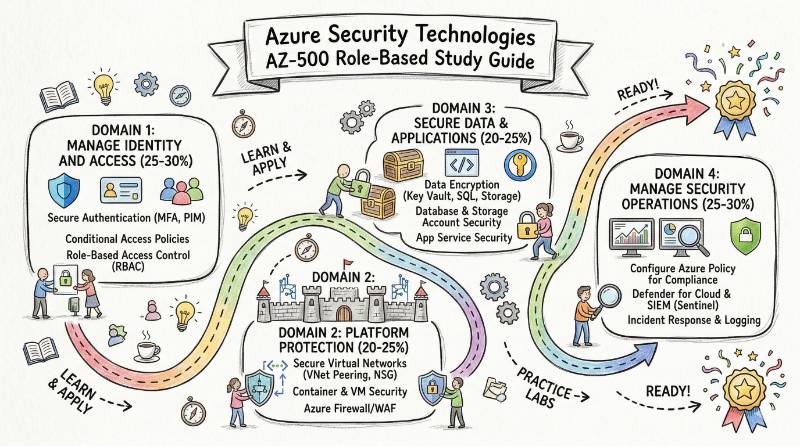
The Microsoft Azure Security Technologies (AZ-500) certification focuses exactly on this need. It shows that you understand how to secure Azure using the platform’s built-in tools instead of scattered, one-off fixes. For working engineers, software developers, SRE and DevOps teams, and managers, AZ-500 is both a career signal and a practical guide to doing security the right way.
In this complete guide, you will learn what AZ-500 is, who it helps, what skills it builds, how to prepare in a realistic timeline, and how to link it with paths like DevOps, DevSecOps, SRE, AIOps/MLOps, DataOps, and FinOps. By the end, you will know if AZ-500 fits your goals and what steps to take next.
What Is Microsoft Azure Security Technologies (AZ-500)?
Microsoft Azure Security Technologies (AZ-500) is a role-based certification for people who secure Azure environments. It focuses on designing and applying security controls, keeping the overall security posture healthy, and protecting identities, networks, data, and workloads in the cloud.
You learn how to:
- Secure identity and access with Microsoft Entra ID (formerly Azure AD), Conditional Access, and privileged access.
- Secure networks using NSG/ASG, Azure Firewall, Application Gateway with WAF, private endpoints, Bastion, and DDoS protection.
- Secure compute, storage, databases, containers, and Kubernetes.
- Use tools like Microsoft Defender for Cloud and Microsoft Sentinel for threat detection, incident response, and continuous monitoring.
Who Should Take AZ-500?
This certification is designed for people who work closely with Azure and are responsible in some way for security. It is most useful if you:
- Design or maintain cloud environments in Azure.
- Work in security teams that review or approve cloud solutions.
- Support DevOps, SRE, or platform teams as they run production workloads.
- Lead engineering teams and need a practical understanding of Azure security.
Good target profiles include:
- Security Engineer or Security Analyst working with Azure.
- DevOps or SRE Engineer responsible for production systems.
- Cloud or Platform Engineer setting up landing zones and shared services.
- Data Engineer dealing with sensitive data in the cloud.
- Engineering Manager or Architect who owns cloud solutions.
You should already know basic Azure concepts such as virtual networks, virtual machines, storage accounts, Azure identities, and role-based access control. If you have done an Azure fundamentals or administrator-style certification or have worked hands-on with Azure, you are in a good starting position.
Key Skills You Will Build
AZ-500 is very practical. The real value is the skill set you take back into daily work.
You will learn to:
- Secure identity and access
- Use Entra ID to manage users, groups, roles, and service principals.
- Configure Conditional Access, multi-factor authentication, and identity protection.
- Control privileged access with tools like Privileged Identity Management (PIM).
- Secure networks
- Design network layouts using vNets, subnets, and segmentation.
- Set up NSGs/ASGs, Azure Firewall, and Application Gateway WAF.
- Protect public-facing apps with DDoS plans and Bastion for admin access.
- Secure workloads and data
- Harden virtual machines and apply security baselines.
- Secure storage accounts, containers, and file shares with encryption and access rules.
- Protect databases with authentication, encryption, auditing, and network restrictions.
- Secure containers and AKS clusters, including images and registries.
- Monitor and respond to threats
- Use Microsoft Defender for Cloud to track secure score and apply recommendations.
- Connect resources to Microsoft Sentinel, write KQL queries, and create analytics rules.
- Build automated responses using playbooks and alerts.
Real-World Outcomes After AZ-500
After completing AZ-500, you should be able to confidently handle typical security work in your Azure environment. For example, you should be able to:
- Design a secure Azure landing zone, including identity structure, RBAC, policies, and network layout.
- Secure a multi-tier web application with WAF, private endpoints, and Key Vault for secrets and certificates.
- Implement a full monitoring and alerting setup using Defender for Cloud and Sentinel that feeds into your operations workflows.
- Help DevOps teams design secure CI/CD pipelines that use managed identities, private links, and secure release practices.
- Work with data and analytics teams to secure data platforms, warehouses, and pipelines.
AZ-500 in the Microsoft Certification Map
AZ-500 is an associate-level certification focused specifically on Azure security. Many professionals combine it with other Azure certifications to build a complete profile. Common patterns:
- Azure fundamentals → Azure Administrator or Developer → AZ-500.
- Cloud Architect path → AZ-500 to strengthen security design skills.
- DevOps/SRE paths → add AZ-500 to bring strong security into operations and pipelines.
Deep Dive: Microsoft Azure Security Technologies (AZ-500)
What It Is
Microsoft Azure Security Technologies (AZ-500) confirms that you can design and run secure solutions on Azure using Microsoft’s own tools and services. It is not just about memorising settings; it tests how you connect features into complete security designs and processes.
Who Should Take It
This certification makes sense if you:
- Work directly on Azure deployments and must keep them safe.
- Review architectures and give security approvals.
- Need to show customers and stakeholders that you understand Azure security.
- Want to move into cloud security or strengthen your current role.
Skills You Will Gain
- Designing identity and access strategy with Entra ID, Conditional Access, MFA, and PIM.
- Building secure network patterns, from simple vNets to more complex hub-and-spoke and hybrid designs.
- Applying security to virtual machines, containers, storage, databases, and serverless components.
- Using Defender for Cloud and Sentinel to monitor, detect, and respond to risks and attacks.
Real-World Projects You Should Handle
- Set up a new Azure subscription structure for a company, with proper RBAC, policies, and security defaults.
- Take an existing application running in Azure and raise its security posture using recommendations and baselines.
- Design a security operations workflow that includes alerts, triage, and automation using Microsoft tools.
- Build secure deployment patterns where secrets are in Key Vault, networks are private, and identities are well managed.
Preparation Plan (7–14, 30, 60 Days)
Fast Track: 7–14 Days
For experienced Azure users who need a focused push:
- Map exam domains and objectives.
- Do high-impact labs on identity, network security, Defender for Cloud, and Sentinel.
- Take several practice tests and fill gaps only where you are weak.
Standard Plan: 30 Days
For most working professionals:
- Week 1: Learn exam structure; build identity and access labs.
- Week 2: Focus on network security scenarios and real deployments.
- Week 3: Cover workload and data security, including containers.
- Week 4: Spend time with Defender for Cloud and Sentinel, then do full practice exams and revisions.
Deep Plan: 60 Days
For people new to Azure or security:
- Start with Azure fundamentals and simple services.
- Build confidence around identity, networking, and basic governance.
- Then move into Defender for Cloud, Sentinel, and more complex designs.
- Finish with repeated labs and several mock exams.
Choose Your Path: 6 Learning Paths Around AZ-500
DevOps
- Goal: Build and run secure pipelines and environments.
- AZ-500 helps you understand which security controls must be in place before each deployment.
DevSecOps
- Goal: Put security into every step of the software lifecycle.
- AZ-500 gives you Azure-specific knowledge you combine with secure coding and testing practices.
SRE
- Goal: Keep systems reliable, observable, and safe.
- AZ-500 helps you integrate security signals into your incident and reliability processes.
AIOps/MLOps
- Goal: Run AI and ML systems safely at scale.
- AZ-500 helps secure the compute, storage, and APIs behind AI/ML workflows.
DataOps
- Goal: Move and manage data securely and reliably.
- AZ-500 supports strong access control, encryption, and monitoring across data platforms.
FinOps
- Goal: Balance cost, value, and risk in the cloud.
- AZ-500 helps you judge where security investments are necessary and where you must not cut corners.
Role → Recommended Certifications
| Role | How AZ-500 helps | Suggested certification direction including AZ-500 |
|---|---|---|
| DevOps Engineer | Designs secure pipelines and infra | Azure fundamentals → Dev/DevOps cert → AZ-500 |
| SRE | Connects security and reliability | Azure fundamentals → ops-focused cert → AZ-500 |
| Platform Engineer | Owns shared platform and landing zones | Admin/Architect cert → AZ-500 |
| Cloud Engineer | Builds and supports cloud workloads | Fundamentals → Admin/Developer → AZ-500 |
| Security Engineer | Focuses on security daily | Fundamentals → AZ-500 → advanced security or architecture |
| Data Engineer | Protects data paths and platforms | Data platform certs → AZ-500 |
| FinOps Practitioner | Adds security to cost and value decisions | Cloud basics → FinOps learning → AZ-500 |
| Engineering Manager | Guides teams on secure cloud choices | Mixed cloud certs → AZ-500 → leadership/architect paths |
Training Institutions for AZ-500
You can prepare on your own, but many professionals prefer guided training plus labs and mentoring-style support. These institutions are commonly associated with Azure and security training:
- DevOpsSchool –
Focuses on hands-on training with real lab environments and project-style exercises. Good for engineers and managers who want to link exam topics to day-to-day work. - Cotocus –
Offers structured programs where Azure security is combined with other cloud and DevOps skills, helping you build a broader learning path. - Scmgalaxy –
Known for practical DevOps and cloud courses that show how tools, automation, and security fit together in real organisations. - BestDevOps –
Provides curated DevOps and cloud courses, including Azure security topics, for professionals who want career-focused learning. - devsecopsschool.com –
Specialises in security in the development and delivery pipeline, with AZ-500 forming part of a complete DevSecOps toolkit. - sreschool.com –
Serves SRE and operations teams, where Azure security is tied closely to reliability, monitoring, and incident response. - aiopsschool.com –
Focuses on automation and intelligent operations, teaching how security events and telemetry feed into AIOps workflows. - dataopsschool.com –
Targets data and analytics teams, helping them apply Azure security concepts to data pipelines and platforms. - finopsschool.com –
Works at the intersection of cloud cost, governance, and risk, showing how Azure security affects financial decisions and policies.
FAQs: Microsoft Azure Security Technologies (AZ-500)
1. Is AZ-500 hard?
It is not easy, but it is fair. If you already work with Azure and do proper hands-on practice, it is very achievable. The challenge is the wide coverage of services and scenarios.
2. How much time do I need to prepare?
Most working professionals need somewhere between three and eight weeks, depending on how much Azure and security experience they already have and how many hours per week they can study.
3. Do I need an Azure certification before AZ-500?
You do not need an earlier certificate, but you do need the skills. If you are new to Azure, it is better to first build foundation knowledge or complete a fundamentals-level course.
4. Can I pass AZ-500 without a security role?
Yes, if you put in the effort. But you may need extra time and more labs because many topics assume you understand basic security ideas like least privilege, segmentation, and incident response.
5. What is the main benefit of AZ-500?
It proves you can design and run secure Azure solutions using real tools, not just theory. This helps when you apply for roles with production responsibility or talk with customers and auditors.
6. Is it more useful for security or DevOps professionals?
Both. For security roles, it is a core certification. For DevOps and SRE roles, it ensures your pipelines and platforms are built with security in mind from the start.
7. How does AZ-500 compare to other cloud security certifications?
AZ-500 is specific to Microsoft Azure. Other certificates might be vendor-neutral or focused on different clouds. If your main platform is Azure, this specialisation is a strong advantage.
8. Will AZ-500 help me in hybrid or multi-cloud setups?
Yes, because the principles and many practices apply across environments. However, the tools and details are Azure-centric, so you still need to learn other platforms separately.
9. What mistakes should I avoid while preparing?
Skipping identity and network topics, ignoring Defender for Cloud and Sentinel, or relying only on notes and videos without touching the Azure portal. These are the most common mistakes.
10. In what order should I take AZ-500 and other certifications?
A typical flow is: Azure basics → one role-based certification (like admin or developer) → AZ-500 → any advanced or leadership certification you want afterward.
11. Does AZ-500 really impact salary?
No certificate guarantees a raise, but cloud security skills are in strong demand. AZ-500 supports your case for higher responsibility and better pay, especially when combined with real project experience.
12. Is AZ-500 worth it for managers?
Yes. Managers who understand Azure security can make better design decisions, ask sharper questions in reviews, and support teams more effectively in security discussions.
Conclusion
Microsoft Azure Security Technologies (AZ-500) is a powerful way to grow from “I know some Azure” to “I can secure Azure in a professional way.” It gives you a clear structure for thinking about identity, networks, workloads, data, and monitoring in the cloud. For engineers and managers in India and around the world, this is exactly the mix of skills that modern organisations look for when they move serious workloads into Azure.
If you connect AZ-500 with the right learning path—DevOps, DevSecOps, SRE, AIOps/MLOps, DataOps, or FinOps—you build a profile that is technically strong and aligned with real business needs. That combination is what helps you stand out in hiring, promotions, and leadership discussions around cloud security and reliability.

Really enjoyed this AZ‑500 study guide — the way it connects real Azure security practices with the exam topics makes it much easier to follow. I’ve worked on securing Azure environments myself, and these insights reflect the practical skills teams need in the field. Thanks for putting this together!